Local War History
Forex Trading in the UK
Forex trading in the UK means speculating on changes in the value of one currency relative to another. A trader buying GBP/USD expects sterling to strengthen against the US dollar, while somebody selling the same pair expects the dollar to outperform sterling. Retail traders usually gain this exposure through rolling spot forex, contracts for difference or financial spread betting rather than exchanging physical currencies through a bank.
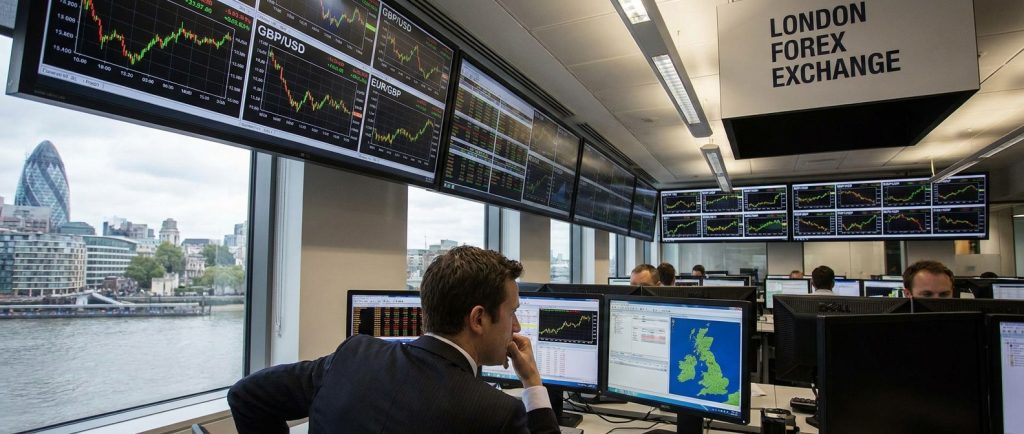
The UK is unusually important to the foreign-exchange market. London remains the largest global centre for FX trading even though the pound is not the world’s dominant currency. The Bank of England’s 2025 Triennial Survey recorded average UK foreign-exchange turnover of approximately $4.745 trillion per day in April 2025, representing 37.8% of global turnover. That was almost unchanged from the UK’s 38% share in 2022.
Most of that volume has very little to do with somebody trading GBP/USD from a laptop. Banks, investment funds, companies, market makers and other institutions use FX for international payments, hedging and portfolio management. The global OTC market reached roughly $9.6 trillion in average daily turnover in April 2025, according to the Bank for International Settlements. Sterling appeared on one side of 10.2% of global transactions, while the US dollar remained dominant at 89.2%.
Retail forex trading operates on the edge of that enormous wholesale market. Access is easy. Consistent profitability is considerably harder.
How Forex Trading Works in the UK
A forex quote contains two currencies. GBP/USD at 1.3500 means one pound is worth approximately $1.35. If the price rises to 1.3600, sterling has strengthened against the dollar. If it falls to 1.3400, sterling has weakened.
The movement itself can look small because major currencies rarely move by 10% during an ordinary trading session. Leverage changes the financial effect. A trader controlling £30,000 of exposure with a much smaller margin deposit experiences profit and loss on the £30,000 position, not simply on the amount of cash required to open it.
UK retail traders normally access currency markets through a broker rather than trading directly with the large banks that dominate institutional FX. Depending on the provider and account, the broker can offer rolling spot FX, CFDs or financial spread betting. The legal structure matters because taxation and regulatory treatment can differ even where two products produce almost identical exposure to the same currency pair.
This is why statements such as “forex profits are tax free in the UK” are too broad. A GBP/USD spread bet and a GBP/USD CFD can look almost identical on a trading platform while producing different tax consequences.
The instrument matters as much as the currency pair.
The UK Is the World’s Largest Forex Trading Centre
London’s position in the FX market is not simply a legacy of the British Empire or the importance of sterling. The UK sits between Asian and North American trading hours, has a large financial-services industry and acts as a major centre for banks, asset managers, hedge funds and international companies.
The latest comprehensive Bank of England data place the UK comfortably ahead of every other trading centre. Average daily turnover measured through the BIS Triennial Survey reached $4.745 trillion in April 2025. The UK accounted for 37.8% of global turnover, while the United States, Singapore and Hong Kong were the next major centres.
A separate semi-annual Bank of England survey using a somewhat different reporting methodology showed how heavily London trading concentrates in the largest currency pairs. EUR/USD represented roughly one quarter of reported UK FX turnover in April 2025, with USD/JPY and GBP/USD also among the most heavily traded pairs.
For a retail trader, London’s institutional importance mainly translates into strong liquidity during UK market hours. Major pairs can have particularly active trading during the London session and during the overlap with New York.
Liquidity is useful because it can reduce spreads and improve execution. It does not make the next currency movement easier to predict.
Major Forex Pairs for UK Traders
GBP/USD is naturally one of the most familiar pairs for British traders. It is highly liquid and reacts to both UK and US economic information, including Bank of England and Federal Reserve policy, inflation, employment and economic growth.
EUR/GBP provides a more concentrated way to trade differences between the UK and euro-area economies. Because neither side contains the dollar, its movement can behave differently from dollar pairs during periods when the US currency dominates global markets.
EUR/USD remains the world’s most heavily traded currency pair and tends to offer tight spreads because of the enormous volume in both currencies. USD/JPY is another major institutional market, particularly sensitive to differences between US and Japanese interest rates.
Traders can also access smaller or more volatile currencies, often described as minor or exotic pairs. Wider price movements can appear attractive, but they commonly arrive with wider spreads, less consistent liquidity and greater sensitivity to political or economic shocks.
A pair is not automatically a better trading opportunity because it moves further each day. The potential price movement has to be considered alongside transaction cost and the size of the position required.
A relatively quiet major pair traded with excessive leverage can be far more dangerous than a volatile pair traded at modest size.
Retail Forex Is Regulated Alongside CFDs
In UK regulation, leveraged retail forex sits closely beside CFDs. The FCA’s framework specifically includes rolling spot foreign exchange within its treatment of CFD products.
This matters because the FCA does not simply allow brokers to offer unlimited leverage to ordinary retail clients. Its permanent product-intervention rules require retail CFD and rolling spot forex providers to comply with leverage restrictions, margin close-out requirements, negative balance protection and standardised loss warnings.
The FCA continues to describe CFDs and related leveraged products as high risk and unsuitable for some retail consumers. FCA guidance on CFDs and rolling spot forex explains that the regulator expects providers to market and distribute these products appropriately rather than treating everybody who can fund an account as an appropriate customer.
This is one of the important differences between an FCA retail account and an offshore account operating under rules permitting much higher leverage. The domestic restrictions intentionally prevent UK retail clients from taking some of the exposures available elsewhere.
That can feel restrictive to experienced traders. It also prevents inexperienced clients from turning ordinary currency movements into extraordinarily large account losses quite as easily.
UK Forex Leverage Limits
The highest FCA retail leverage is generally 30:1, but the actual maximum depends on the underlying market.
Major currency pairs can generally be offered at up to 30:1 leverage, corresponding to a minimum initial margin of approximately 3.33%. Non-major currencies normally sit under the lower 20:1 level, corresponding to 5% margin. More volatile asset classes covered by the same CFD framework have progressively stricter limits.
The FCA’s permanent measures cover leverage between 30:1 and 2:1 according to asset volatility. They also require firms to close positions when account funds fall to 50% of the margin required to maintain open positions and to provide negative balance protection for retail accounts.
Negative balance protection is particularly important during violent markets because it limits an eligible retail client’s losses to the funds in the CFD account. It does not mean the trader cannot lose the account balance. It means a severe price move should not turn that trading loss into an additional debt to the broker under the protected retail structure.
The restrictions also prevent firms from using cash bonuses and similar inducements to encourage retail clients to trade.
Maximum permitted leverage remains a ceiling, not a suggested trading setting.
How Margin Changes Forex Risk
Margin is the collateral required to support a leveraged position. It is not the maximum amount that can be lost on an individual trade.
Suppose a retail trader uses 30:1 leverage to control £30,000 of major-currency exposure with roughly £1,000 of initial margin. A 1% movement in the underlying position represents around £300 before costs. The currency moved only 1%, but the £300 change equals 30% of the original £1,000 margin.
If the trader had instead taken only £5,000 of exposure, the same 1% market movement would represent approximately £50. The market behaved identically. Position size changed the financial result.
This is one reason traders should calculate risk from notional exposure and stop distance rather than from the broker’s margin requirement. A broker asking for £1,000 of margin does not mean £1,000 is an appropriate position risk.
The FCA’s leverage caps reduce the maximum exposure available to retail clients, but they do not prevent someone using the maximum leverage on every trade.
Regulation establishes a boundary. Position sizing still determines whether the account can survive ordinary mistakes.
Negative Balance Protection Does Not Make Forex Low Risk
Negative balance protection is occasionally interpreted as meaning losses are capped at a small amount. The protection is more precise than that.
An eligible FCA retail client should not lose more than the money in the protected trading account as a result of CFD trading. A trader with £20,000 in the account can therefore still lose £20,000. The rule protects against an additional negative balance rather than protecting the original deposit.
Margin close-out provides another layer. FCA rules require providers to begin closing positions when funds fall to 50% of the margin needed to maintain the account’s open CFD positions.
Neither mechanism should replace stop placement and conservative sizing. Automatic close-out exists as a final account-level control, not as a practical trade-management method.
Relying on the broker’s liquidation system means allowing losses to continue until the account has already deteriorated substantially. It also gives the trader less control over which positions are closed during a period of stress.
A properly sized trade should normally reach its planned invalidation point long before regulatory margin protection becomes relevant.
Day Trading Forex in the UK
Forex is popular with day traders because the major currency market operates continuously from Monday through Friday as trading moves between Asia, Europe and North America. The UK session sits in an especially active part of that cycle.
A day trader might concentrate on GBP/USD during the London morning, trade EUR/USD around European economic releases or remain active into the London-New York overlap when institutional liquidity is particularly heavy.
The advantage of day trading is that positions can normally be closed before overnight financing accumulates and before the trader leaves the screen. The cost is much greater dependence on execution. A strategy targeting eight pips does not have much room for a wide spread, commission and two additional pips of slippage.
Day trading also encourages activity simply because the market is always moving somewhere. A trader can move from GBP/USD to EUR/USD, USD/JPY and several crosses within minutes, creating the feeling that another opportunity must always exist.
A good intraday strategy does not require continuous participation. Sometimes the highest-quality position during a trading session is the one that never qualifies for entry.
Swing Trading Forex
Swing traders normally hold currency positions for several days or weeks. Their trades can be based on interest-rate expectations, broader monetary-policy differences or slower technical trends.
Suppose markets increasingly expect the Bank of England to keep interest rates higher than the European Central Bank. A trader might believe the resulting change in expected yield differences could support sterling against the euro. Rather than attempting to capture a 15-minute reaction to one announcement, the trader might hold a EUR/GBP position while that policy divergence develops.
Swing trading reduces the importance of tiny spread differences because targets are usually larger. Overnight financing becomes more important because leveraged positions remain open across multiple rollover periods.
Unexpected news creates another risk. Central-bank commentary, political developments and geopolitical shocks can occur while the trader is away from the screen. Weekend positions can open at a price materially different from Friday’s close.
The slower approach gives more time for analysis but does not remove risk. It moves risk away from rapid decision making and toward overnight exposure, financing and gaps.
The appropriate account therefore depends partly on how long positions are normally kept open.
Forex Scalping
Scalping attempts to collect small price movements repeatedly. The method can suit liquid pairs such as EUR/USD and GBP/USD because spreads can be narrow during active UK trading hours.
Its weakness is mathematical rather than conceptual. If a trader targets five pips while spread, commission and slippage consume two pips on average, a substantial share of the gross movement is already gone before losing trades are considered.
This makes broker selection unusually important for scalpers. The advertised minimum spread means little if it appears only briefly. Average executable spread during the actual trading session is far more useful.
Order execution matters equally. A broker can advertise 0.0-pip raw spreads but still prove expensive if market orders repeatedly fill worse than expected. Another provider with a slightly wider headline price can produce lower realised costs through better fills.
Scalping also magnifies behavioural problems because the trader makes many decisions in a short period. Revenge trading after a loss can occur within minutes.
A strategy that depends on tiny price movements needs unusually disciplined execution from both broker and trader.
Fundamental Analysis in UK Forex Trading
Currency prices react heavily to expectations about monetary policy. UK forex traders therefore pay close attention to the Bank of England as well as the central bank responsible for the other currency in the pair.
GBP/USD can respond to differences between expected Bank of England and Federal Reserve policy. EUR/GBP reacts partly to differences between UK and European Central Bank expectations. Inflation, employment, wage growth and economic activity matter mainly because they influence the path investors expect central banks to take.
The important word is expectations. Sterling does not automatically rise because the Bank of England increases interest rates. If the increase was already fully anticipated, the currency can do very little. It can even fall if the accompanying statement suggests future policy will be less restrictive than traders expected.
Political and fiscal events can matter as well, particularly where they alter expectations for inflation, government borrowing or economic growth.
Fundamental analysis therefore requires asking what information is new rather than simply whether the information sounds positive or negative.
Currencies trade the difference between reality and the price that existed immediately beforehand.
Technical Analysis
Technical analysis is widely used in retail forex because liquid currency pairs generate continuous price histories across multiple timeframes.
Traders can use support and resistance, moving averages, volatility measures, momentum indicators and chart structure to define trades. The useful role of technical analysis is organisation rather than certainty.
A trader might require GBP/USD to remain above a longer moving average before considering long trades, then wait for a pullback toward previous support. Another strategy can trade breakouts from an established range.
These rules create entry and invalidation points that can be tested. “Sterling looks strong today” is difficult to evaluate objectively. “Buy after a daily close above the previous 20-session high and exit below the breakout level” produces an observable process.
Indicators should not be treated as independent votes when they are derived from the same price history. A moving average, RSI and MACD can all turn bullish because the same underlying price movement has occurred.
The aim is not to collect enough indicators to eliminate uncertainty. It is to decide exactly what market behaviour justifies risking money.
Forex Trading Costs
Spread is the most visible cost. It represents the difference between the price available to buyers and sellers. Standard retail accounts commonly incorporate much of the broker’s compensation into this spread.
Raw-spread accounts can display tighter prices while charging a separate commission. These accounts are often marketed to active traders and scalpers, but the correct comparison is total cost rather than whether the spread begins at zero.
Slippage matters when an order fills at a different level from the expected price. This can happen during ordinary fast markets and becomes particularly noticeable around central-bank meetings, inflation releases and employment reports.
Swing traders need to pay attention to overnight financing. FCA research published in November 2025 found that some CFD providers applied varying overnight funding charges without giving sufficiently clear justification and warned firms that potentially material charges were not always adequately disclosed.
A broker therefore needs to be assessed according to the strategy being used. The cheapest account for a scalper may not be cheapest for someone holding positions for three weeks.
Forex costs rarely arrive as one neat number.
Choosing a Forex Broker in the UK
Regulation should come before trading software, spreads or account bonuses when choosing a UK forex broker.
The FCA states that almost all firms providing regulated financial services in the UK need to be authorised or appropriately registered. Its Firm Checker allows consumers to verify whether the exact company has authorisation and permission for the service being offered. The FCA updated this guidance on 9 September 2026, and specifically advises consumers to avoid firms that lack the required permission.
After regulatory status has been confirmed, practical comparisons can include spreads, commissions, overnight funding, trading platforms, available currency pairs and execution method. Independent broker research can help reduce the number of providers worth investigating; ForexBrokersOnline.com is one example of a broker-comparison resource. Comparison sites should complement rather than replace the FCA’s official records.
The exact legal entity remains critical. International broker groups can operate several companies under the same brand. The British subsidiary can be FCA-authorised while another entity in the group is supervised elsewhere and offers very different leverage.
The company’s terms and conditions should therefore agree with the entity shown on the FCA register.
The logo is not the licence.
Broker Brands and Legal Entities Are Not the Same Thing
A broker brand can operate simultaneously through UK, European, Australian and offshore legal entities. The customer might use the same website design and trading software regardless of which company ultimately holds the account.
This becomes important when comparing protections. The FCA warns consumers to check a firm’s terms and conditions to establish the actual entity they will contract with and where that company is incorporated. It also specifically cautions that overseas businesses can use names very similar to FCA-regulated firms.
A licence held by the UK company does not automatically cover an account deliberately opened through another subsidiary. The overseas company might offer greater leverage precisely because FCA retail restrictions do not apply to that account.
The distinction is not necessarily evidence of wrongdoing. Large financial groups commonly operate multiple regulated entities because financial rules differ between countries.
Problems arise when customers assume that protections advertised at brand level follow them everywhere.
The sensible procedure is to identify the exact legal company in the customer agreement, verify that company independently and determine which rules govern the account before sending money.
That takes a few minutes and can answer more useful questions than reading twenty pages of broker reviews.
FCA-Authorised Does Not Mean Profitable
Regulation deals principally with how the provider operates. It cannot make the underlying market predictable.
An FCA-authorised broker can provide proper risk warnings, comply with leverage restrictions and process customer money appropriately while most of its retail clients still lose from trading decisions.
This is why FCA-regulated CFD providers must publish a standardised warning showing the proportion of their retail accounts that lose money.
The distinction between broker risk and market risk is worth keeping clear. Broker regulation can reduce the chance that the intermediary mishandles funds, uses unauthorised practices or operates without meaningful accountability. It cannot stop GBP/USD moving 100 pips against the trader.
A properly regulated broker is therefore the minimum operational foundation rather than evidence that forex itself is appropriate for a particular person.
The same distinction applies to compensation arrangements. Where a customer qualifies for protections connected with an authorised firm, those arrangements concern eligible failures and claims. They are not insurance against bad market trades.
A £10,000 losing trade does not become compensable because the broker happened to be regulated.
Regulation reduces avoidable risks. The trader remains responsible for speculative ones.
Offshore Forex Brokers
Some British traders are attracted to offshore brokers because they can offer leverage far above FCA retail limits, different products, larger promotional incentives or less restrictive account requirements.
There are legitimate international firms operating outside the UK. Offshore should not automatically be translated as fraudulent. The question is which legal protections have been exchanged for the different account conditions.
The FCA’s October 2025 warning is particularly relevant. It said some firms and promoters were encouraging UK clients to give up retail protections or redirecting them to related providers in third-country jurisdictions without equivalent consumer safeguards. The regulator estimated that its retail protections prevent nearly 400,000 people each year from risking losses beyond their original stake and provide benefits worth between £267 million and £451 million.
Higher leverage can have a legitimate capital-efficiency use. An experienced trader maintaining exactly the same £20,000 market exposure does not increase market risk simply because a lower-margin account allows less cash to remain with the broker.
The danger appears when 500:1 leverage is used as permission to take dramatically larger positions.
Greater buying power and greater skill are unrelated concepts.
Professional Client Status
Some experienced UK traders may qualify, or be encouraged to apply, for elective professional client treatment.
Professional classification can provide greater flexibility, including access to account conditions unavailable to ordinary retail clients. It can also mean surrendering important protections.
The FCA has repeatedly warned about firms pressuring customers to “opt up.” Its 2025 intervention noted that professional clients can lose retail safeguards and, depending on arrangements, may even have client funds moved outside segregated retail client-money structures.
The decision should therefore be based on the legal and financial consequences rather than the attraction of higher leverage.
Professional status is not a certification that somebody is a profitable trader. Nor is it an award for passing a knowledge quiz. It changes how the regulatory system treats the relationship between customer and provider.
A person capable of meeting professional eligibility criteria can still lose money very quickly using a heavily leveraged currency account.
For most retail traders, protections such as negative balance limits and restricted leverage have genuine financial value.
Giving those protections up should provide a concrete benefit to an established strategy, not simply make the account feel more sophisticated.
Forex Scams in the UK
The popularity of forex gives scammers a convenient product to imitate. A fraudulent platform can display professional-looking charts, account balances and apparent profits without providing genuine market access.
The FCA’s forex scam guidance warns that unauthorised firms commonly promise high or guaranteed returns, show customers initial apparent profits and encourage larger deposits before accounts are suspended or withdrawals become impossible. The guidance was updated in January 2026.
Clone firms create another problem. Fraudsters copy the name, address or FCA reference number of a legitimate business while substituting their own website and contact information. Somebody checking only the name can therefore believe they are dealing with a genuine regulated company.
The FCA advises consumers to retrieve contact details independently from the Firm Checker rather than trusting telephone numbers or email addresses supplied by someone making an unsolicited approach.
Guaranteed returns should receive particular suspicion. Foreign exchange is uncertain by definition. Nobody legitimately trading GBP/USD can guarantee what the exchange rate will do next month.
A broker promising certainty in an uncertain market has already provided useful information about itself.
Spreads, Raw Accounts and ECN Claims
UK forex brokers use several pricing models. A standard account can charge through a wider spread without a separate commission, while a raw-spread account can offer pricing closer to the underlying liquidity and charge commission separately.
Terms such as ECN, STP and no dealing desk are also widely used. These labels can describe meaningful differences in execution, but traders should not treat them as regulatory classifications.
An ECN-labelled account is not automatically safer than a market-maker account. A properly regulated market maker can offer competitive prices and reliable execution, while an unregulated company advertising “true institutional ECN” conditions can still create substantial counterparty risk.
The practical comparison is how orders actually execute. Average spread, commission, slippage, rejected orders and overnight financing collectively determine the cost of the account.
Scalpers may benefit materially from raw pricing because spread is paid repeatedly. A swing trader making a few transactions each month can care considerably more about financing rates.
The broker’s execution policy should therefore receive more attention than the acronym displayed beside the account name.
Trading performance is measured using prices actually obtained, not the broker’s minimum advertised spread.
Forex Tax in the UK
UK forex taxation depends heavily on the instrument used and the circumstances of the trader. There is no single rule under which every profit described as “forex” receives identical treatment.
Retail CFDs provide one relatively clear example. HMRC’s current Capital Gains Manual on CFDs states that retail CFD outcomes are, unless taxable as trading income, in almost every case dealt with under the capital gains regime. Commission and contractual amounts equivalent to financing and dividends can enter the capital-gains computation when the position is closed.
HMRC also makes clear that simply trading frequently does not automatically turn an individual’s speculative activity into a tax trade. Its guidance says buying and selling financial instruments by an individual will normally amount to investment or speculation falling short of trading unless the facts take the activity outside the normal case.
For the 2026/27 tax year, individuals generally have a £3,000 Capital Gains Tax Annual Exempt Amount. General gains falling within the available basic-rate band are charged at 18%, with gains above it generally charged at 24%.
Tax treatment depends on personal circumstances, so anyone generating substantial trading income should use HMRC guidance or professional tax advice rather than assuming their broker’s product name settles the matter.
Forex Spread Betting Has Different Tax Treatment
Financial spread betting can create almost the same directional exposure as a forex CFD while receiving different UK tax treatment for an ordinary private individual.
HMRC’s Capital Gains Manual on financial spread betting states that no asset is acquired or disposed of through an ordinary spread bet, so no chargeable gain or allowable capital loss normally arises.
HMRC’s business-income guidance goes further, stating that a person placing spread bets is not normally carrying on a trade; ordinary betting profits are not taxed as trading income and losses do not receive corresponding relief.
This is the origin of the familiar statement that financial spread betting is generally “tax free” for UK individuals. The shorthand needs care. HMRC recognises circumstances where wagering contracts connected with a separate commercial activity, such as genuine hedging, can be treated differently. Companies also operate under a different tax framework.
The normal private speculative case is nevertheless clear: ordinary spread-betting winnings generally fall outside Capital Gains Tax and Income Tax, while losses normally cannot be claimed against taxable gains.
The loss treatment is the other half of the tax advantage and is sometimes forgotten until a losing year arrives.
CFD Losses Can Have Tax Value That Spread-Betting Losses Do Not
The tax difference can influence which product is more efficient for a particular trader.
A profitable spread bettor may appreciate that ordinary winnings generally fall outside CGT. A consistently losing spread bettor does not receive capital-loss relief for those losses.
CFDs normally sit differently. HMRC treats ordinary retail CFD outcomes under the capital-gains regime unless the facts support trading-income treatment. This means qualifying CFD losses can generally enter the capital-gains calculation alongside gains, subject to the usual rules.
A trader should therefore avoid comparing the products only on the basis that one is “tax free.” The value depends partly on whether the trader has taxable capital gains elsewhere and whether losses are likely to be useful.
The economic contract can otherwise be very similar. Both products can provide leveraged exposure to GBP/USD without the trader owning pounds and dollars in the conventional sense.
Tax law cares about the legal structure of the contract, not simply the chart displayed on the platform.
This is another reason the account agreement matters. Two trades that appear almost identical on screen can create different consequences once the position is closed.
Position Sizing for UK Forex Traders
Position sizing is the part of forex risk management most directly controlled by the trader.
Suppose an account contains £10,000 and the trader is prepared to lose £100 if one setup fails. The entry and invalidation level are 50 pips apart. The position should be sized so that those 50 pips correspond to roughly £100 of risk before allowing for slippage and costs.
If another setup requires a 100-pip stop, the position needs to be roughly half the size if the same £100 maximum planned loss is retained.
This is safer than trading one standard lot every time regardless of currency pair or volatility. A fixed nominal size can produce wildly different losses when one trade requires a narrow stop and another needs much more room.
The percentage chosen is less important than keeping the arithmetic consistent. A risk limit does not need to be 1% simply because trading books frequently use that example.
What matters is that a normal series of losing trades remains survivable.
A strategy needs capital long enough for its statistical results to become meaningful. Excessive position size can destroy the account before anybody discovers whether the strategy had an edge.
Stops and Slippage
A stop loss specifies where a trader intends to exit, but it cannot guarantee one exact execution price under every condition.
Currency markets are generally highly liquid, particularly in major pairs, but they can still move abruptly around central-bank decisions, inflation reports, employment data or geopolitical events. Liquidity can thin while spreads widen, allowing a stop to execute at a worse price than expected.
Weekend gaps create another risk. A market can close on Friday and reopen at a materially different level on Sunday evening following an important event. There may have been no opportunity to trade at the prices between.
FCA negative balance protection provides an important backstop for retail accounts, but it does not make individual stops guaranteed. The trader still needs enough room in position sizing to tolerate an exit somewhat worse than the planned level.
Some brokers offer guaranteed stop products on certain instruments, usually for an additional cost or under defined conditions. Ordinary stops should not be assumed to provide the same protection.
Risk calculation therefore works best when the planned loss is treated as an estimate rather than an absolute maximum guaranteed by the chart.
Is Forex Trading Suitable for Beginners in the UK?
The UK provides relatively strong regulatory protections compared with many retail forex markets, but regulation cannot remove the difficulty of the activity itself.
A beginner must learn how currency pairs work, calculate position size, understand margin and determine what spreads and financing do to performance. They also need a method for deciding when to enter and exit that can be tested rather than changed after each loss.
Starting with very small positions can make these lessons considerably cheaper. Demo accounts help with platform mechanics but do not reproduce all live trading conditions or the emotional effect of losing actual money.
The FCA’s requirement that providers disclose the percentage of retail accounts losing money should also be taken seriously rather than treated as legal text to click through before opening the platform.
High retail loss rates do not prove that every individual is destined to fail. They do show that access to a broker and access to a profitable method are two entirely different achievements.
A regulated account solves the first problem.
The trader still has to solve the second.
Forex Trading in the UK Is Well Regulated, Not Low Risk
The UK combines two unusual characteristics: it is the world’s largest institutional foreign-exchange centre and one of the more tightly regulated major markets for leveraged retail forex.
London’s scale provides liquidity and market infrastructure. FCA regulation places boundaries around how much leverage retail brokers can offer and requires protections including account-level margin close-out, negative balance protection and standardised loss warnings.
That framework materially reduces some risks without changing the nature of currency speculation.
A UK trader can still lose because sterling moved unexpectedly after a Bank of England announcement, because a technical breakout failed or simply because the position was far too large. Regulation does not compensate for weak risk management.
The most sensible approach is therefore fairly conventional. Verify the exact broker entity through the FCA, understand whether the account uses CFDs, rolling spot forex or spread betting, compare the complete trading cost rather than the headline spread and size positions from planned financial risk rather than available leverage.
Offshore brokers and professional accounts can offer greater flexibility, but that flexibility can mean surrendering protections that have real economic value.
Forex trading in the UK is easy to access. The harder part remains exactly what it is everywhere else: developing an approach that survives costs, leverage and enough losing trades to demonstrate whether a genuine advantage exists.