Local War History
Binary Options Warning UK
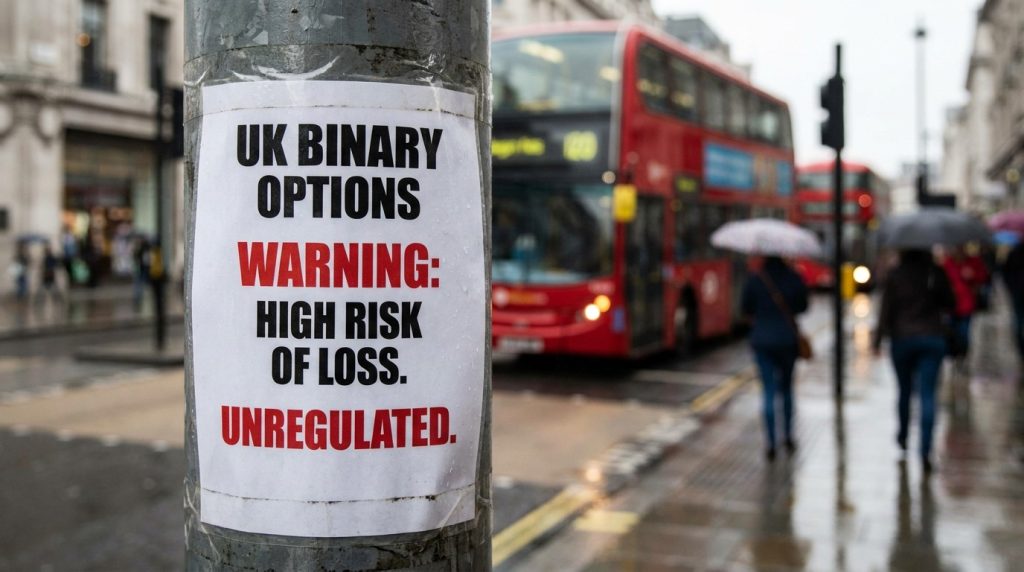
Binary options should carry an immediate warning for anyone living in the UK. Since 2 April 2019, firms have been prohibited from selling, marketing or distributing binary options to UK retail consumers. The rule is not a temporary restriction left over from an earlier regulatory experiment. It remains part of the Financial Conduct Authority’s current rules in 2026, and the FCA’s updated consumer guidance says plainly that anyone being offered binary options should consider that the offer is probably a scam. The FCA’s current binary options scam guidance was updated again in January 2026 and continues to warn about offshore businesses, manipulated trading software, refused withdrawals and professional looking websites used to attract British consumers.
That does not mean every binary contract ever created is fraudulent. Binary options are a type of financial contract based on a yes or no outcome, and regulated versions have existed in some overseas markets. The warning for British consumers is much narrower and more useful: an ordinary company claiming it can legally provide FCA regulated binary options to UK retail customers is making a claim that conflicts with the current UK prohibition. The FCA’s 2026 perimeter report has even considered newer prediction market products and stated that financial prediction contracts it has examined can fall within the definition of binary options and therefore remain subject to the retail ban.
This makes binary options scams somewhat easier to identify than many other investment frauds. With shares, funds or ordinary brokerage services, a consumer needs to establish whether the provider has the appropriate regulatory permissions. With retail binary options, there is an earlier question: why is a company offering a UK retail customer a product that authorised firms are prohibited from selling to them?
A polished website, London telephone number and impressive looking trading platform do not answer that question.
What Are Binary Options?
Binary options are contracts with two possible outcomes. A customer predicts whether an event will occur by a stated expiry time, usually involving the price of a financial asset. A platform might ask whether gold will be above a particular price at 3pm, whether EUR/USD will finish higher than its current level after an hour or whether an equity index will close above a defined strike price. If the condition is satisfied, the trader receives a predetermined payout. If it is not, the amount committed to the trade can be lost.
The apparent simplicity was one reason binary options became popular with online retail traders. The customer did not need to understand the mechanics of conventional exchange traded options, calculate changing option values or manage a complex position. The trading screen could be reduced to an asset, expiry time, stake and two possible directions. Anyone researching how these products have historically worked can use BinaryOptions.net for educational material covering binary option mechanics, payouts and trading terminology. British readers should separate learning about the product from the current legal position, however. Understanding a binary contract does not make an offshore platform authorised to sell it to UK retail customers.
The payout structure is also less generous than a simple 50/50 presentation can suggest. Suppose a customer risks £100 and receives an £80 profit when correct, while losing the full £100 when wrong. Winning five trades and losing five does not produce a break even result. The five profitable trades generate £400 while the five losing positions cost £500. The trader needs a success rate above 50% simply to overcome the payout structure.
This was part of the broader regulatory concern. The FCA described binary options as difficult for consumers to value and noted that the companies selling them commonly benefited when customers lost. Short expiry times added another problem because a contract that lasts only a few minutes can encourage rapid repeated betting, with little opportunity for meaningful investment analysis. The FCA’s original consumer warning on binary options highlighted retail losses, difficulties valuing the contracts, potentially addictive behaviour and conflicts between providers and customers well before the permanent ban arrived.
Why the UK Banned Binary Options
The FCA did not prohibit binary options simply because they were risky. Plenty of legal investments can lose substantial amounts of money. The regulator’s concern was that several problematic characteristics appeared together: poor expected outcomes for consumers, very short contract durations, difficulties establishing fair value, conflicts of interest and a market already suffering from substantial misconduct.
The permanent UK prohibition was confirmed in March 2019 and became effective on 2 April 2019. In its statement confirming the binary options ban, the FCA estimated that stopping retail sales could save consumers as much as £17 million each year and reduce opportunities for fraud by unauthorised companies pretending to offer legitimate binary options services. The ban went further than the temporary European measures in force at the time by covering forms of binary options that the FCA believed presented similar risks.
The regulator’s language was unusually forceful. Its concern was not simply that inexperienced traders occasionally misunderstood the product. Binary options had become associated with a business model where the platform could be the customer’s counterparty, meaning the provider could benefit directly when the customer lost. If the same company controlled the pricing, account software, contract settlement and withdrawal process, a dishonest operator had plenty of opportunities to interfere.
The UK’s current rulebook continues to prohibit the retail marketing, distribution and sale of derivative contracts with binary or other fixed outcomes. The current FCA Handbook section covering binary products remained in force in August 2026, so an advertisement implying that the UK ban quietly disappeared years ago should be treated with suspicion.
The emergence of prediction markets has made the definition relevant again. Some newer platforms allow users to take yes or no positions on future events and can appear technologically different from the binary brokers operating a decade ago. The FCA’s March 2026 perimeter report states that financial prediction market products it has reviewed can constitute binary options and remain subject to the permanent retail prohibition. The terminology on the website may change, but regulators look at what the contract actually does.
How Binary Options Scams Target UK Consumers
Modern binary options fraud rarely begins with somebody introducing themselves as a criminal offshore broker. The first contact is more likely to be a social media advertisement, search result, WhatsApp message, trading group or supposed investment opportunity promising an unusually effective way of making money from currencies, commodities or shares.
The advertisement can be remarkably restrained. Not every scam promises to turn £250 into £25,000 by Friday. Regulators have learned that some operators use more believable returns precisely because exaggerated promises are easier to recognise. The FCA’s January 2026 guidance warns that scammers can advertise through search engines as well as social media and may make relatively plausible offers to appear legitimate.
After clicking the advertisement, the customer may reach a professional website containing live market prices, account dashboards, biographies of supposed analysts and statements about security. A telephone call follows from an “account manager” who explains how the service works and recommends starting with a modest amount. The first deposit might be only £100 or £250.
That small opening payment matters psychologically. Sending £250 to test a platform feels less dangerous than transferring £10,000 to a stranger, even though the smaller payment gives the operator a route into a much larger conversation. Once the deposit arrives, the account manager can demonstrate apparently profitable trades and gradually encourage the customer to increase the balance.
There is no guarantee that the trades displayed by a fraudulent platform exist outside its own software. A website can show genuine market prices while fabricating the customer’s positions completely. If the operator controls the account database, turning an apparent £250 balance into £600 requires no successful market prediction. It requires changing a number on a screen.
The FCA specifically warns that binary options scam firms may manipulate software to produce false prices and payouts before closing accounts or refusing to return customer money. The regulator also notes that these operations are often based outside the UK even when they claim to maintain a British presence, sometimes using a City of London address to look more credible.
Fake Profits Can Be the Most Effective Part of the Scam
One of the more dangerous misconceptions about trading fraud is that a scam account will immediately show losses. Often the opposite happens. Fake profitability can be far more effective because it persuades the customer to send additional money voluntarily.
Consider a person who deposits £500. After several days the website shows £720. The account manager explains that a successful currency trade generated the gain and encourages the customer to increase the account to £2,000. A week later the displayed balance reaches £2,700. The customer now has what appears to be evidence that the system works.
Nothing requires those profits to be real.
The customer may even receive a small withdrawal. Allowing somebody to take £100 from a fraudulent account can create enough confidence to obtain another £5,000 later. A successful test withdrawal therefore proves only that the company returned one payment, not that the account balance represents money genuinely held on the customer’s behalf.
As deposits grow, the sales pressure can change. The supposed account manager begins talking about premium status, managed trading, guaranteed events or better payout levels available to customers above a certain balance. Someone who started with £250 can gradually be persuaded to transfer savings, pension withdrawals or borrowed money because the earlier account performance appears to support the decision.
This is why investment fraud can continue for months. The victim is not necessarily repeatedly ignoring obvious evidence that the scheme is failing. They may be looking at an account apparently generating excellent profits.
A screen displaying £32,000 is not the same thing as holding £32,000.
The distinction usually becomes painfully clear when a substantial withdrawal is requested.
Withdrawal Fees, Taxes and Other Invented Charges
Withdrawal problems are among the strongest warning signs of a fraudulent trading operation. The customer asks to withdraw £8,000 from an account apparently worth £20,000 and is told that another payment must be made first. The reason may be described as tax, insurance, an anti money laundering deposit, a liquidity charge or a regulatory release fee.
Paying the first charge often produces another.
The scam works because each new fee appears small relative to the balance supposedly waiting for release. Sending £1,000 can seem rational if £20,000 is on the other side. The calculation collapses if the £20,000 never existed.
A legitimate financial business can have documented withdrawal procedures and can require customers to complete proper identity checks. That is very different from repeatedly demanding fresh deposits before returning money the customer supposedly already owns. A particularly worrying pattern is being asked to transfer cryptocurrency to settle a tax or release charge before a withdrawal can proceed.
The FCA’s current binary options warning describes firms suddenly closing accounts and refusing to return customer funds after manipulating prices and payouts. Its broader 2026 forex scam guidance documents a similar progression among fraudulent trading firms, where customers may initially receive apparent returns that encourage larger deposits before communication and withdrawals become difficult.
Once a platform refuses to return money, sending more usually increases the loss rather than solving the problem. A customer facing repeated unexpected charges should stop making payments, preserve communications and contact their bank or payment provider promptly.
The account manager will probably disagree.
That is not surprising. Another deposit is the part of the conversation they are interested in.
Social Media Makes Binary Options Fraud Easier to Distribute
Binary options scams no longer need large telephone sales operations to find potential victims. Social media advertising can target people who have watched investment videos, searched for trading information or interacted with financial content. Once somebody responds, the conversation can be moved into WhatsApp or Telegram where there is less public scrutiny.
Trading groups can make the offer appear more credible. A new member may see dozens of supposed customers posting profitable screenshots and thanking an administrator for successful signals. The apparent consensus creates social proof: if everyone else seems to be making money, being sceptical begins to feel overly cautious.
There is no reason to assume those other accounts belong to independent customers.
One fraud operation can control multiple profiles, fabricate conversations and post fake withdrawal screenshots. Testimonials on the platform’s own website deserve similar caution because the operator controls both the product and what visitors are allowed to read about it.
The UK’s prohibition makes these promotions easier to assess than ordinary trading advertisements. If the product being promoted to a British retail customer is genuinely a binary option, the consumer does not need to decide whether the Instagram personality seems trustworthy. The retail sale itself conflicts with the FCA prohibition.
This remains true when the marketing uses different language. Calling the product an event contract, fixed return trade, digital option or prediction contract does not necessarily move it outside financial regulation. The FCA’s 2026 review of financial prediction markets makes clear that it considers the economic structure of the contract rather than simply accepting whatever name the provider puts on the homepage.
Beware of Fake FCA Regulation and Clone Firms
A common scam defence is “we are regulated.”
That statement should never be accepted without independent verification.
Fraudsters can copy the name, company number, address and FCA reference number of a genuine financial firm. This creates what regulators call a clone firm. Someone searching the copied company name may find a genuine regulatory entry and mistakenly assume the website they are using belongs to the same business.
The safer method is to begin with the FCA’s own records and use the contact information provided there rather than information supplied by the person making the offer. The FCA’s binary options guidance specifically recommends its Firm Checker and says consumers should be wary of unexpected contact, pressure to act quickly and promises of unrealistic returns.
Binary options provide an additional clue. Even if a website displays the name of a genuine FCA authorised investment firm, that does not mean the real company can legally offer retail binary options. The UK prohibition still applies.
A copied regulatory number therefore does not solve the contradiction.
Neither does a London address. Offshore fraud operations have historically claimed British addresses to create the impression of local regulation. An address can belong to another company, a serviced office or nobody connected with the website at all.
The actual legal entity receiving customer money matters far more than the impressive address printed in the footer.
Offshore Binary Options Leave UK Customers With Fewer Protections
Some consumers respond to the UK prohibition by deliberately searching for overseas binary options platforms. That does not necessarily mean every overseas company is fraudulent, but it creates a major consumer protection problem.
A business located outside effective UK supervision may not fall within the normal British complaints and compensation framework. The FCA has repeatedly warned that consumers dealing with unauthorised firms may lose access to protections that apply when dealing with appropriately authorised financial businesses. One historic FCA warning concerning an unauthorised binary options operator explicitly noted that customers using such firms would not have normal Financial Ombudsman Service or Financial Services Compensation Scheme protection if things went wrong.
Practical enforcement can be harder too. A website may use a company incorporated in one jurisdiction, payment processing in another and sales staff physically located somewhere else. If the operator stops answering messages, identifying who actually controls the business can become difficult before anyone even reaches the question of recovering money.
This is why the offshore route should not be viewed simply as finding a broker willing to accept a customer whom UK firms cannot. It also means accepting the legal and counterparty risks that come with leaving the domestic regulated market.
Someone can be correct about the direction of gold and still lose because the website refuses the withdrawal.
That is not market risk. It is counterparty risk, and on a fraudulent platform it may be the only risk that ever mattered.
Recovery Scams Can Follow the Original Binary Options Scam
Victims who lose money through fraudulent binary options websites should be prepared for a second approach. The FCA warns that people who have already invested in scams can be targeted again, either by the original fraudsters or by criminals who acquire their details. The follow up offer may claim that money can be recovered after payment of an upfront charge.
The caller may introduce themselves as a lawyer, insolvency specialist, regulator, blockchain investigator or asset recovery company. They may know the name of the original binary broker, the amount deposited and the approximate date of the loss.
That information feels convincing because it seems unlikely a stranger would possess it.
The more uncomfortable explanation is that the victim’s information has been sold, shared or retained by the people involved in the first scam.
A typical recovery fraud claims that funds have already been located and only a tax, legal fee or processing payment is needed to release them. Once the payment is made, another requirement appears.
The mechanism is almost identical to the original withdrawal scam, except the customer is now paying to recover money rather than withdraw supposed trading profits.
Anyone contacted unexpectedly about recovering binary options losses should independently verify the organisation and should be extremely cautious about paying money upfront. A genuine regulator is not going to require cryptocurrency to unlock a secret account containing recovered trading funds.
What to Do if You Have Already Sent Money
Someone who believes they have paid a binary options scam should stop further transfers immediately. Do not send another payment simply because the account manager says it is necessary to preserve the account, meet a margin requirement or release the existing balance.
Contact the bank, card issuer or payment company used for the transaction as soon as possible. Recovery is never guaranteed, particularly where funds have moved overseas or through cryptocurrency, but speed can matter. The payment provider can explain whether any recall, card dispute or other process is available for the transaction involved.
The suspected company should also be reported to the FCA. The regulator’s current binary options page provides its consumer helpline and reporting routes for suspicious investment businesses. Reporting does not guarantee individual recovery, but the information can support warnings, intelligence and enforcement activity.c
Fraud reporting arrangements changed recently. In England, Wales and Northern Ireland, Report Fraud replaced Action Fraud on 4 December 2025 as the national service for reporting fraud and cybercrime. The government’s announcement launching Report Fraud confirms that reports can now be submitted through the new service or by telephone. Scotland uses a different route, with fraud victims generally directed to Police Scotland rather than Report Fraud.
Keep evidence before websites, accounts or messages disappear. Transaction records, wallet addresses, email correspondence, telephone numbers, screenshots, account statements and the exact website address may all be useful. Do not rely only on access to the trading dashboard because a fraudulent operator can remove that access without warning.
Password security also deserves attention. If the same password used on the trading website appears elsewhere, change it. If remote access software was installed at the request of the broker, remove it and review the affected device and financial accounts. If passport, driving licence or other identity documents were provided, monitor for signs that the information is being reused.
The loss may therefore require more than simply closing a trading account.
Binary Options and CFDs Are Not the Same Thing
UK consumers sometimes assume the binary options ban means every form of leveraged trading has been prohibited. That is not correct.
Retail CFDs remain legal when provided under the applicable UK rules, although they are subject to restrictions including leverage limits, margin close out requirements, negative balance protection and standardised risk warnings. The FCA made those measures permanent separately from its outright retail binary options ban.
The distinction matters when assessing a broker. An FCA authorised company can legally provide qualifying CFDs to retail customers under the relevant restrictions. The same firm cannot simply add retail binary options to the menu.
Nor should the existence of legal CFDs be treated as evidence that they are safe or suitable for everybody. Leveraged trading remains high risk, and broker risk warnings commonly show that a majority of retail CFD accounts lose money.
The point is regulatory rather than promotional.
CFDs are restricted.
Retail binary options are prohibited.
Does the Binary Options Ban Mean the Product Has Disappeared?
No. It has disappeared from the legitimate UK retail broker market, which is not the same thing.
The FCA still maintains a binary options scam page years after the prohibition because online operators can continue reaching British consumers from overseas. Search engines, social media and messaging applications do not respect national financial regulatory boundaries.
The terminology has also shifted. Some newer financial prediction products use yes or no contracts that can resemble binaries economically without using the familiar binary options branding. This is one reason the FCA revisited the subject in its 2026 perimeter report. The regulator’s current view is that financial prediction market contracts it has seen can amount to binary options and therefore remain caught by the ban.
Consumers should therefore judge what a product does rather than relying entirely on its marketing name.
If the customer stakes money on whether a financial event occurs, receives a fixed payout when correct and loses the stake when wrong, changing the button from “binary option” to “prediction trade” may not change the economic substance.
Fraudsters are quite capable of changing vocabulary when an older phrase begins frightening customers away.
UK Binary Options Warning: The Simple Rule
The most useful binary options warning for UK consumers is straightforward. Since 2 April 2019, FCA authorised firms have been prohibited from selling, marketing or distributing binary options to retail consumers. As of August 2026, that prohibition remains in force. The FCA’s own updated consumer guidance states that if somebody in the UK is offered binary options, the offer is probably a scam.
That should change how every binary options advertisement is approached.
Do not treat FCA regulation printed on a website as proof. Check the company independently. Do not treat displayed profits as money until funds can actually be withdrawn. Do not keep paying invented taxes or release fees to recover a fictional account balance, and be suspicious when someone unexpectedly offers to recover previous losses for an upfront payment.