Local War History
The Home Front in Wartime Leicestershire
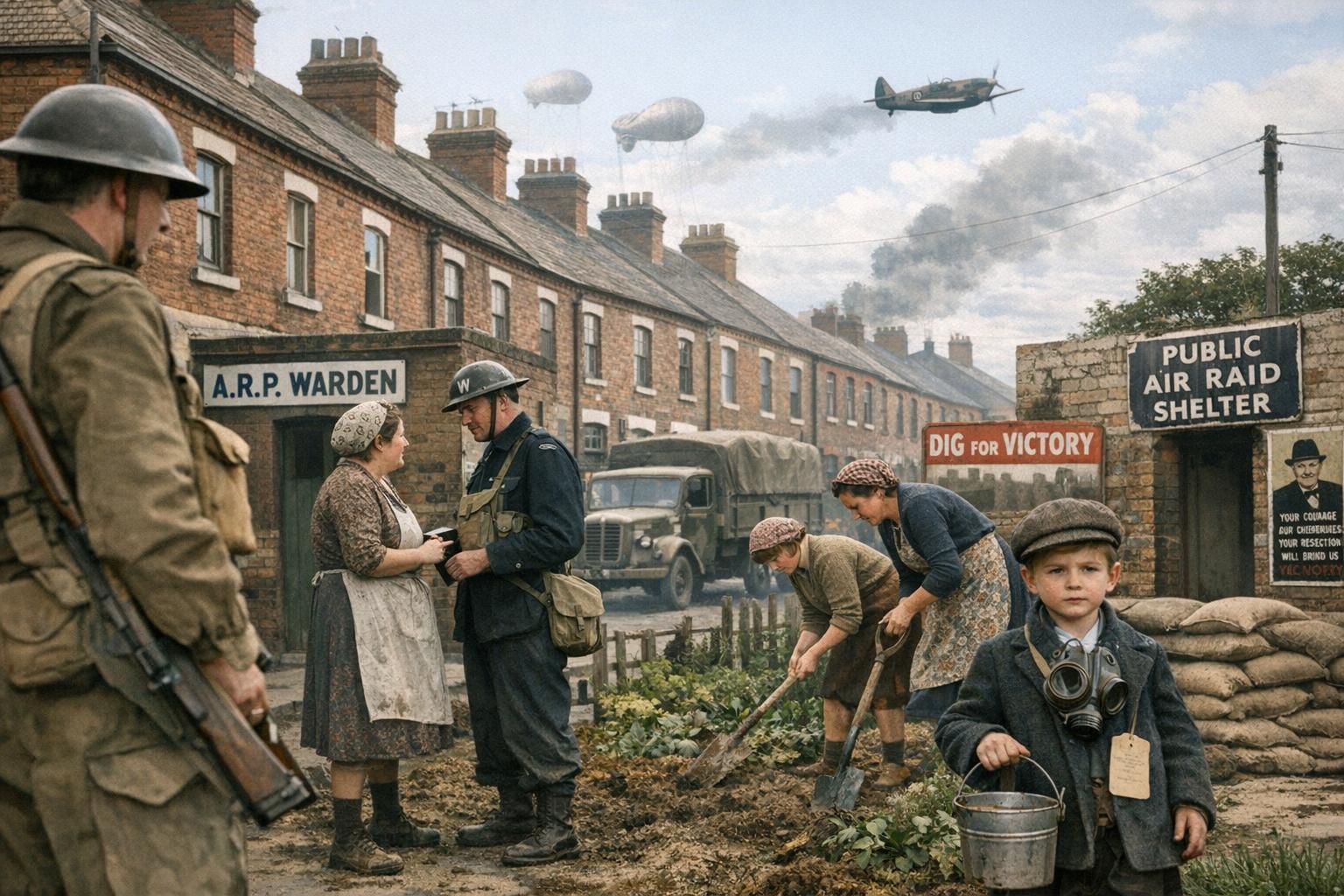
Leicestershire’s home front between 1939 and 1945 reflected the county’s place at the centre of England, its combination of industry and farming, and its busy road and rail connections. Leicester supplied clothing, footwear, engineering goods and processed food. The coalfield around Coalville provided fuel, while farms across the county raised livestock and increased arable production. Military airfields, training sites, storage depots and camps brought service personnel into many rural districts.
The county did not suffer bombing on the scale endured by Coventry or Birmingham, but distance from the coast did not make it safe. Leicester’s factories, railway yards and utilities offered potential targets. Aircraft sometimes crossed the county on their way to other industrial centres, and bombs fell during planned attacks, opportunistic raids and navigational errors. Air-raid warnings, blackout restrictions and civil defence duties became routine.
Daily life depended on the interaction between local government, employers, voluntary groups and households. Factory workers accepted longer shifts. Farmers ploughed former pasture. Families took in evacuees, repaired old clothing and learned to cook with rationed ingredients. Schoolchildren collected scrap metal and waste paper. Much of the home-front effort consisted of repetitive work rather than dramatic events, but it kept production, transport and public services running through six years of war.
Leicestershire at the Outbreak of War
Britain declared war on Germany on 3 September 1939. Preparations in Leicestershire had begun well before the announcement. National legislation required councils to plan air-raid precautions, recruit wardens and identify buildings that could serve as shelters, first-aid posts or rest centres. Hospitals reviewed emergency capacity, schools developed evacuation arrangements, and businesses received instructions on fire protection and blackout practice.
The county contained communities with very different economic roles. Leicester was a large manufacturing city with established hosiery, knitwear, boot and shoe, clothing, engineering and food businesses. Loughborough combined engineering with textile production and railway activity. Hinckley was closely associated with hosiery and footwear, while Wigston had factories, railway connections and nearby residential districts. Market Harborough served a broad agricultural area as well as supporting manufacturing and transport.
North-west Leicestershire had a separate industrial identity based on coal mining, brickmaking and related trades. Coal from pits around Coalville fed power generation, railways, factories and domestic heating. Mining already involved hazardous work, and wartime demand placed added pressure on pits facing shortages of experienced labour and machinery.
Rural districts had fewer factories but carried much of the burden of food production and military accommodation. Large houses could be requisitioned for government use, schools or hospitals. Open land was assessed for farming, training grounds and airfields. Village halls, chapels and public buildings became meeting places for civil defence, voluntary organisations and billeting committees.
Many residents initially expected immediate air attack. Families prepared rooms, taped windows and collected gas masks. Children practised air-raid drills at school. Yet the opening months brought fewer attacks than feared. This period, often called the Phoney War, allowed councils and households to improve preparations. It also created uncertainty. People carried gas masks, followed official news and waited for a form of war that had not yet fully reached the county.
Local Government and Wartime Administration
Wartime administration depended on both Leicester’s city authorities and Leicestershire’s county, borough and district councils. They worked under national direction but had to apply regulations to local conditions. Their duties covered civil defence, emergency housing, evacuation, food control, public health, salvage and the maintenance of roads and utilities.
Food offices issued ration books and handled changes of address, lost documents and entitlement questions. Billeting officers placed evacuees and some war workers in private homes. Surveyors inspected damaged buildings, while public health departments monitored sanitation in shelters, hostels and crowded accommodation. Housing officers dealt with families displaced by bombing or requisitioning.
Records and communications required careful protection. Councils prepared duplicate documents, emergency telephone systems and messenger services in case ordinary lines failed. Control rooms collected reports during air raids and directed rescue teams, ambulances, fire crews and utility workers. Telephone operators and messengers had to relay accurate details despite darkness, damaged roads or conflicting reports.
Local administration could be unpopular. Billeting orders intruded into private homes, blackout rules led to warnings or fines, and food controls generated paperwork for shopkeepers. Yet without such systems, evacuation, rationing and emergency response would have been far less orderly. The home front was bureaucratic as well as industrial. Forms, registers and duty rotas mattered almost as much as sandbags.
Industry and War Production
Leicestershire’s manufacturing base made the county a valuable production centre. Government contracts redirected civilian factories toward military supply. Firms did not always abandon their pre-war trades; many adapted existing machinery and employee skills. A hosiery plant could produce service socks and underwear, while a footwear factory could turn to boots made to military specifications.
Leicester’s knitting and clothing businesses supplied socks, gloves, scarves, underwear, uniforms and other garments. Military clothing had to meet set standards for size, durability and material. Large orders required close coordination between mills, dyers, knitting factories, clothing workshops and packing departments. Even a simple pair of socks depended on yarn allocation, machine maintenance, inspection and transport.
Boot and shoe manufacturers supplied footwear for troops and other services. Leather and rubber were controlled materials, so factories had to reduce waste and meet government rules. Repairs also took on greater value. Civilian shoes needed to last longer because replacements required coupons and suitable stock was not always available.
Engineering firms made machine tools, gauges, vehicle parts, aircraft components and production equipment. Some work was carried out under secrecy rules. Employees might know the task assigned to their own bench without knowing the final use of the component. Posters warned workers not to discuss output, factory layout or transport movements outside the workplace.
War production relied on a chain of smaller suppliers. Metalworkers produced fittings, printers prepared labels and instructions, chemical businesses supplied treatments and dyes, and packaging firms made boxes or protective wrapping. Railway depots and road hauliers then moved raw materials and finished goods. A disruption in one trade could slow several others.
Long Shifts and Factory Discipline
Factories extended working hours and introduced night shifts. Employees had to arrive despite crowded buses, reduced lighting and poor weather. Canteens served meals to workers whose shifts did not fit ordinary household routines. First-aid rooms, fire parties and shelter arrangements became standard features of larger industrial premises.
Air-raid warnings posed a difficult production question. Managers had to protect workers, yet repeated stoppages could reduce output. Factory rules set out when machinery should stop, which staff would remain on duty and how employees should reach shelters. Fire watchers stayed alert for incendiary bombs, particularly on roofs and in yards where a small fire could spread to stores or production areas.
Accidents remained a serious concern. Fatigue, unfamiliar workers and pressure to maintain output could make industrial jobs more dangerous. Machine guards, protective clothing and training were necessary, though practice varied from one employer to another. Noise and repetitive work also took a physical toll that rarely appeared in public accounts of wartime production.
Coal Mining and Fuel Supply
The Leicestershire coalfield formed another part of the county’s wartime economy. Coal powered steam locomotives, industrial boilers, electricity generation and household heating. Maintaining output was therefore a national priority, though mining competed with the armed forces and factories for labour.
Experienced miners possessed skills that could not be replaced after a short training course. Some were kept in reserved occupations, meaning that their civilian work took precedence over military service. Later in the war, young men selected by ballot were directed into coal mining. These workers became known as Bevin Boys, after Minister of Labour Ernest Bevin.
Mining communities faced rationing and blackout rules like everyone else, but shift patterns gave daily life a distinct rhythm. Early starts, night work and pit transport continued regardless of air-raid warnings or winter weather. Coal had to be cut, brought to the surface, sorted and dispatched by rail. Equipment shortages or transport delays could leave fuel waiting at the pithead while factories and homes needed deliveries.
Domestic coal was also controlled. Households could not assume that enough fuel would arrive whenever cold weather began. Families closed unused rooms, shared fires and made economical use of heating. In older houses, where insulation was poor, such economies could be uncomfortable. Wartime thrift was not always charming; often it meant wearing another jumper indoors.
Women in Wartime Employment
Women already formed a large share of Leicester’s textile, clothing and footwear workforce before 1939. War expanded both the number of female employees and the jobs open to them. Women moved into engineering, transport, clerical administration, inspection, civil defence and agricultural work, as well as continuing established factory occupations.
Government labour controls directed women of eligible ages into war work or national service. Personal circumstances were considered, particularly where young children or dependent relatives were involved, but many married women entered paid employment. Employers created training courses for machine operation, assembly, inspection and other tasks previously assigned mainly to men.
Pay did not always match male rates, even where work was comparable. Workplace expectations could also be contradictory. Women were asked to meet production targets while continuing to manage shopping, cooking, laundry and childcare. Queuing for rationed goods did not fit neatly around factory shifts, and public transport could be unreliable after dark.
Day nurseries opened in some industrial districts to care for workers’ children. Their availability varied, and opening hours did not always cover night work or long journeys. Families often depended on grandparents, older siblings or neighbours. Informal childcare therefore supported industrial production even though it rarely appeared in official output figures.
Women also joined the Auxiliary Territorial Service, Women’s Auxiliary Air Force and Women’s Royal Naval Service. Others served as nurses, telephonists, ambulance drivers or clerks. Uniformed service could take women away from Leicestershire, while military postings brought women from other counties into local camps and air stations.
Agriculture and the Drive for More Food
Before the war, Britain imported much of its food. German submarine attacks threatened shipping, so the government pressed counties to raise domestic output. In Leicestershire, War Agricultural Executive Committees assessed land use, advised farmers and, where required, directed changes in cultivation.
The county had a strong pastoral tradition, including livestock and dairy farming. Wartime policy called for more arable crops because grain and potatoes could feed more people per acre than livestock raised on comparable land. Some grassland was ploughed for wheat, barley, potatoes and other crops. The change demanded tractors, ploughs, seed, fertiliser and workers at a time when all were under pressure.
Not every field suited arable farming. Soil type, drainage, slope and access affected what could be grown. Farmers had to balance national targets against practical conditions. Wet weather could delay planting or harvesting, while machinery breakdowns were hard to remedy when spare parts were scarce.
Milk retained a central place in civilian nutrition, particularly for children and expectant mothers. Dairy farms continued production under controls governing prices and distribution. Regular collection had to be maintained despite petrol restrictions and labour shortages. Livestock also needed feed, veterinary attention and winter shelter, none of which stopped because national policy favoured cereals.
The Women’s Land Army
Members of the Women’s Land Army worked on farms throughout rural Leicestershire. Usually called land girls, they milked cows, drove tractors, tended livestock, cleared ditches, harvested crops and repaired fences. Assignments differed according to farm type and the willingness of an employer to train a new worker.
The work was physically demanding and often exposed to cold, mud and rain. Some land girls lived with farming families; others stayed in hostels and travelled to their place of work. Rural postings could feel isolated, particularly for women accustomed to city life. Social activities in nearby villages and market towns offered some relief, but transport home was not always easy.
Relations between land girls and farmers varied. Many gained confidence and skill, while others encountered poor accommodation, long hours or scepticism about female labour. Their contribution became most visible during harvest, when delays could cost a crop. Yet routine winter work, including feeding animals and cleaning sheds, was just as necessary.
Prisoners of War and Seasonal Labour
Prisoners of war worked on some Leicestershire farms, usually under organised arrangements. Italian and German prisoners could be assigned to planting, harvesting, drainage or general farm labour. Camps and hostels provided accommodation, and transport took work parties to farms.
Regulations governed supervision and contact with civilians. Daily reality could be less formal, particularly once prisoners had worked in the same district for some time. Farmers valued reliable labour, and local residents sometimes exchanged brief conversation or food despite official caution. Attitudes were not uniform, especially among families with relatives serving overseas or held as prisoners themselves.
Schoolchildren, youth groups and urban volunteers also helped with seasonal work. Potato picking and harvest camps gave young people a direct role in food production. The work could be tiring and repetitive, but it released experienced farm workers for jobs requiring machinery or animal-handling skills.
Rationing, Shopping and Household Management
Food rationing began in January 1940 and continued after the fighting ended. Each person received a ration book and registered with chosen retailers for controlled goods. The system managed national supply while discouraging panic buying and unfair accumulation.
Meat, bacon, butter, margarine, sugar, tea, cheese and other products were rationed at various points. Bread was not rationed during the main wartime period, though its quality and composition changed. Fruit, fish and vegetables were generally sold outside the coupon system, but availability depended on season, transport and local supply.
Households had to plan meals around what shops held rather than what a recipe demanded. Substitution became ordinary. Dried egg could replace fresh egg, powdered milk supplemented fresh supplies, and grated vegetables stretched meat dishes. Offal required fewer ration points and appeared more often in official cookery advice.
Families with gardens or allotments grew potatoes, onions, carrots, beans and cabbage. Soft fruit could be bottled or made into preserves when sugar allowed. The Dig for Victory campaign encouraged productive use of spare land, including gardens, allotments and institutional grounds. Keeping hens or rabbits gave some households another source of food, though animal feed was controlled.
Fair Shares and Unequal Circumstances
Rationing aimed at fairness, but households did not begin from equal positions. A family with a large garden, farming relatives and space for food storage had options unavailable to people in crowded city housing. Manual workers often needed more calories than sedentary workers. Children, expectant mothers and people with certain medical needs could receive extra allowances or priority foods.
Queues were common, especially when rumours spread that a shop had received scarce goods. A queue did not guarantee a purchase. Stock might run out before the final customers reached the counter. Retail workers had to manage ration books, points, registrations and disappointed shoppers while facing shortages themselves.
Illegal trading occurred, ranging from informal exchanges to organised black-market sales. Police and food-control officers investigated hoarding, theft and transactions outside the ration system. Many exchanges were less clear-cut: a farmer might give eggs to a relative, or neighbours might swap home-grown produce. Such practices blurred the line between mutual help and avoidance of controls.
Clothing, Repairs and Civilian Consumption
Clothing rationing began in 1941. Consumers used coupons as well as money, which reduced demand for cloth, leather and factory labour needed by the armed forces. Coupon values encouraged families to postpone purchases and make existing garments last.
The government promoted utility clothing made to approved standards. Designs reduced unnecessary fabric and decorative features. Men’s suits used fewer pockets and narrower cuts, while women’s clothing avoided excess material. These rules did not remove personal style, but they restricted what manufacturers could produce.
Repair work became part of normal household management. Socks were darned, sheets were turned, collars were replaced, and adult garments were cut down for children. Leicester’s established clothing and footwear trades gave local residents access to practical skills, though materials remained controlled. Cobblers repaired soles and heels whenever the upper part of a shoe could still be used.
Furniture, household equipment and bicycles were also kept in service longer. Replacement parts could be hard to obtain, so local repair shops handled a steady flow of kettles, clocks, radios and tools. The wartime economy rewarded patience with old objects. A temperamental bicycle was still better than no transport at all.
Evacuation and Billeting
Leicestershire received evacuees from districts judged more exposed to bombing. Most were schoolchildren, though mothers with young children, teachers, disabled people and hospital patients also moved under government schemes. Some children left Leicester for rural districts, while others arrived from cities beyond the county.
Evacuation trains brought groups to reception points, where officials checked names, assessed health and assigned billets. Children often carried labels, gas masks and small cases containing clothing and personal items. Host families had little time to assess whether an arrangement would work. Billeting officers sometimes had to persuade reluctant householders to accept children.
Home conditions could differ sharply. An urban child might encounter an outdoor toilet, well water, farm animals and unfamiliar meals. A rural host might be surprised by a child’s accent, health, clothing or habits. Some placements became affectionate and lasted for years; others broke down within days.
Host families received billeting payments, but money did not remove the practical strain of extra washing, food preparation and sleeping arrangements. In houses already short of space, even one child could alter household routines. Older hosts could find the demands tiring, while families with children of their own had to manage rivalry and discipline.
Education Under Evacuation
Schools adapted through shared buildings, split timetables and temporary classrooms. Local pupils might attend in the morning and evacuees in the afternoon, or the two groups might be taught together. Teachers evacuated with their schools where possible, preserving familiar routines for children separated from home.
Education was repeatedly interrupted by air-raid drills, staffing shortages and the use of school premises for civil defence. Some buildings lacked adequate shelters, which restricted attendance during periods of higher risk. Practical wartime activities, including gardening, salvage collection and farm work, became part of school life.
Many evacuees returned home during quieter periods, only to be moved again when bombing increased. This repeated movement disrupted friendships and schooling. Letters linked children with parents, but postal delays and censored military correspondence could complicate family communication.
Air-Raid Precautions and the Blackout
Air-raid precautions, usually shortened to ARP, covered warning systems, shelters, rescue, first aid, fire response and damage reporting. Paid staff worked alongside volunteers. Wardens knew their streets, checked blackout compliance and recorded where residents lived so they could help rescuers after an attack.
Sirens warned of approaching aircraft, while a steady signal announced the all-clear. Residents learned to distinguish these sounds and respond quickly. False alarms and aircraft passing elsewhere could produce long periods in shelters without an attack on the county. Even so, ignoring a warning carried an obvious risk.
Anderson shelters were issued to eligible households with gardens. Their curved corrugated-steel sections were partly buried and covered with earth. They offered protection from blast and fragments but could be cold, damp and cramped. Families added bunks, blankets and whatever home comforts would fit.
Morrison shelters provided an indoor option. These steel-framed structures resembled heavy tables and were intended to protect occupants if part of a house collapsed. Public shelters served residents caught away from home and people whose housing offered poor protection. Factories, schools and offices arranged communal shelter space for workers and pupils.
Living With Darkness
Blackout rules required windows, doors and skylights to prevent light escaping. Street lamps were switched off or heavily shaded. Vehicle headlights used masks that reduced the beam to a narrow patch. Wardens could report households or businesses that allowed visible light to show.
The blackout made ordinary travel hazardous. Pedestrians struggled to see kerbs, bicycles and obstacles. Drivers had less time to react on dark roads, and railway stations became harder to use. White paint appeared on posts, steps and street furniture to reduce accidents, but movement after sunset still demanded care.
Rural Leicestershire presented its own problems. Unlit lanes, sharp bends and farm traffic could be difficult even in peacetime. Wartime convoys and service vehicles added pressure. Residents learned familiar routes by memory, carried shaded torches and listened carefully for approaching traffic.
Fire Watching, Rescue and Medical Services
Incendiary bombs were designed to start fires rather than cause heavy blast damage. Because they were small and often dropped in clusters, early action could prevent a minor fire becoming a major one. Fire watchers took positions on factory roofs, public buildings and commercial premises during periods of alert.
Teams used sand, water and specialised equipment according to the type of bomb and fire. Training stressed calm action and rapid reporting. Industrial sites holding fuel, timber, textiles or chemicals required close observation because fire could spread quickly through stores and workshops.
Rescue parties entered damaged buildings, cleared debris and searched for trapped occupants. The work demanded knowledge of construction as well as physical strength. Collapsed walls, broken gas mains, live electrical cables and unexploded bombs created hazards after the immediate raid had ended.
First-aid posts treated minor injuries and stabilised patients before hospital transfer. Ambulance crews operated under blackout conditions, often with streets blocked by debris. Hospitals prepared for casualties while continuing ordinary maternity care, surgery and treatment of illness. Nursing staff faced long shifts, shortages and the chance of sudden mass admissions.
Rest centres received people whose homes were damaged or unsafe. Volunteers supplied tea, food, blankets and temporary sleeping space. Councils then had to inspect properties and find accommodation for displaced families. A raid lasting minutes could create housing and welfare work that continued for months.
Bombing in Leicester and the County
Leicestershire avoided continuous aerial assault, but raids caused deaths, injuries and destruction. Leicester’s factories, railway facilities and dense housing placed civilians at risk. One of the city’s worst attacks occurred during the night of 19–20 November 1940, when bombs struck residential and industrial districts.
Bomb damage was often highly localised. One street might lose several houses while nearby properties remained standing. Blast shattered windows and displaced roof tiles beyond the direct impact area. Water, gas and electricity services could fail, adding to the work of emergency crews.
Bombs also fell in smaller towns and rural districts. Some were aimed at airfields, railways or factories; others were released by aircraft trying to escape fighters or anti-aircraft fire. Navigation at night was imperfect, so open fields and villages could receive bombs intended for another location.
Unexploded bombs caused prolonged disruption. Police established cordons, residents were moved, and bomb-disposal teams assessed the device. Roads or railway lines might close while work proceeded. The delay between impact and removal created a different kind of strain, with households waiting to learn when they could return.
Official reporting restricted details that might help enemy intelligence. Local newspapers could describe casualties and damage only within wartime rules. Rumour often filled the gap. Residents compared what they had heard, seen or counted, though such accounts were not always accurate.
Airfields, Training Stations and Military Camps
Leicestershire’s position and open farmland made it suitable for wartime aviation. Air stations at places including Desford, Wymeswold, Bruntingthorpe, Bottesford, Husbands Bosworth and the Market Harborough area supported flying instruction, bomber training, aircraft movement and related work at different stages of the war.
Airfield construction altered rural districts. Contractors laid runways, built hangars and erected accommodation blocks, workshops and fuel stores. Heavy vehicles used village roads that had not been designed for such traffic. Landowners lost access to requisitioned fields, sometimes for years.
RAF Desford was associated with flying training and nearby aircraft work. Reid and Sigrist used the area for aircraft production and testing. Other stations trained crews on larger aircraft or served operational and transport needs. Training itself carried risk. Mechanical failure, poor weather and inexperienced crews led to accidents, some of them fatal.
Airfields employed far more than pilots. Mechanics, armourers, radio operators, drivers, cooks, clerks, medical staff and ground crews kept aircraft operating. Civilian workers maintained buildings, roads and services. Local businesses supplied food, repairs and recreation to a growing service population.
British and Allied personnel mixed with residents in pubs, cinemas, dance halls and cafés. Overseas servicemen brought unfamiliar accents, uniforms and spending power. Their presence broadened social contact but could also produce friction over behaviour, relationships and scarce goods.
Transport and Communications
Leicestershire’s railways carried troops, evacuees, coal, food, machinery and military equipment. Leicester and Loughborough were busy rail centres, while Market Harborough connected routes running north, south and east. Goods yards worked under pressure as civilian and military traffic competed for space.
Passenger journeys became slower and more crowded. Timetables could change without much warning, and troop trains received priority. Station signs were removed or obscured in some places as an anti-invasion measure, though regular travellers knew their route. Porters and railway clerks handled military paperwork alongside ordinary passengers and freight.
Petrol rationing sharply reduced private motoring. Buses carried factory workers, schoolchildren and shoppers, often at capacity. Bicycles became even more useful, particularly for journeys between villages, farms and industrial sites. Tyre and replacement-part shortages made maintenance a constant concern.
Postal, telephone and telegraph services linked families, employers and military authorities. Service personnel relied on letters from home, though censorship restricted discussion of locations and operations. Civilian callers were reminded to keep telephone conversations brief because lines were needed for official traffic.
Voluntary Work, Salvage and Community Support
The Women’s Voluntary Services supported evacuation, rest centres, mobile canteens, clothing distribution and emergency feeding. Volunteers worked with councils but retained a strong local character. They knew which hall had a usable kitchen, which household could lend bedding and who owned a vehicle.
The British Red Cross and related groups collected supplies, supported hospitals and prepared parcels for prisoners of war. Churches organised clubs, aid funds and social events. Community halls hosted lectures, training sessions and fundraising drives alongside ordinary meetings.
Salvage campaigns gathered paper, metal, rubber, rags and bones. Schoolchildren and youth groups collected household waste that could return to industrial use. Councils placed bins and organised collection points. Not every item had equal value, and publicity sometimes exaggerated what could be reused, but salvage reduced demand for imported or newly produced material.
National Savings campaigns encouraged households to lend money to the government through savings certificates and bonds. Factories, schools and neighbourhood groups set targets and displayed progress. Public ceremonies linked local saving with named military equipment, giving an abstract financial policy a visible purpose.
Children and Young People
Children experienced war through evacuation, school drills, rationing and family separation. Fathers and older brothers might be serving away from home, while mothers worked longer hours. Newsreels and radio broadcasts brought reports of fighting into domestic life, although adults did not always explain what children heard.
Gas-mask practice and shelter drills became familiar at school. Pupils carried masks in cardboard boxes or stronger cases supplied by their families. Teachers checked straps and tried to keep classes orderly during warnings. Younger children could find the equipment uncomfortable or frightening, even when adults treated drills as routine.
Older pupils helped on farms, collected salvage and joined cadet or youth organisations. Teenagers leaving school entered factories, offices, mines or agricultural work. Their transition into employment could be rapid, with wartime training replacing the longer apprenticeships once common in skilled trades.
Leisure remained part of childhood. Children played in streets, visited cinemas and exchanged comics or toys. Bomb sites, military vehicles and discarded equipment could attract curiosity, sometimes with dangerous results. Authorities repeatedly warned children not to touch unidentified objects or stray onto restricted land.
Leisure, News and Morale
Cinemas remained popular across Leicester and the county. Programmes combined feature films, short films and newsreels. The cinema offered warmth and entertainment, but an air-raid warning could interrupt a showing. Managers followed local rules on whether audiences should leave, shelter or remain seated.
Dance halls, public houses, church clubs and village events gave civilians and service personnel places to meet. Music and dancing continued under blackout and licensing restrictions. Local sports survived where players, grounds and transport were available, though many organised competitions were reduced.
Radio became a primary source of national news and entertainment. Families listened to government announcements, speeches, comedy, drama and music. Reports were censored to protect military operations, so information often arrived after a delay. Enemy broadcasts could be heard, but official campaigns warned listeners against trusting them or repeating rumours.
Local newspapers published rationing notices, civil defence instructions, court reports, casualty announcements and appeals for workers. Paper shortages reduced page counts. Editors had to make room for practical notices while observing censorship rules. Personal columns carried messages about births, marriages, deaths and service personnel, preserving a record of family life beneath the larger military story.
VE Day, Demobilisation and the Post-War Period
Victory in Europe was announced on 8 May 1945. Leicestershire marked VE Day with flags, church services, street gatherings and public events. Celebration did not mean an immediate return to pre-war conditions. Fighting against Japan continued until August, and many local service personnel remained overseas.
Demobilisation proceeded in stages. Returning men and women needed jobs, housing and time to adjust to civilian routines. Families reunited after long separations sometimes found that roles and expectations had changed. Children might scarcely know a returning parent, while spouses had become accustomed to managing alone.
Factories converted from government work to civilian production, but the process required new orders, materials and machine settings. Demand for clothing, shoes, household goods and vehicles was high after years of restricted consumption. Supply could not immediately catch up.
Rationing continued well beyond 1945, and some controls became stricter before they eased. Housing shortages remained severe because building had slowed during the war and bombing had destroyed homes. Councils used temporary housing and resumed development programmes as labour and material became available.
Women’s employment patterns shifted again. Some left wartime jobs when servicemen returned, whether through personal choice or employer policy. Others remained in paid work, particularly in Leicester’s established female industries. Wartime experience had shown that women could perform jobs once described as male work, even if pay and promotion did not fully reflect that fact.
Remembering Leicestershire’s Home Front
The physical evidence of wartime Leicestershire can still be found in former airfield buildings, pillboxes, factory records, memorials and altered streets. Some sites have been redeveloped, leaving photographs, maps and oral testimony as the main evidence of their wartime use. Local archives hold council minutes, civil defence reports, school logbooks, newspapers and personal papers.
Oral histories add details that official records often omit: the smell of a damp shelter, the sound of bombers at night, the awkwardness of receiving an evacuee, or the difficulty of cycling home after a late shift. Memory can be inaccurate, but it records how policies felt to the people living under them.
Leicestershire’s home front cannot be reduced to bombing statistics or factory totals. It included miners working below ground, land girls milking before dawn, wardens checking shaded windows and children sharing classrooms with evacuees. Shopkeepers counted coupons, railway workers moved military freight, and volunteers opened rest centres after raids.
The county’s contribution rested on its industrial skills, coal reserves, farmland, transport connections and civilian labour. War reached homes through ration books, absence, fatigue and regulation as much as through air attack. That pattern explains why the home front remains central to the history of wartime Leicestershire: it joined ordinary work and domestic life directly to the demands of national survival.