Local War History
Air Raids on Leicester During the Second World War
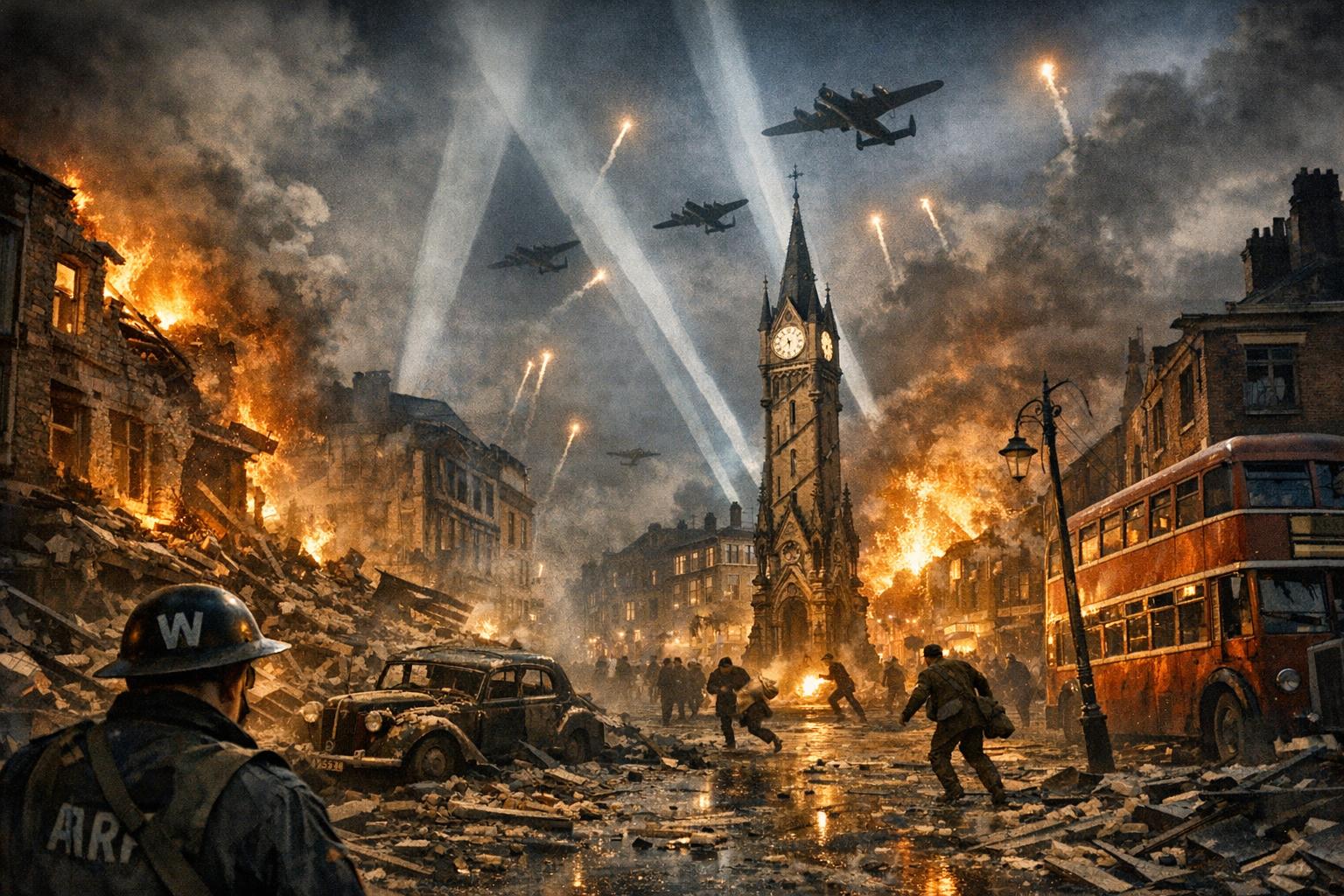
Leicester did not endure bombing on the scale suffered by London, Coventry or Birmingham, but German aircraft attacked the city repeatedly during the Second World War. Bombs killed civilians, destroyed homes, damaged factories and disrupted rail and road transport. The heaviest raid came on the night of 19–20 November 1940, when local records state that 108 people were killed.
The city had several features that attracted Luftwaffe attention. Leicester was a major centre for hosiery, footwear, textiles and engineering. Local factories supplied clothing, machinery, optical equipment and electrical goods for military and civilian use. Railway lines connected Leicester with London, the East Midlands and the industrial towns farther north. Aiming at those factories and transport links at night was another matter; bombs intended for industrial premises often landed among nearby houses.
Air attack affected far more people than casualty figures suggest. Residents lost homes, spent nights in public shelters and faced repeated interruptions to work and school. Civil-defence personnel dealt with fires, collapsed buildings, unexploded bombs and damaged utility mains. Leicester remained fully active as an industrial city, yet daily routines had to operate around sirens, blackout restrictions and the possibility of another raid.
Why Leicester was a target
Leicester’s wartime economy rested on manufacturing and transport. The city was widely associated with hosiery and knitwear, but its industrial base went well beyond clothing. Engineering businesses made machinery, precision instruments, electrical equipment and components required by government contracts. Shoe and boot production also supported military supply. Large factories employed substantial workforces, and many smaller workshops contributed parts or carried out subcontracted work.
Textile production had a direct military purpose. Armed forces required socks, underwear, knitted garments and other clothing in very large quantities. Factories that had served commercial customers before the war could be directed towards government orders. Engineering firms also adapted their output as military demand changed. This made Leicester part of Britain’s production network even though it was not dominated by shipbuilding, aircraft assembly or heavy armaments.
The railway system added to the city’s value as a possible target. Leicester had passenger stations, freight facilities, sidings, goods yards and routes serving several regions. Railways carried workers, troops, coal, raw materials and finished goods. Damage to track or signalling could delay traffic well beyond the place where a bomb landed. German planners therefore treated rail infrastructure as a military objective in its own right.
Geography mattered too. Bombers flying towards Birmingham, Coventry or other Midland centres might pass near Leicester. Crews that became lost, encountered anti-aircraft fire or failed to identify their assigned objective sometimes released bombs over another built-up area. Aircraft returning to occupied Europe could also drop unused weapons rather than carry them home. Not every bomb that fell on Leicester was necessarily aimed at the city, though it would be misleading to treat all attacks as accidental.
Air-raid preparations before 1939
British local authorities had begun preparing for air attack several years before war started. Leicester City Council worked within the national Air Raid Precautions programme, commonly known as ARP. Planning covered warning systems, shelters, firefighting, medical treatment, rescue work and the movement of civilians from damaged districts.
Air-raid wardens were recruited and trained to supervise streets or groups of buildings. Their duties included enforcing blackout rules, directing residents to shelter and reporting bomb damage. Auxiliary firefighters supported the established fire brigade. Rescue squads learned how to enter damaged buildings, shore up unstable masonry and remove casualties. First-aid parties prepared to treat burns, fractures, cuts and blast injuries before patients reached hospital.
Training exercises could not reproduce the conditions of a real raid. During an attack, telephone lines might fail, roads could become blocked and crews often worked without normal lighting. Exercises did, however, establish reporting procedures and clarify who had authority at an incident. They also showed where equipment, vehicles and medical supplies were lacking.
Public buildings were assigned wartime roles. Schools, halls and other premises could serve as rest centres, first-aid posts or temporary accommodation. Hospitals reviewed their capacity to accept many casualties within a short period. Mortuary arrangements were also prepared, an unpleasant but necessary part of civil defence.
Domestic and communal shelters
Many Leicester households received an Anderson shelter. Made from curved sections of corrugated steel, it was normally sunk partly into the ground and covered with earth. When installed properly, an Anderson shelter offered useful protection from fragments, falling debris and nearby blast. It was less comfortable during cold or wet weather. Water seepage, poor ventilation and cramped conditions led some families to avoid using theirs until raids became frequent.
Residents without gardens relied on communal shelters, strengthened basements or public shelters. Local authorities inspected and marked suitable premises, though standards varied. A basement could protect people from flying glass and fragments but become dangerous if the building above collapsed or exits were blocked.
The Morrison shelter became available later. This indoor steel structure resembled a heavy table with mesh sides. Families could sleep beneath it, and it could protect occupants if upper floors fell into the room. It was practical for terraced housing without garden space, although its size occupied a fair chunk of the average living room.
The blackout and wartime routine
The blackout began at the outbreak of war. Householders covered windows with heavy curtains, shutters or blackout material so that no light could be seen outside. Shops screened doors and display windows. Factories fitted covers to roof lights and checked for escaping light. Wardens could order residents to correct any visible gap.
Vehicles used shielded headlights that cast a narrow beam towards the road. Street lighting was reduced or switched off. The policy made towns harder to identify from the air, but it also increased traffic collisions, falls and other accidents. Pedestrians had trouble seeing kerbs, road signs and approaching bicycles. Emergency crews faced the same conditions while travelling to incidents.
Blackout duties extended into factories. A poorly screened skylight or open door could reveal the position of an industrial district. Businesses appointed staff to inspect buildings and monitor compliance. Production had to continue without allowing bright light to escape, which required alterations to entrances, ventilation openings and windows.
Residents also learned the warning signals. The rising and falling note of the air-raid siren announced danger, while a steady note gave the all-clear. An alert did not guarantee that bombs would fall on Leicester. Aircraft might pass over the district, change course or be driven away. Even so, no one hearing the siren could know whether the night would bring a brief interruption or several hours in a shelter.
Factories and fire precautions
Industrial premises faced two connected risks: blast damage and fire. Managers organised fire-watching teams, positioned buckets of sand and water, and checked access to hydrants. Larger works created internal civil-defence groups with wardens, first-aid staff and trained firefighters.
Incendiary bombs were small and often dropped in clusters. Their purpose was to ignite roofs, timber, stored goods and other combustible material. A trained fire watcher could sometimes control one with sand or suitable firefighting equipment before the flames spread. Delay made the job much harder, particularly in upper floors or roof spaces.
High-explosive bombs caused a different type of damage. Blast could collapse walls, tear off roofs, break windows and damage machinery. Burst gas pipes increased the chance of fire, while broken water mains reduced the supply available to firefighters. Debris might block factory entrances, leaving crews to find another route into the building.
Businesses tried to protect production records, drawings and valuable machinery. Some materials were moved to alternative premises, and firms prepared emergency repair arrangements. Where practical, production was dispersed among several buildings. Such measures reduced dependence on one factory, although dispersal created its own transport and management problems.
Early bombing incidents in 1940
Leicester experienced isolated bombing during 1940 as German air operations over Britain increased. Some incidents involved only a small number of bombs, but they exposed weaknesses in local preparations. An unexploded bomb could close streets for hours or days. Even a blast causing few casualties might break hundreds of windows and damage roofs across a broad area.
Early alerts had a strong effect on public behaviour. Families tested shelters under real conditions, wardens put their reporting systems into use, and factories paused production. False alarms and aircraft passing at a distance still caused lost sleep and interrupted shifts. Workers might spend part of the night in a shelter and then report to a factory the next morning.
The absence of heavy damage during an alert did not make the warning pointless. Bombing accuracy at night was poor, and crews relied on maps, estimated timings, landmarks, fires and radio-navigation aids. Cloud, smoke and defensive action could all affect bombing. A district spared on one night might be struck during the next operation.
The Leicester raid of 19–20 November 1940
The city’s worst air raid began on the evening of 19 November 1940 and continued into the early hours of the following day. It came during the Blitz, shortly after the destructive attack on Coventry on 14–15 November. German operations at this stage concentrated on British industrial centres, transport facilities and urban production districts.
Aircraft dropped both high-explosive and incendiary bombs across Leicester. The pattern was spread across residential, commercial and industrial areas rather than confined to one objective. Factories and railway property may have been intended aiming points, but houses, shops and streets received much of the damage. Night bombing offered little ability to separate a factory from homes standing a few hundred yards away.
Local histories commonly record 108 deaths from the raid. Several hundred residents suffered injuries, ranging from minor cuts to severe burns and blast wounds. Exact totals can differ among records because some count only deaths at the scene, while others include people who died in hospital later.
How the damage developed
High-explosive bombs created craters, demolished houses and damaged utility lines. Blast pressure broke windows at a distance, sending glass into rooms and streets. Roof tiles and fragments of masonry became dangerous projectiles. A building did not need to receive a direct hit to become uninhabitable.
Incendiaries produced many smaller fires. Fire watchers tackled devices that landed on factories, shops and houses, but crews could not reach every outbreak at once. Roof fires were hard to detect from ground level until flames had taken hold. If an incendiary penetrated an attic containing dry timber or stored material, the fire could spread down through the building.
Water supply became a central concern. Firefighters required steady pressure, yet bomb damage could fracture mains. Emergency supplies, static water tanks and portable pumps helped compensate where normal hydrants failed. Crews also had to conserve water and decide which fires posed the greatest risk to adjoining property.
Gas leaks created another hazard. Damaged pipes could feed fires or cause explosions inside partly collapsed houses. Electricity supplies were cut in affected districts to reduce danger, leaving rescue teams dependent on protected lamps. Broken sewers and water pipes added to the sanitation problems faced after the all-clear.
Residential areas under attack
Terraced streets were particularly vulnerable. Houses shared walls, stood close to the pavement and often had small yards rather than open ground. A direct hit could demolish several homes, while blast stripped tiles and windows from many more. Collapsed staircases and blocked doorways trapped residents on upper floors or in cellars.
Families used Anderson shelters, communal shelters, basements and strengthened rooms. Survival often depended on where a person happened to be when a bomb landed. A shelter could remain intact while the house beside it collapsed. In other cases, debris blocked the entrance and rescue workers had to dig occupants out.
People who survived the bombing could not always return home after the all-clear. Buildings needed inspection, streets remained closed and unexploded bombs posed a continuing danger. Some residents stayed with relatives or neighbours. Others went to rest centres arranged by the council, where they could receive food, basic clothing and help finding temporary lodging.
Unexploded bombs
Not every high-explosive bomb detonated on impact. A weapon could bury itself beneath a road, garden or building and remain active. Delayed-action fuses were especially disruptive because they prevented rescue, firefighting and repair teams from working nearby.
Police and wardens established cordons around suspected bomb sites. Residents might be evacuated while military bomb-disposal personnel investigated. Locating a buried bomb required evidence from craters, eyewitness reports and visible entry holes. Excavation then had to proceed carefully, often beside damaged buildings or utility pipes.
An unexploded bomb could interrupt a neighbourhood for longer than the raid itself. Roads closed, public transport changed route and businesses stayed shut until the area was declared safe. The lack of an explosion did not mean the weapon had caused no harm.
Civil defence during the November raid
The November attack placed Leicester’s civil-defence organisation under severe pressure. Wardens sent reports from local posts to control centres, identifying fires, casualties, blocked roads and damaged mains. Control staff then assigned rescue, ambulance and firefighting resources. Reports were often incomplete because telephone connections failed or messengers had to cross bombed streets.
Rescue parties searched collapsed houses for survivors. They removed debris by hand where heavy equipment risked causing another collapse. Teams used timber supports to stabilise walls and floors. Dust, leaking gas, darkness and falling masonry made the work hazardous. A rescuer also had to distinguish between sounds from trapped occupants and the movement of an unstable structure.
Ambulance crews carried casualties to first-aid posts and hospitals. Road closures forced drivers to change routes, and vehicle lighting remained restricted. First-aid workers treated bleeding, shock, burns and fractures before transfer. Casualties covered in plaster dust or soot were not always easy to identify, which complicated registration and family enquiries.
Fire crews worked across many separate sites. Their task was not simply to extinguish every flame. They had to prevent fire spreading to factories, warehouses, housing rows and buildings holding combustible stock. Crews moved between incidents as priorities changed, sometimes returning to places where a fire had restarted beneath debris.
Hospitals, rest centres and voluntary help
Leicester’s hospitals had prepared for mass admissions, but the November casualties tested staff, beds and supplies. Doctors and nurses treated wounds caused by glass, collapsing masonry, heat and blast. Some patients required surgery, while others needed cleaning and dressing of cuts that might otherwise become infected.
Hospital staff also faced identification and record-keeping duties. A patient might arrive without papers after being pulled from a damaged house. Children could become separated from parents during evacuation or treatment. Registers helped authorities answer enquiries, though delays were common during the busiest hours.
Rest centres supported people whose homes had become unsafe. Volunteers provided hot drinks, simple meals, blankets and replacement clothing. Council staff recorded names and addresses so that families could be reunited and accommodation assigned. The work could continue for days after a raid as inspectors decided which houses were fit for occupation.
Voluntary organisations assisted with welfare, first aid and the distribution of donated goods. Neighbours also provided informal help. Spare rooms, kitchens and household tools became part of the local response. This was practical cooperation rather than a tidy story of universal unity; shortages, confusion and disagreement still occurred.
Reporting, censorship and rumours
Wartime reporting had to balance public knowledge against military security. Newspapers could describe casualties and general damage, but they were restricted from publishing details that might help German intelligence assess bombing accuracy. Reports avoided precise information about factory output, military contracts and transport disruption.
Censorship could make rumours more persistent. Residents saw smoke, damaged streets and emergency vehicles but received few verified details during the raid. Casualty totals changed as rescue teams reached new buildings and hospitals updated their records. Early figures were therefore provisional.
Officials tried to correct false stories through notices, newspapers and local broadcasts. Wardens also passed information within their sectors. Accurate communication mattered because rumours about unexploded bombs, contaminated water or further attacks could lead people to leave safe areas or crowd already busy roads.
Raids during 1941
Bombing continued through the winter of 1940–41 and into the spring. Attacks during March 1941 caused more deaths, injuries and property damage. None matched the November raid, but repeated alerts kept civil-defence services active and prevented residents from treating the earlier attack as an isolated event.
The pattern of bombing varied. Some nights brought aircraft passing overhead with no local impact. On others, bombs fell in small groups across housing and industrial districts. Records for individual incidents do not always agree because wartime reports, hospital registers and later historical accounts used different boundaries and counting methods.
After spring 1941, German bombing of many inland British cities declined as military priorities shifted to operations elsewhere. Leicester still faced danger from occasional aircraft, and local precautions remained in force. Fire watching, blackout controls, shelter maintenance and civil-defence training continued because no authority could assume the threat had ended.
| Period | Event in Leicester | Main effects |
|---|---|---|
| Late 1930s | ARP planning and recruitment | Wardens, rescue parties, first-aid staff and auxiliary firefighters were trained. |
| September 1939 onward | Blackout and shelter measures | Homes and factories screened lights; domestic and public shelters entered regular use. |
| 1940 | Early isolated bombing | Property damage, disruption and testing of local reporting procedures. |
| 19–20 November 1940 | Heaviest raid on Leicester | 108 deaths commonly recorded, several hundred injuries and broad damage to homes and workplaces. |
| Winter 1940–41 | Intermittent raids and alerts | Continuing pressure on residents, factories, transport and civil defence. |
| March 1941 | Further damaging attacks | More civilian casualties and property loss. |
| After spring 1941 | Reduced bombing intensity | Precautions remained in force despite fewer major attacks. |
Damage to housing
Bomb damage did not fall into a simple division between destroyed and untouched property. Surveyors used several grades to describe buildings. Some required minor repairs, such as replacing windows and roof tiles. Others needed structural work before residents could return. Houses damaged beyond economical repair had to be demolished.
Blast affected broad areas. A bomb landing in a street might destroy two or three houses while damaging dozens nearby. Broken roofs allowed rain into bedrooms and attics. Missing windows left homes exposed to cold weather, and temporary coverings did little to restore normal comfort.
Repair work competed with other wartime demands for timber, glass, bricks, labour and transport. Builders could make a house weatherproof before carrying out permanent repairs, but temporary patches sometimes remained for months. Council inspectors had to decide which work deserved priority.
Displaced households faced practical problems that casualty statistics omit. Furniture and clothing might be buried or ruined by water used in firefighting. Ration books, identity cards and family papers could be lost. Residents needed new accommodation near work and school at a time when housing was already under pressure.
Effects on factories and wartime production
A factory did not need to be demolished to lose production. Broken windows and roof damage could expose machinery to rain. Interrupted electricity stopped powered equipment, while damaged gas and water connections made buildings unsafe. Rubble in loading yards delayed deliveries even when the production floor survived.
Managers assessed damage quickly because government contracts operated to strict schedules. Machinery was cleared, cleaned and restarted where possible. Work shifted between departments or moved to other premises. Employees sometimes helped clear debris before returning to their usual jobs.
Factory firefighting teams had a valuable role after incendiary attacks. Staff knew the layout of buildings, the location of hazardous stock and the controls for machinery and utilities. Their familiarity saved time when municipal crews arrived. It also allowed small fires to be dealt with before they spread through roof spaces.
Absence from work created another problem. Employees might be injured, displaced or required for civil-defence duty. Others lost sleep during long alerts. Production records rarely show the full effect of exhaustion, late arrival and household disruption, yet these factors affected output after every serious raid.
Railways, roads and public utilities
Leicester depended on transport for raw materials and finished goods. Railway damage could affect passenger traffic, freight movement and factory supply. Craters near tracks, damaged points or broken signalling cables required rapid repair. Engineers often worked under blackout conditions so lines could reopen as soon as possible.
Road transport faced blocked streets, debris and cordoned bomb sites. Buses changed routes around damaged districts. Emergency vehicles received priority, while ordinary journeys took longer. Railway stations and bus services also had to cope with people leaving unsafe accommodation or travelling to relatives.
Utility crews dealt with broken gas pipes, electrical cables, sewers and water mains. Repairs had to be coordinated with bomb-disposal and rescue teams. Restoring one service could not proceed if excavation might disturb an unexploded weapon or weaken a damaged wall.
Water mains had military as well as domestic value because firefighters depended on them. Emergency tanks and alternative pumping points provided backup, but they could not fully replace a functioning network. Restoring water pressure therefore ranked among the most urgent post-raid tasks.
Schools, children and evacuation
Children experienced bombing through evacuation, interrupted education and nights spent in shelters. Government evacuation schemes moved some Leicester children to rural districts or smaller towns judged less exposed to attack. Teachers often travelled with school groups and continued lessons in borrowed premises.
Evacuation did not always last. Some parents brought children home during periods of lighter bombing, while others found separation difficult to maintain. Receiving households varied in their ability to accommodate evacuees. Differences in food, discipline and household routine could produce friction.
Children who remained in Leicester attended schools operating under wartime restrictions. Alerts interrupted lessons, and classes moved to shelters when warning time allowed. Some school buildings served civil-defence or welfare purposes, reducing teaching space. Damage elsewhere could lead pupils to share premises or attend on staggered schedules.
Parents had no risk-free choice. Evacuation reduced exposure to urban bombing but separated families. Keeping children at home preserved family routine but placed them nearer factories, railways and dense housing. Decisions changed as raids became more or less frequent.
Living through repeated alerts
The burden of air raids included long periods in which little happened. Residents could spend hours in a shelter while aircraft passed far away. Sleep was broken, rooms were cold and families still had to work, shop and attend school the next day.
Some households made shelters more usable with bunks, blankets, thermos flasks and simple lighting. Neighbours sometimes shared larger shelters. Public shelters developed their own routines, including informal seating arrangements and agreed expectations about noise. Conditions could still be damp, crowded and poorly ventilated.
People responded differently to warnings. Some entered shelter as soon as the siren sounded. Others waited until they heard aircraft or anti-aircraft guns. Factory workers followed workplace rules, which might require them to remain near machinery unless an alert reached a more serious stage.
Anti-aircraft fire created hazards of its own. Shell fragments fell back to the ground, and the noise made it difficult to judge whether bombs were nearby. Residents learned to distinguish aircraft engines, gunfire and explosions, though such judgments were hardly reliable in darkness.
Casualty records and differences between sources
The figure of 108 deaths for 19–20 November 1940 appears widely in Leicester histories. Variations may arise when researchers use hospital death dates, civil registration records or incident reports. Someone who died several days after being injured might appear in one raid total but not another.
Records were created for different purposes. Wardens recorded incidents and immediate casualties. Hospitals documented treatment and death. Registrars entered legal details, while cemetery registers recorded burial. Newspaper reports relied on figures approved for publication and often appeared before searches had finished.
Names and addresses can also vary through spelling errors, house renumbering or damaged documents. Researchers studying one victim may need to compare several records. Family testimony can clarify identity and relationships, though memories recorded decades later may place an event on the wrong night.
Casualty totals also exclude many people whose lives were disrupted. A resident who escaped without physical injury but lost a home does not appear among the dead or wounded. Nor do figures measure interrupted employment, displacement or the long repair process.
Burial, mourning and commemoration
Funerals took place while the city remained under wartime restrictions. Families faced delays in identification, transport and registration. Some funerals involved several members of one household or neighbours killed in the same incident. Churches and cemeteries preserve names that place the casualty statistics in a human setting.
Public remembrance developed through anniversary services, local memorials, exhibitions and historical research. The raid of 19–20 November remains the main date associated with Leicester’s bombing because it brought the highest loss of life. Smaller incidents receive less public attention, despite their effect on the streets involved.
Local history groups and family researchers have helped preserve photographs, letters and oral testimony. Such material records details missing from official documents: where a family sheltered, how a street looked the next morning, or which neighbour provided accommodation.
Personal accounts require careful comparison with contemporary records. Memory can merge separate alerts or confuse dates, particularly after many decades. That does not make oral testimony worthless. It works best beside incident maps, civil-defence reports and registration documents.
What wartime records can show
Several types of record help reconstruct the Leicester raids. Civil-defence incident logs identify times, streets, bomb types and the services sent to each site. Bomb maps show the distribution of high-explosive weapons and incendiaries. Council papers record damaged housing, emergency accommodation and repair programmes.
Newspapers provide contemporary reporting, though censorship shaped what editors could print. Hospital and burial records offer firmer evidence for casualties. Electoral registers and the 1939 Register can help identify household members living at an address before a raid.
Factory archives may describe production losses, fire-watching arrangements and repairs. Railway records can document line closures or damage to property. Government files place local incidents within the broader German bombing campaign and British civil-defence system.
Researchers should note the date on which a document was produced. A report written during a raid may contain estimates, while a later summary may correct them. Later accounts can still repeat early errors, so agreement between several independent records carries more weight than one isolated statement.
Leicester’s place in the Blitz
Leicester’s bombing history sits between two misleading descriptions. The city was neither untouched nor subjected to the sustained destruction experienced by the best-known Blitz targets. Its factories and transport connections gave German planners valid reasons to attack, but the frequency and weight of bombing remained below that suffered by major ports and heavy-industrial centres.
The November raid showed what one concentrated night could do to a densely built city. More than one hundred people died, hundreds were injured and many households lost usable accommodation. Factories, roads, railways and utilities all required attention at the same time.
Civil defence reduced the scale of further loss. Wardens reported incidents, fire watchers dealt with incendiaries, rescue parties entered unstable buildings and medical staff treated casualties. Their work did not prevent bombing, but it shortened delays and stopped some fires from spreading.
The raids also show why local wartime history cannot be judged only by comparison with London or Coventry. For a family whose house was demolished, the fact that another city suffered greater destruction offered little practical meaning. Leicester’s experience was smaller in scale but still involved repeated danger, death, displacement and years of repair.
The lasting record of the raids
Physical traces of bombing became less visible as damaged streets were repaired or redeveloped. Replacement buildings, altered plots and post-war housing can conceal where bombs fell. Archival maps and photographs are therefore useful for linking present-day streets with wartime incidents.
The clearest account comes from combining official records with personal evidence. Incident reports explain what happened at street level. Casualty registers identify those killed. Housing files show what became of damaged property, while memories describe how residents experienced shelters, rescue work and displacement.
The night of 19–20 November 1940 remains central to the account of Leicester at war. It was the city’s deadliest raid and the strongest test of its emergency services. The smaller attacks before and after that date also belong in the record, since they prolonged disruption and kept the population under the threat of renewed bombing.
Leicester continued producing clothing, equipment and machinery despite the raids. Rail traffic resumed, damaged factories reopened and households returned where repairs allowed. That recovery depended on council staff, utility workers, builders, railway employees, civil-defence volunteers and residents carrying out ordinary jobs under wartime restrictions. It was not dramatic work most of the time, but it kept the city functioning.