Local War History
Leicestershire During the First World War
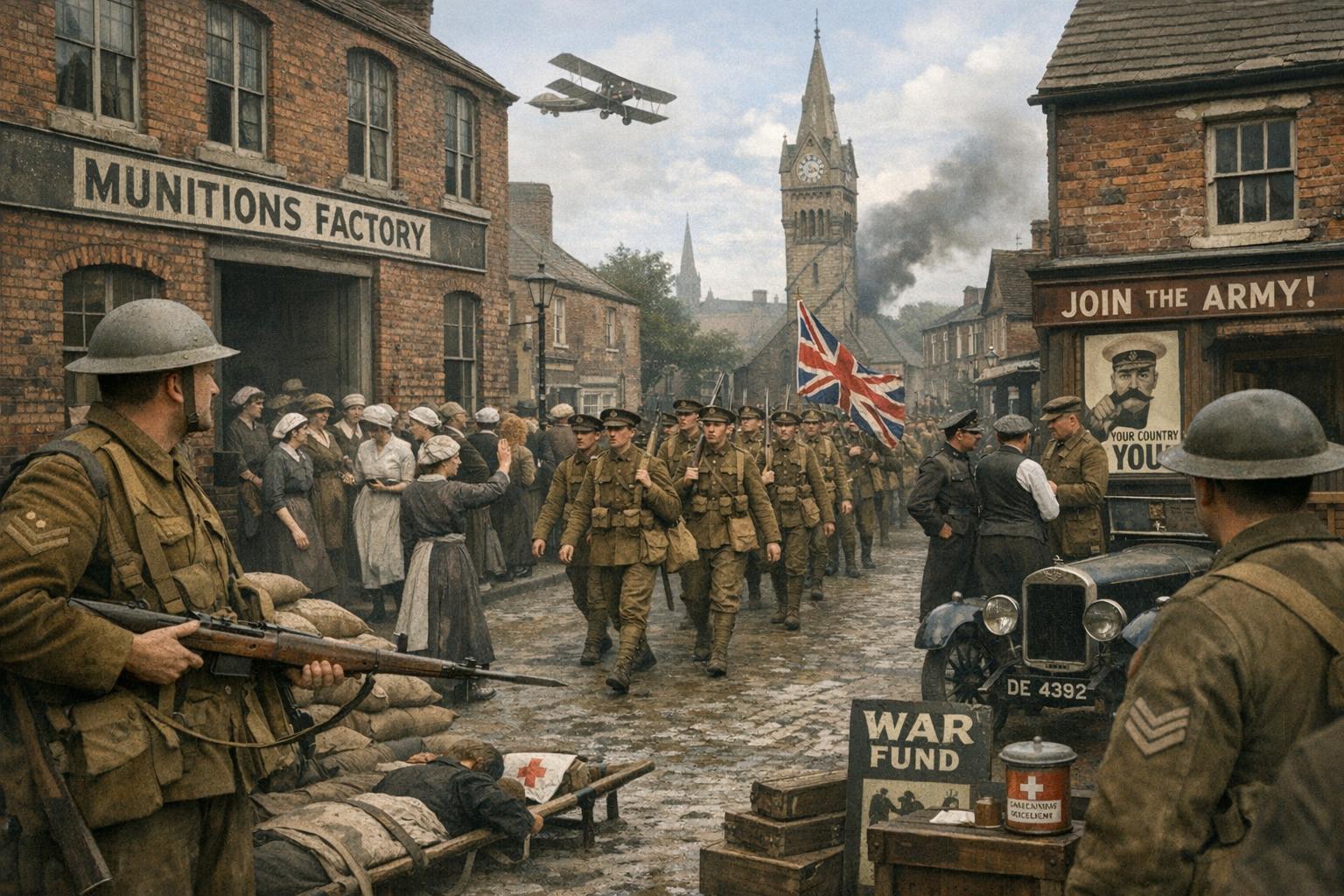
When Britain declared war on Germany on 4 August 1914, Leicestershire was a county of factories, mines, farms and expanding market towns. Leicester, then a county borough administered separately from the county, remained the region’s commercial and manufacturing centre. Railways, roads, employment and family connections bound the city to Loughborough, Hinckley, Coalville, Melton Mowbray, Market Harborough and the surrounding villages.
The First World War affected nearly every household in some form. Men entered the armed forces, factories accepted government contracts, farms lost experienced labourers and hospitals received wounded troops. Women took on more industrial, agricultural and administrative work. Food controls, military tribunals, air-raid precautions and casualty reports brought the authority of the wartime state into ordinary life.
Leicestershire’s contribution reflected its established economy. Leicester produced hosiery, footwear and clothing on a large scale. Coal mining dominated communities in the north-west of the county, while engineering, quarrying, brickmaking and food production supported local and national trade. Beyond the industrial districts, mixed farming and livestock remained central to rural employment. War redirected much of this activity toward military needs, though the change brought shortages, wage disputes and pressure on transport.
Leicestershire at the outbreak of war
The declaration of war did not bring an instant, organised conversion to wartime production. During the opening weeks, many businesses faced cancelled orders, disrupted exports and uncertainty about credit. Employers could not know whether the conflict would last for months or years. Some reduced working hours before military contracts began to arrive. Workers who depended on weekly wages felt the effects quickly.
Public meetings took place in town halls, drill halls and open spaces. Newspapers printed official announcements beside reports from France and Belgium. Church congregations held services for troops and their families. Local councils discussed relief for dependants, the accommodation of soldiers and measures against possible espionage. Rumour travelled fast, often much faster than verified news.
Reservists were among the first men to leave. They reported to depots before travelling to their assigned units. Territorial Force soldiers were mobilised soon afterwards. Railway stations became places of departure, with relatives gathering on platforms while military trains carried men south and east. Later in the war, those same stations received hospital trains and returning veterans.
The early volunteer campaign drew upon civic duty, loyalty to friends and pressure from employers or neighbours. Posters and newspaper notices described military service as an obligation. Some men enlisted with workmates, brothers or members of the same sports club. Others joined units outside the county because they wanted a trade, a preferred branch of service or an earlier place in the recruiting queue.
Recruitment and the Leicestershire Regiment
The county’s infantry regiment was the Leicestershire Regiment, commonly called the Tigers. Its depot stood at Glen Parva Barracks, south of Leicester. The tiger badge and nickname reflected the regiment’s long association with service in India. Wartime expansion turned a relatively small regimental structure into a network of regular, Territorial, service, reserve and training battalions.
The 1st Battalion was serving in Ireland when the war began and landed in France in September 1914. The 2nd Battalion came from India and reached the Western Front later that year. Both regular battalions contained professional soldiers alongside recalled reservists and later replacements. Early fighting reduced the number of pre-war regulars, so drafts of newly trained men were required repeatedly.
Leicestershire’s Territorial battalions included the 1/4th and 1/5th Battalions. They formed part of the North Midland Division, later designated the 46th (North Midland) Division. Territorial service had begun as a part-time commitment, with evening drills and annual camps. Mobilisation converted it into full-time service. Men who had expected to defend Britain were asked to volunteer for duty overseas, and most did so.
New Army battalions were also raised after Lord Kitchener called for volunteers. The 6th, 7th, 8th and 9th Service Battalions drew recruits from Leicester and the county, though their composition changed as casualties and replacement drafts broke down the early local character of each unit. The 11th Battalion became known as the Midland Pioneers. Pioneer troops performed infantry duties but also carried out construction, road work, trench repair and other heavy tasks near the fighting line.
Not every Leicestershire recruit joined the county regiment. Men served with the Royal Engineers, Royal Field Artillery, Army Service Corps, medical units and other infantry regiments. Others entered the Royal Navy or Royal Marines. The Royal Flying Corps attracted men with mechanical or technical experience before becoming part of the Royal Air Force in April 1918.
Training, billeting and departure
New recruits needed uniforms, rifles, instructors and accommodation. Supplies did not always keep pace with enlistment. Some volunteers trained in civilian clothing or received older equipment while waiting for standard kit. Drill, route marches, musketry and field exercises filled their days. Training also included sanitation, first aid, trench construction and the use of gas masks as the character of the war became clearer.
Barracks could not house every new soldier. Units used camps and temporary huts, while private homes and public buildings sometimes provided billets. Local traders supplied bread, meat, laundry services and transport. Military demand offered welcome business, but large bodies of troops also placed pressure on food, roads and public order.
Letters and postcards connected recruits with home. Soldiers wrote about training, weather and meals, though censorship discouraged detailed references to unit movements. Families sent parcels containing socks, tobacco, food and small comforts. A parcel might take weeks to arrive, and its recipient could have moved before it reached the battalion.
Leicestershire battalions in France and Belgium
Men of the Leicestershire Regiment served through the main phases of fighting on the Western Front. Their duties extended beyond attacks. They held trenches, repaired wire, carried ammunition, escorted prisoners and moved supplies through communication trenches. Even a so-called quiet sector exposed soldiers to snipers, artillery, disease and accidents.
Trench conditions varied with weather, drainage and location. Mud caused swollen feet and damaged equipment. Rats fed on waste and unburied remains. Lice were difficult to remove from uniforms, while contaminated water could cause illness. Soldiers rotated between the front line, support positions, reserve areas and billets, but rest periods often included training or labour.
Loos and the Hohenzollern Redoubt
The Battle of Loos began on 25 September 1915. It was Britain’s largest offensive up to that date and included the first British use of poison gas on a large scale. The gas did not always move as planned, and artillery support proved inadequate against intact German positions.
The 46th (North Midland) Division attacked the Hohenzollern Redoubt on 13 October. The 1/4th and 1/5th Leicesters took part in an assault across exposed ground against wire and machine-gun fire. The attack failed with heavy losses. Local newspapers later carried long casualty lists, turning the battle’s military name into a familiar reference across Leicester and county communities.
Losses affected workplaces, chapels, schools and sports clubs because Territorial units had recruited locally. A single action could remove several men from the same street or factory department. The effect reached far beyond official casualty totals.
The Somme and Gommecourt
The Somme offensive opened on 1 July 1916. British forces suffered more than 57,000 casualties on the first day, including over 19,000 deaths. The 46th Division attacked near Gommecourt as part of a diversion intended to support the larger offensive farther south. The assault met uncut wire and strong German defences. Many troops were killed, wounded or trapped before reaching their objectives.
Service battalions of the Leicestershire Regiment also fought on the Somme. The 6th, 7th, 8th and 9th Battalions served together in the 110th Brigade and were involved around Bazentin during July 1916. Repeated operations, artillery fire and harsh field conditions steadily reduced battalion strength. Replacements arrived from training units, but they often had little time to get to know experienced soldiers before entering the line.
The Somme continued into November. It did not consist of one continuous attack but of many battles spread across a wide area. For Leicestershire families, distinctions between official phases mattered less than the telegrams, letters and printed casualty notices that followed.
Operations from 1917 to 1918
Leicestershire soldiers fought at Arras and in the Ypres sector during 1917. The Third Battle of Ypres became associated with shell holes, broken drainage and severe mud. Moving guns, food and ammunition through that ground demanded sustained physical labour. Stretcher-bearers sometimes needed hours to carry a wounded man from an exposed position.
In March 1918, Germany launched a series of offensives before American manpower could be fully deployed. British units retreated under intense pressure, and some Leicestershire battalions suffered heavy casualties or lost men as prisoners. The Allied advance later that year reversed the position. The 46th Division gained particular notice for crossing the St Quentin Canal on 29 September 1918, breaking through a strongly defended section of the Hindenburg Line.
Fighting continued until the Armistice took effect at 11 a.m. on 11 November. News reached Leicestershire through bells, newspapers and public announcements. Celebrations did not mean that every soldier came home at once. Occupation duties, transport shortages and administrative delays kept many abroad for months.
Service beyond the Western Front
France and Belgium received most press attention, but Leicestershire men served across several theatres. Units fought the Ottoman Empire in Mesopotamia, Palestine and related campaigns. Other servicemen worked in Egypt, Salonika, East Africa, India and naval stations around the British Isles.
Conditions in Mesopotamia differed sharply from trench warfare in northern France. Heat, poor sanitation, disease and difficult supply routes caused many casualties. Medical arrangements struggled during the early campaign, particularly around the failed attempt to relieve the besieged garrison at Kut. Later reforms improved transport and hospital provision, though sickness remained common.
The Palestine campaign required long marches and careful movement of water, animals and ammunition. Mounted units, infantry, engineers and medical personnel all depended upon railways and supply columns built across difficult ground. Letters from these regions sometimes described climate and local customs, but censorship still restricted operational detail.
Naval service brought its own pattern of danger. Sailors faced mines, submarines, storms and long periods of routine duty. Merchant seamen from the county helped maintain imports of food and raw materials as German U-boats attacked shipping. Their work had a direct bearing on the food and fuel available at home.
Casualty reports and family life
Official telegrams were brief and formal. A family might learn that a man had been killed, wounded or reported missing without receiving a clear account of what had happened. Officers or comrades sometimes wrote later with further details, though such letters could rely on incomplete recollection.
The term missing covered several possibilities. A soldier might have been killed without identification, wounded and taken to another hospital, separated from his unit or captured. Enquiries passed through military offices, the Red Cross and prisoner-of-war agencies. Weeks or months could pass before a firm answer arrived.
Local newspapers printed lists arranged by town, street or battalion. They also published photographs and short biographies submitted by families. These notices often recorded employment, school attendance, church membership and sporting interests. They now provide valuable evidence about the civilian lives behind military records.
Bereavement had financial as well as personal consequences. Soldiers’ dependants received allowances, while widows and disabled veterans could qualify for pensions. Claims required forms, medical assessments and proof of dependency. Delays or disputed decisions caused hardship. Charities and local relief committees attempted to fill gaps, but support varied by place and circumstance.
Leicester’s factories and military production
Leicester’s established manufacturing base allowed firms to move into military supply work. Hosiery factories made socks, underwear, knitted garments and other clothing. Footwear businesses supplied army boots, while clothing manufacturers produced uniform items. Engineering firms made tools, machinery and metal parts.
Military orders could bring steady work, yet government contracting imposed strict prices, materials and delivery dates. Inspectors checked whether goods met the required standard. A batch of poorly made boots or socks was not a minor retail problem; it could affect soldiers serving in wet conditions. Manufacturers had to balance speed against durability.
| Local trade | Wartime output or role | Common pressures |
|---|---|---|
| Hosiery and textiles | Socks, underwear, shirts and knitted clothing | Wool controls, long shifts and labour shortages |
| Footwear | Army boots and related leather goods | Leather rationing, inspections and high production targets |
| Engineering | Machinery, tools, components and repair work | Loss of skilled men and restricted metals |
| Coal mining | Fuel for factories, railways and households | Manpower demands, transport pressure and safety risks |
| Quarrying | Stone and construction material | Heavy labour requirements and railway congestion |
| Agriculture | Grain, meat, milk and potatoes | Worker shortages, feed controls and machinery scarcity |
Coal, quarrying and engineering
The Leicestershire coalfield around Coalville, Whitwick and nearby settlements supplied fuel for industry and transport. Coal output depended upon skilled underground labour, yet miners were also eligible for military service unless their work earned exemption. Government policy had to balance recruiting demands with the need to keep pits operating.
Mining remained dangerous. Wartime pressure did not remove the daily risk of roof falls, explosions and machinery accidents. Longer hours and inexperienced replacement workers could make safety harder to manage. Rail capacity also affected whether coal reached customers, since military trains received priority.
Quarries around Charnwood and other parts of the county produced stone used in roads, railway works and construction. Engineering businesses repaired equipment and manufactured components for government contracts. Skilled fitters and machinists became highly valued, leading tribunals to consider whether a man’s industrial work justified temporary or permanent exemption from service.
Wages and industrial relations
Prices rose throughout the war, reducing the value of wages. Workers pressed for increases or wartime bonuses, while employers cited controlled prices and material costs. The government restricted industrial action in work connected with munitions and military supply. Arbitration often replaced ordinary bargaining.
Long shifts brought fatigue, particularly where factories operated at night. Canteens, washing facilities and welfare supervision became more common in larger workplaces. Standards differed considerably between firms. Some employers invested in worker welfare, while others treated it as an avoidable expense.
Women’s paid and voluntary work
Women already made up a large share of Leicester’s hosiery and clothing workforce before 1914. The war did not introduce women to factory employment, but it altered the duties available to them and increased demand for their labour. Women moved into clerical posts, transport work, engineering processes and public services previously associated mainly with men.
Factory employment could involve long hours, repetitive work and strict output targets. Women making military clothing worked under close inspection because faulty goods could be rejected. Those employed on metal work or munitions faced noise, dust and chemical hazards. Training was often brief, especially during periods of urgent demand.
Payment remained unequal. Employers frequently divided a skilled male job into smaller tasks and paid women at lower rates for each process. Trade unions debated whether wartime substitution would weaken established wages after demobilisation. Agreements sometimes promised that men would regain their posts after the war, leaving women with little job security.
Women in agriculture
Rural women had always contributed to farm work, dairying and seasonal harvesting, although official records often understated their labour. As enlisted farm workers became scarce, women assumed a larger share of field and livestock duties. The Women’s Land Army, formed in 1917, recruited women for milking, ploughing support, hoeing, fruit work and animal care.
Land Army workers could face scepticism from farmers who doubted their physical ability or experience. Practical performance often settled the matter. Clothing and equipment also required adjustment; fashionable dress was not much use in a wet Leicestershire field. Breeches, boots and protective coats became working necessities rather than statements.
Schoolchildren, soldiers on leave and organised groups sometimes helped with harvest work. Prisoners of war were also used for agricultural labour under supervision. These measures reduced shortages but did not replace the knowledge of experienced workers who had left their farms.
Nursing and welfare
Women served as trained nurses, Voluntary Aid Detachment members and hospital assistants. Their duties included cleaning wards, preparing dressings, serving meals and helping patients who could not move independently. Medical care demanded discipline and stamina rather than the sentimental image often used in wartime publicity.
Voluntary groups collected money, knitted clothing and packed parcels. Committees supported prisoners of war by sending food and basic supplies. Churches, chapels, schools and workplaces held fundraising events. Much of this work relied on repeated small contributions rather than large donations.
The Representation of the People Act 1918 gave parliamentary voting rights to women aged thirty or over who met property conditions, or whose husbands did. It also expanded voting rights for men. The change did not produce equal suffrage; women gained the vote on the same terms as men only in 1928. Still, wartime service strengthened the public case for women’s political participation.
Military hospitals and wounded servicemen
Leicester became part of the national hospital system for sick and wounded personnel. The 5th Northern General Hospital operated through a main centre and associated buildings. Auxiliary hospitals elsewhere in the county used adapted houses, institutions and public premises. They cared for men who no longer needed treatment near a military port but were not ready to return to duty or civilian life.
Hospital trains carried patients from the coast into inland districts. Ambulances then distributed them among medical centres. Staff treated gunshot wounds, fractures, burns, gas injuries, infections and illnesses contracted on service. Surgery had advanced, but antibiotics were not available. Preventing infection depended on cleaning, drainage, antiseptic methods and careful nursing.
Amputees required further treatment, artificial limbs and occupational support. Men affected by shell shock presented another challenge. Symptoms could include tremors, paralysis, memory loss, disturbed sleep and an inability to speak. Medical opinion differed over causes and treatment, and some patients received little sympathy from military authorities.
Convalescent soldiers appeared in parks, streets and public buildings, often wearing hospital uniform. Local residents organised entertainment, reading rooms and outings. Such activities helped pass the time, but recovery could be slow. Some men returned to duty; others received a medical discharge and had to find work while managing permanent disability.
Belgian refugees in Leicestershire
Germany’s invasion of Belgium in August 1914 forced civilians to leave their homes. Britain admitted more than 200,000 Belgian refugees during the war, and groups were accommodated in Leicester and county towns. Local committees arranged housing, clothing, food and schooling.
Accommodation came from private households, rented properties and buildings prepared by charitable organisations. Refugees arrived with different levels of English and with little certainty about how long exile would last. Belgian adults sometimes found work in factories or skilled trades, though employment raised questions about wages and local labour.
Children attended schools where teachers had to manage language differences. Churches and relief committees provided social support. Relations were generally helpful, though hospitality could become strained as the war continued and household costs rose. Most Belgians returned after 1918, while a smaller number remained or maintained family links with Britain.
Farming, food controls and rationing
Britain depended heavily on imported food. German submarine warfare placed shipping at risk, particularly after unrestricted U-boat attacks resumed in 1917. The government responded by controlling distribution, encouraging domestic production and reducing waste.
Leicestershire farmers were pressed to plough grassland and grow more cereals and potatoes. This policy could conflict with local farming practice, especially on land better suited to grazing. Dairy and livestock farms also needed feed, labour and transport. Decisions made by wartime agricultural committees did not always match a farmer’s view of his soil or animals.
Machinery, fertiliser and horse power were hard to obtain. The Army required large numbers of horses, removing animals from civilian work. Tractors became more visible, but they were not available in enough numbers to replace every horse. Repairs could be delayed by shortages of parts and skilled mechanics.
Ration books and household management
Voluntary restraint came before compulsory rationing. Public campaigns asked households to reduce bread consumption and avoid waste. Queues and uneven distribution showed the weakness of relying on voluntary measures alone. Formal rationing brought a more orderly system during 1918.
Consumers registered with retailers and used coupons for controlled goods. Sugar, meat, butter and margarine were among the foods subject to restrictions at different stages. Rationing did not mean that every household ate equally well. Income still affected access to unrationed food, and rural families could sometimes obtain produce unavailable to urban residents.
Local newspapers printed economical recipes and advice on preserving food. Allotments supplied vegetables, while gardens were converted from decorative use to food growing. Substitutes became common. Some were acceptable; others tested the goodwill of even the least fussy diner.
Coal and transport restrictions
Fuel controls affected homes as well as factories. Coal shortages reduced heating and complicated cooking. Shops and public buildings faced rules on lighting, opening hours and consumption. Railway services were cut or rearranged so that troop movements, coal trains and military freight took precedence.
Civilian passengers dealt with crowded carriages and fewer services. Delays affected workers commuting into Leicester and traders moving goods between market towns. Road transport could not fully compensate because petrol, vehicles and tyres were controlled.
The Zeppelin raid on Leicester
Leicestershire was far from the trenches, but aircraft brought the threat of attack to civilians. On the night of 31 January 1916, a German Zeppelin bombed Leicester. Explosions caused deaths, injuries and damage to buildings. Ten people were killed in the city during the raid.
Airship crews flew at night and relied on uncertain navigation. Blackout rules aimed to make towns harder to identify, though industrial fires, railway lines and gaps in cloud could still guide raiders. Streetlights were reduced or shielded, and households had to cover windows.
Warnings were less organised than the air-raid systems used in the Second World War. Police, fire brigades and medical staff responded to damaged areas. Residents were told to remain indoors or seek shelter, but suitable protected spaces were not always available.
Wartime censorship restricted reporting that might help Germany assess the results of raids. This could leave local people dependent on rumour. The physical damage in Leicester was modest beside the destruction later associated with aerial warfare, yet the attack showed that civilians in an inland industrial city were within enemy reach.
Conscription and military service tribunals
Voluntary recruitment slowed as losses increased. The Military Service Act of January 1916 introduced conscription for many unmarried men, and later measures expanded liability to married men and older age groups. Registration gave the state far greater authority over civilian manpower.
Men could apply to local tribunals for exemption. Grounds included poor health, serious domestic hardship, employment judged necessary to the economy and conscientious objection. Employers often submitted applications on behalf of skilled workers. Farmers argued that losing another labourer would reduce food production. Shopkeepers and family businesses claimed that enlistment might close their premises.
Tribunals had to judge competing demands with incomplete evidence. They could grant full exemption, temporary exemption or exemption conditional on continued employment. Decisions were reported in newspapers, although applicants did not always welcome that publicity.
Conscientious objection
Conscientious objectors opposed military service on religious, moral or political grounds. Quakers formed a recognised part of this group, but objectors came from other churches and secular movements as well. Their cases produced heated debate in Leicester and rural communities.
Some accepted non-combatant duties in the Army. Others joined ambulance services, agriculture or civilian work schemes. Absolutists refused any activity connected with the war and could face repeated court proceedings, military discipline and imprisonment.
Public treatment was often hostile. Objectors were accused of cowardice or disloyalty, while their supporters argued that legal recognition of conscience meant little unless tribunals respected it. The dispute raised lasting questions about state power and personal belief under wartime conditions.
Schools, churches and civic life
Schools adjusted to the absence of male teachers, the demands of fundraising and the use of buildings for military or medical purposes. Pupils collected salvage, worked on gardens and contributed small sums to war charities. Lessons could be interrupted by air-raid precautions, fuel shortages or influenza outbreaks.
Churches and chapels supported servicemen’s families, organised parcels and held memorial services. Clergy also dealt with bereavement on a scale few had experienced before. Rolls of honour appeared before permanent memorials, listing those serving as well as those killed.
Sporting clubs lost players and officials to the forces. Organised competition continued in reduced form, often for charity, but wartime priorities changed fixtures and attendance. Public houses faced restricted opening hours, partly to control drinking among workers and soldiers. Entertainment continued through cinemas, theatres and concerts, offering information, propaganda and temporary relief from wartime routine.
The Armistice, demobilisation and influenza
The Armistice stopped the fighting on 11 November 1918, but demobilisation took time. The Army released men according to administrative categories, employment needs and length of service. Soldiers who had survived years abroad sometimes watched newer recruits return before them, a source of understandable irritation.
Businesses lost military contracts and had to resume civilian production. Footwear and hosiery firms returned to ordinary markets, but demand, export conditions and raw material supplies had changed. Returning men expected employment, while many women were dismissed from posts described as wartime substitutions.
Veterans did not all return in good health. Disability, chronic illness and psychological injury affected their ability to work. Pension assessments could reduce complex medical conditions to percentages and categories. Ex-servicemen’s organisations campaigned for jobs, treatment and fair benefits.
The influenza pandemic of 1918 and 1919 placed further pressure on Leicestershire’s families and medical services. Schools and workplaces experienced high absence rates. Young adults, including troops in crowded camps and transport, were particularly vulnerable. Death after the Armistice complicated the common idea that danger ended with the ceasefire.
War memorials and remembrance
Communities debated how to commemorate the dead. Proposals included stone monuments, memorial halls, hospital funds, parks and church fittings. Arguments arose over location, design, cost and whether a memorial should be practical or ceremonial. Funding usually came through public subscription.
Names were gathered from relatives, military records, churches and employers. Errors and omissions occurred because a man might have been born in one parish, worked in another and enlisted elsewhere. Some memorials included nurses or civilian victims, while many recorded only men in military service.
Workplaces and schools created their own memorials. Factory plaques linked industrial communities with the employees they had lost. Church memorials placed wartime death within religious practice, and annual services made remembrance part of the civic calendar.
The county’s surviving memorials show the local scale of loss, but names alone cannot describe the full result. Widows raised children with reduced incomes, parents aged without sons who might have supported them, and disabled veterans adapted to changed bodies and careers. Communities also absorbed refugees, new voters and altered expectations about government welfare.
Leicestershire’s lasting wartime record
The First World War connected Leicestershire’s factories, farms and households to campaigns far beyond the county. The Leicestershire Regiment’s battalions fought in France, Belgium and other theatres, while local workers supplied clothing, boots, coal, food and manufactured goods. Hospitals treated casualties, tribunals allocated manpower and councils administered controls that reached into daily routines.
The war increased the role of central government in employment, food distribution, transport and welfare. It widened women’s work and political rights without ending wage inequality. It demonstrated the value of Leicester’s manufacturing base while exposing its dependence on imported materials, skilled labour and railway transport.
Military service records, newspapers, hospital papers, factory rolls and parish documents preserve different parts of the county’s experience. No single source tells the whole story. A battalion diary records movements but rarely a private soldier’s thoughts. A memorial gives a name but may omit employment or family connections. Newspaper reports add local detail, though censorship and patriotic editorial policy shaped what readers saw.
Leicestershire between 1914 and 1918 was neither a remote home front nor a single industrial centre. It was a connected county in which military recruitment, manufacturing, agriculture and family life operated side by side. The traces remain in Glen Parva’s regimental history, Leicester’s industrial records, village memorials and the private papers kept by families. Together, they show how a global war was experienced street by street, workplace by workplace and parish by parish.