Local War History
Leicester and the Blitz
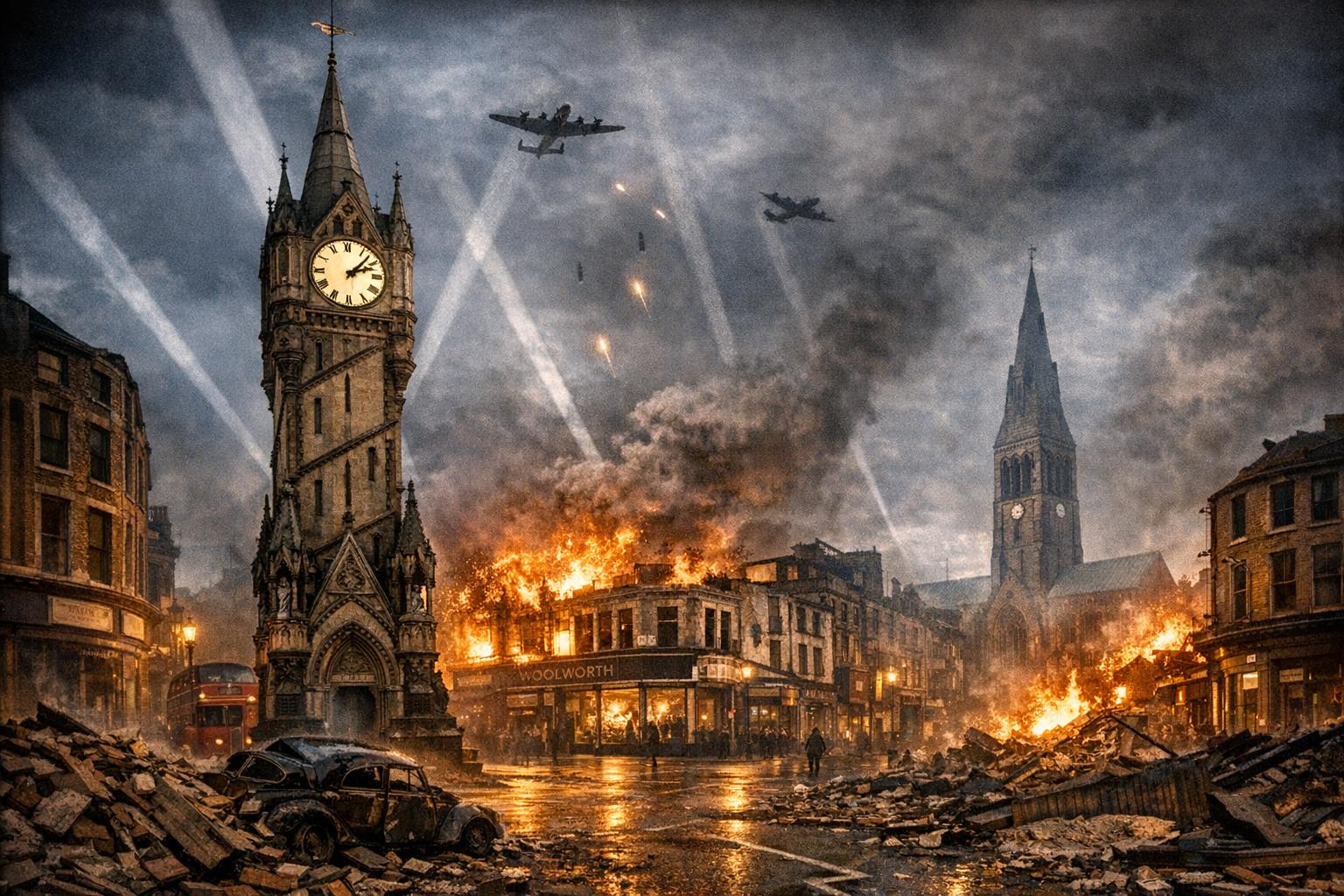
Leicester entered the Second War as a major industrial city with a population of roughly 240,000. Its factories produced footwear, textiles, engineering goods, clothing and components needed by the armed forces. Rail links connected the city with Birmingham, London, Derby, Nottingham and the ports. These industrial and transport roles placed Leicester within the range of German bombers, even though it never faced raids on the scale suffered by London, Coventry or Liverpool.
The Leicester Blitz was concentrated in a relatively short period, with the heaviest attack taking place during the night of 19–20 November 1940. More than 100 people died in that raid, hundreds were injured, and many homes and commercial buildings were damaged or destroyed. Later attacks added to the death toll, but November 1940 remained the defining night of Leicester’s wartime experience.
Bombing affected far more than streets and buildings. It changed working hours, family routines, schooling, transport, policing and public health. Residents slept in shelters, covered windows, carried gas masks and learned to recognise the sound of warning sirens. The danger was irregular, which made it hard to treat as either a constant emergency or a normal part of life. Most people carried on with work and domestic duties, but always with the possibility that another alert might interrupt the evening.
Why Leicester Was at Risk of Air Attack
Leicester was not one of Britain’s largest ports or centres of heavy industry, yet it had enough military and economic value to attract German attention. The city’s manufacturing base was broad. Factories that had once concentrated on civilian goods adapted their production to meet wartime orders. Engineering firms made parts, tools and machinery. Clothing businesses supplied uniforms and other items, while footwear manufacturers produced boots for military personnel.
The city also sat close to major rail routes. Trains carried troops, raw materials, factory output and food through the Midlands. Damage to a junction, depot or line could delay movement well beyond Leicester itself. Railway targets were difficult to hit accurately at night, however, and bombs intended for transport sites often landed in residential areas.
Geography also mattered. Leicester lay within reach of bombers operating from bases in occupied Europe. German aircraft could cross the east coast and approach the Midlands by following radio beams, rivers, railway lines or visible fires. Night navigation remained imprecise, particularly during poor weather. Even when crews had a planned target, cloud, smoke, anti-aircraft fire and human error could scatter bombs across a wide area.
Leicester’s proximity to Coventry affected its wartime risk as well. Coventry was attacked heavily because of its aircraft and engineering industries. Bombers heading there, returning from raids or struggling to locate their assigned target might release bombs over other Midlands towns. Some attacks on Leicester were deliberate; other incidents may have resulted from navigational mistakes or aircraft unloading before the return flight.
Preparing the City for War
Long before the heaviest raid, Leicester City Council, the police, fire services, hospitals and civil defence organisations had prepared for air attack. Their plans covered blackouts, public shelters, casualty treatment, rescue work, emergency water supplies and the removal of rubble. No plan could predict where bombs would fall, but preparation reduced confusion once raids began.
The Blackout
The blackout required households, shops and factories to prevent light escaping after dark. Heavy curtains, shutters and improvised coverings were used over windows. Street lamps were switched off or fitted with covers, while vehicle headlights were reduced to narrow slits.
The policy aimed to make towns harder to identify from the air. It also created everyday hazards. Pedestrians struggled to see kerbs and obstacles. Road accidents increased, and people sometimes walked into posts, walls or one another. Air raid wardens patrolled neighbourhoods and warned residents if light could be seen from outside. A careless gap in a curtain might bring a sharp knock at the door.
Factories faced a harder task because large buildings often operated through the night. Roof lights, loading bays and furnaces had to be screened. Managers needed to maintain production without giving aircraft an obvious point of reference. Blackout inspections became part of ordinary industrial management.
Air Raid Shelters
Leicester residents used several types of shelter. Public shelters were installed in basements, reinforced buildings and purpose-built structures. Some households received Anderson shelters, made from curved corrugated steel sheets and partly buried in gardens. Families without suitable outdoor space could use Morrison shelters, steel-framed cages designed for installation inside a room.
Not everyone trusted the shelters. Anderson shelters could be cold, damp and uncomfortable, especially during winter. Water entered poorly drained sites, bedding became clammy, and families had little privacy. Indoor shelters felt more convenient, but some residents doubted whether they could withstand a direct hit. A direct hit was unlikely, though that fact offered small comfort during a night of nearby explosions.
Communal shelters presented other problems. Crowding, poor ventilation and sanitation required close supervision. Shelter marshals tried to maintain order and help children, older residents and people with disabilities. Families brought blankets, flasks, cards and small items of food. Some stayed for hours; others went home once the immediate danger appeared to have passed.
Air Raid Precautions and Civil Defence
Air Raid Precautions personnel, commonly known as ARP wardens, formed the local link between official policy and residents. They checked blackout compliance, reported bomb damage, directed people to shelters and recorded unexploded devices. During raids they had to move through dark streets while bombs were falling, often with very little knowledge of conditions a few roads away.
Rescue parties searched damaged houses and removed trapped occupants. First-aid posts treated minor injuries before sending serious cases to hospital. Stretcher bearers, ambulance crews, police officers, utility workers and council staff worked alongside them. Many were volunteers who had completed training in the months before large raids began.
The Auxiliary Fire Service supported Leicester’s established fire brigades. Incendiary bombs created a demanding form of work because a large number could fall in a short period. Small fires had to be put out before they spread through roofs, warehouses or closely packed terraces. Factory fire-watchers and householders were encouraged to deal with an incendiary device when it was safe to do so, usually with sand, a scoop or approved firefighting equipment.
The Early Air Raids
Leicester experienced warnings and isolated bombing before the main raid of November 1940. Early incidents tested the city’s procedures and showed residents that the threat was real. The first alerts did not always lead to bombs falling nearby, which could produce a dangerous degree of complacency. After repeated alarms, some people preferred to remain in bed rather than move to a shelter.
Raid warnings followed a familiar pattern. Sirens sounded when hostile aircraft approached the area. Wardens directed residents indoors, traffic stopped or moved under strict controls, and emergency teams reported to their posts. The all-clear sounded once the authorities believed the immediate danger had passed.
Alerts could last for hours. Factory shifts were disrupted, entertainment venues had to manage audiences, and families lost sleep. The physical effect of repeated interruption soon became apparent. Workers still had to report for duty the next morning, even after spending much of the night in a shelter.
Bombing accuracy varied. High-explosive bombs could destroy buildings, rupture gas mains and leave large craters. Incendiaries were smaller and designed to start fires. Parachute mines, originally developed for use at sea, caused severe blast damage when dropped over built-up areas. Unexploded bombs posed a continuing threat after aircraft had gone, leading to road closures and evacuations while bomb disposal teams worked.
The Raid of 19–20 November 1940
The night of 19 November 1940 brought Leicester’s most destructive air raid. German bombers attacked during the evening and continued into the early hours. High-explosive bombs and incendiaries fell across residential and industrial districts, leaving emergency crews to deal with fires, collapsed houses and broken utility lines.
Historical accounts commonly place the number of deaths at 108, though figures may differ slightly according to the dates and categories used by each source. Hundreds more were injured. The scale of loss was severe for a city that had not previously endured an attack of comparable force.
Bombs struck several parts of Leicester rather than one tightly defined target area. Highfields, Spinney Hill and districts east and south of the centre suffered badly. Streets of terraced housing were especially vulnerable to blast and fire. A bomb that hit one property could bring down adjoining walls or trap residents beneath shared roofs and masonry.
The attack damaged homes, factories, shops, places of worship and public buildings. Telephone lines failed, roads became blocked and broken water mains hindered firefighting. Gas leaks created another hazard. Emergency crews had to assess each scene quickly, deciding whether to search for survivors, contain a fire, close the road or isolate damaged services.
Conditions During the Raid
For people inside shelters, the raid was mainly experienced through sound and vibration. Aircraft engines passed overhead, anti-aircraft guns fired, and explosions shook doors and walls. Dust entered basements as nearby buildings were hit. The delay between hearing a bomb fall and feeling the explosion could seem much longer than it really was.
Residents outside formal shelters often took cover beneath stairs, under strong tables or in ground-floor rooms away from windows. Flying glass caused many injuries, so people were advised to keep curtains closed and stay clear of exposed panes. Blast could remove roofs, doors and ceilings without bringing down the entire structure.
Accounts from survivors often mention uncertainty rather than clear knowledge of events. A family might know that a bomb had fallen nearby but have no idea whether relatives in another district were safe. Telephone disruption and blocked streets meant that reliable news travelled slowly. Rumour filled the gap, sometimes exaggerating damage and sometimes understating it.
Rescue and Emergency Work
Once a building had collapsed, rescue teams worked carefully through timber, brick and plaster. Heavy machinery was not always available, and careless movement could cause further collapse. Teams listened for voices, tapped on pipes and removed debris by hand. The work was slow, physical and dangerous.
Doctors and nurses treated blast injuries, burns, fractures and cuts. Leicester Royal Infirmary and other medical sites had prepared for mass casualties, but a large influx placed pressure on staff and supplies. Patients had to be identified, stabilised and assigned treatment according to need. Temporary treatment areas helped hospitals manage the flow.
Firefighters faced incidents across the city at the same time. Control rooms sent crews where the risk to life and property appeared greatest, though reports could be incomplete. Water pressure sometimes fell after mains were damaged. Static water tanks and emergency supplies provided an alternative, but moving hoses through rubble remained difficult.
Local residents also helped. They carried injured neighbours, offered spare rooms, prepared tea and brought blankets to rest centres. Such work rarely appeared in formal reports, yet it kept emergency arrangements functioning. A council could organise a rest centre; it still relied on people to staff kitchens, clean rooms and comfort frightened children.
Damage to Homes and Neighbourhoods
The human cost of the Leicester Blitz was closely tied to housing. Many residents lived in terraces built near factories and main roads. These streets supported close social ties, but their construction made them vulnerable to blast passing from one property to the next.
A house did not need to receive a direct hit to become uninhabitable. Roof damage allowed rain inside, windows were blown out, chimneys became unstable and internal walls cracked. Gas, electricity and water supplies might be cut for safety. Surveyors inspected damaged properties and marked those that required demolition or repair.
People who lost their homes were directed to rest centres, where they could receive food, bedding and advice. Some moved in with relatives or friends. Others were placed in temporary accommodation. Families could become separated during the process, especially if an injured person had been taken to hospital without relatives knowing which one.
Personal possessions presented a practical and emotional problem. Residents often returned to damaged houses to recover clothing, identity documents, ration books, photographs and money. Authorities restricted entry where walls were unstable or unexploded bombs were suspected. From an official point of view, the rule was sensible; from the resident’s point of view, everything they still owned might be inside.
Repairs competed with wartime shortages. Timber, glass, tiles and skilled labour were all required for military production and government projects. Emergency work focused on making homes weatherproof and safe rather than restoring them to their pre-war condition. Boarded windows, patched roofs and temporary walls remained common sights long after a raid.
Factories, Employment and Wartime Production
Leicester’s factories had to maintain output despite bombing, blackout restrictions and staff shortages. Production mattered to the war effort, and managers were expected to restart work as soon as conditions allowed. A damaged factory might resume in one section while repairs continued in another.
Industrial sites organised fire-watching teams, first-aid groups and internal ARP units. Workers learned evacuation routes and procedures for shutting down machinery. Some factories built shelters within or beside their premises. Others moved valuable equipment, records or stores to less exposed sites.
Women filled a growing share of industrial roles as men entered military service. Many combined shift work with domestic responsibilities and civil defence duties. Night raids made this routine harder. A worker might spend several hours in a shelter, prepare children for school or evacuation, and then begin a factory shift with very little rest.
Absence from work after a raid did not always indicate injury. Employees might be searching for relatives, arranging accommodation or dealing with damage at home. Employers and government offices had to distinguish between unavoidable disruption and avoidable absence, not always with much tact.
Bomb damage to transport created wider delays. Workers depended on buses, bicycles and rail services, while factories needed coal and raw materials. Debris blocking a road or damage to a railway line could interrupt several businesses at once. Repairs were often completed quickly, though temporary arrangements might remain in place for weeks.
Children, Schools and Evacuation
Children experienced the Blitz through evacuation, disrupted schooling and long nights in shelters. Government evacuation schemes moved many pupils from cities to rural districts at the start of the war. Some Leicester families took part willingly, while others kept children at home or brought them back after the expected heavy bombing failed to begin at once.
Evacuation could protect children from air raids, but it introduced other strains. Young evacuees lived with host families they had never met, sometimes far from parents and siblings. Standards of care differed. Many children were treated well; others encountered neglect, class prejudice or simple incompatibility with the household receiving them.
Schools that remained open had to adapt. Buildings could be requisitioned for civil defence work, damaged by bombs or judged unsafe. Lessons ran in shifts where space was scarce. Air raid drills taught pupils how to reach shelters quickly and calmly. Teachers carried registers so that children could be accounted for after an alert.
Education often became irregular. Alerts interrupted lessons, transport problems reduced attendance, and staff entered military or wartime service. Yet schools also provided stability. A normal timetable, even a shortened one, gave children a routine beyond sirens, rationing and adult conversation about casualties.
Children sometimes treated bomb sites as playgrounds, despite warnings about unstable walls, broken glass and unexploded munitions. Shrapnel became a collectable item. This behaviour worried police and parents, but it was not hard to explain. Ruined buildings were unusual, accessible and, to a child, rather more interesting than another warning poster.
Rationing and Daily Life During the Blitz
Air raids took place within a wider system of wartime controls. Food rationing, clothing restrictions and fuel shortages affected every household. Leicester residents had to combine civil defence routines with queues, ration books and careful household budgeting.
Bombing could interrupt local distribution. A damaged shop, warehouse or road reduced access to supplies in one district even when the city still had adequate stock elsewhere. Shopkeepers boarded windows, cleared debris and reopened where possible. Customers learned to accept substitutions and smaller selections.
Government campaigns encouraged people to reduce waste, repair clothing and grow vegetables. Gardens and allotments produced potatoes, cabbages and other crops. Anderson shelters took up valuable garden space, which sometimes led to inventive planting around the structure. Nothing went to waste if a row of beans could be fitted beside it.
Restaurants, canteens and communal feeding centres helped residents whose kitchens had been damaged or who were working long shifts. Tea had a practical social role. It provided warmth, a short pause and something familiar during emergency work. Reports from bombing incidents across Britain repeatedly mention tea because someone nearly always found a kettle, even when very little else was functioning.
Information, Censorship and Public Morale
Wartime authorities controlled reports about bombing to prevent useful details reaching Germany. Newspapers could describe raids, casualties and acts of bravery, but they were restricted from publishing material that identified industrial targets or exposed weaknesses in local defence.
This censorship shaped how Leicester residents learned about attacks. Local knowledge was often far more detailed than published reports. People could see which road had been hit or which factory had stopped work, yet the newspaper might refer only to a Midlands town or a district.
Officials also wanted to maintain public morale. Reports emphasised rescue work, continued production and calm behaviour. Such accounts were not necessarily false, but they presented a selected view. Panic was less common than later popular stories sometimes suggest; confusion, fear and exhaustion were quite ordinary.
Rumours circulated quickly after major raids. Claims about casualty totals, delayed-action bombs or poisoned water could spread before officials issued a statement. Police and wardens tried to correct false reports, though their own knowledge was sometimes incomplete. Reliable communication remained one of the hardest parts of raid management.
Later Raids and the Continuing Threat
The November raid was Leicester’s worst single night, but it did not end the danger. Further alerts and attacks occurred during the remaining war years. Some caused casualties and property damage; others involved isolated bombs or aircraft passing over the area.
The irregular nature of later raids made vigilance difficult. Long gaps encouraged residents to relax blackout habits or stop using shelters. A renewed attack then forced everyone back into procedures they had hoped were no longer needed.
Unexploded bombs could disrupt an area without a fresh raid. Delayed-action devices were intended to hamper rescue, repair and production. Once one was reported, police established a cordon and evacuated nearby properties. Bomb disposal officers then identified the fuse and attempted to make the device safe. Their work demanded patience because movement, vibration or a damaged mechanism could trigger an explosion.
Anti-aircraft batteries and searchlights around Leicester formed part of the region’s defences. Searchlight crews tried to locate bombers so guns or night fighters could attack them. Success depended on weather, visibility, aircraft height and coordination. The guns also created falling fragments, so residents were warned to remain under cover during alerts even if bombs did not appear to be falling nearby.
Recording the Dead
The casualty figures of the Leicester Blitz represent individual people with occupations, families and addresses. Civilian war-dead records preserve many of those details. Local memorials, cemetery records, newspapers and council documents help identify who died and where the fatal incident occurred.
Some victims died at the scene, while others died later from their injuries. This can account for differences between totals in contemporary reports and later histories. Record-keeping during a raid was difficult because hospitals, mortuaries, police stations and rest centres held separate pieces of the same account.
Deaths often affected several members of one family. A direct hit on a house could kill parents, children and visiting relatives together. Neighbours might die while helping at the site. Such losses changed the social structure of a street, leaving surviving relatives to arrange funerals, care for children and settle housing matters under wartime restrictions.
Public funerals were constrained by practical conditions. Transport, materials and staff were scarce, and families could not always arrange the service they would have chosen in peacetime. Religious groups and local authorities worked to provide dignified burial while managing a sudden rise in deaths.
Rebuilding Leicester
Immediate repair began while the war was still in progress, but full redevelopment took much longer. Dangerous ruins were cleared, roads reopened and utilities restored. Some buildings could be repaired; others remained vacant until demolition became possible.
Post-war planners faced a city with existing housing shortages and new bomb damage. Temporary prefabricated homes offered one response. These houses could be erected faster than traditional brick properties and included modern facilities that many older terraces lacked. They were intended for short-term use, though some remained occupied far longer than planned.
Bomb sites also gave planners opportunities to alter roads, rebuild commercial premises and replace older housing. Not every scheme was carried out, and later redevelopment sometimes removed buildings that had survived the raids. As a result, the modern street plan reflects wartime destruction, post-war policy and later economic change rather than bombing alone.
Physical evidence of the Blitz can be hard to identify without records. A newer building between older terraces may mark a bomb site, but it may equally result from later demolition. Maps, photographs and damage reports are needed before drawing firm claims from the present appearance of a street.
How Leicester Remembers the Blitz
Leicester’s wartime history survives through memorials, museum collections, oral testimony, photographs and official records. Each source has strengths and weaknesses. Government files record dates, locations and administrative decisions, while personal accounts show how events felt to those who experienced them.
Oral histories require careful use. Memories recorded decades later may merge separate raids or place events in the wrong order. Even so, they preserve details that formal documents often omit: the smell of dust, the condition of a shelter, the behaviour of neighbours or the difficulty of finding family members after an attack.
Newspaper reports provide another valuable source, though censorship affected what could be printed at the time. Reports written soon after a raid may contain errors caused by incomplete casualty lists. Later anniversary articles often add witness testimony, but they can repeat mistakes from earlier publications.
Photographs need context as well. An image of a damaged street may have lost its original caption or been labelled incorrectly during later copying. Comparing architecture, street signs, directories and bomb maps can help confirm a location. Historical research is often less glamorous than the finished account suggests; a fair amount of it involves checking addresses and wondering whether someone misread a handwritten number.
Local Archives and Family Research
People researching relatives who lived in Leicester during the Blitz can begin with civil registration records, electoral registers, census material and wartime casualty databases. Cemetery registers may identify burial dates and family relationships. Local authority minutes can provide details about damaged streets, rest centres and post-raid repairs.
Family papers may contain letters, ration books, service documents or photographs. A brief note about staying with an aunt after “the bad raid” can become more useful when compared with an address and the damage records for November 1940.
Researchers should allow for spelling errors, changed street numbers and informal names. A person may appear under a married name in one record and a birth name in another. Children staying with relatives might be recorded at an address different from their usual home.
Leicester’s Place in Britain’s Bombing War
Leicester’s experience sits between two common accounts of the Blitz. It was not destroyed on the scale of Coventry, nor was it untouched because it lay inland. The city suffered a concentrated major raid, smaller later attacks and years of disruption caused by alerts, defence measures and wartime production.
This position helps explain why Leicester’s Blitz can receive less national attention than attacks on London, Birmingham, Plymouth or Liverpool. National histories often focus on cities with the highest casualty totals or the most sustained bombing. Local history gives a fuller account by showing how one severe night affected neighbourhoods for decades.
The bombing also shows the close relationship between the home front and military operations. Factory output, railway traffic, civil defence and household routines formed parts of the same war effort. Civilians were not distant observers. Their work and homes stood within the operational reach of enemy aircraft.
Leicester continued functioning after the raid of 19–20 November, but continuation did not mean that the damage was minor or easily absorbed. Production resumed because workers, emergency personnel and residents carried out difficult tasks under pressure. Families adapted because they had little alternative. The city’s response was practical rather than theatrical: rescue the trapped, put out fires, find beds for those without homes and reopen workplaces where it was safe.
The Leicester Blitz is best remembered through that combination of loss and routine. More than 100 deaths in one night represented a major civic disaster. At the same time, buses ran again, shops reopened, children returned to lessons and factories restarted. The traces remain in records, memorials, family histories and parts of the built city, even where later development has covered the visible scars.