Local War History
Leicestershire During the Second World War
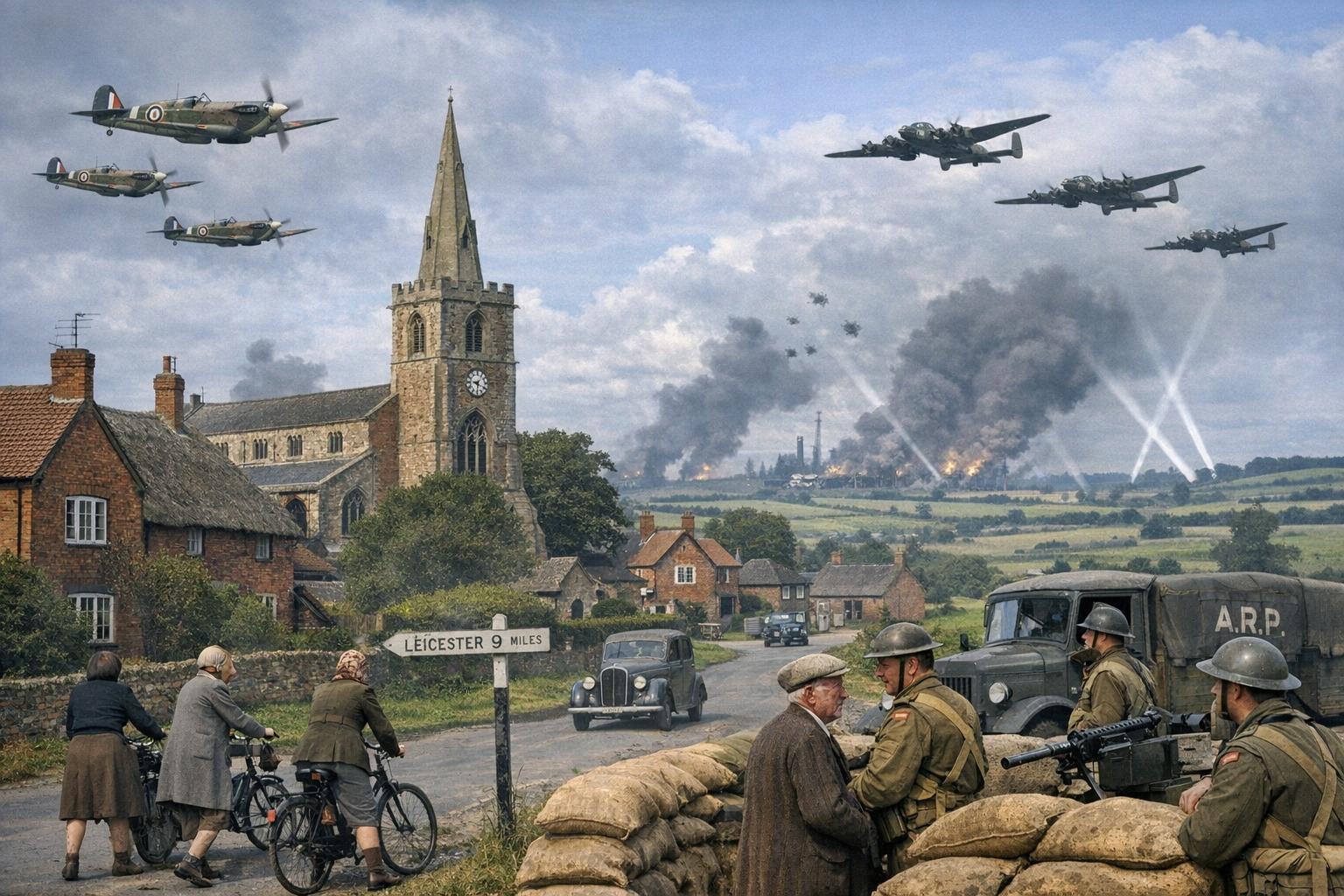
When war began in September 1939, Leicestershire combined a densely populated industrial centre with market towns, mining communities and a broad agricultural hinterland. Leicester was known for hosiery, knitwear, footwear and engineering. Loughborough, Hinckley, Coalville, Market Harborough and Melton Mowbray supported manufacturing, mining, food production and local trade. Across the county, farms and estates supplied food while providing land for airfields, military camps and training grounds.
Leicestershire was not a leading centre of shipbuilding or heavy weapons manufacture. Its value came from a broad industrial base, skilled labour, central location and good rail connections. Local factories supplied clothing, boots, machine tools, optical equipment and engineering components. Mines produced coal, farms raised output, and railway workers kept freight and military traffic moving. Residents also served in the armed forces, civil defence, the Home Guard and voluntary organisations.
The county escaped the sustained bombing suffered by London, Coventry and several major ports, but it did not pass through the 1939–45 conflict untouched. Leicester experienced destructive air raids, families spent nights in shelters, and rural districts received evacuees. Rationing, conscription, blackout rules and wartime production controls reached into homes and workplaces. By 1945, daily life across Leicestershire had changed in ways that lasted long after the fighting stopped.
Leicestershire at the Outbreak of War
At the start of hostilities, Leicester had a population of roughly a quarter of a million people. Much of the city consisted of tightly packed terraced housing built near nineteenth-century factories. Workers often lived within walking or cycling distance of hosiery mills, footwear plants, engineering works and railway yards. This close relationship between housing and industry shaped the city’s experience of air raids, factory shifts and civil-defence planning.
Hosiery and footwear remained central to Leicester’s economy. Large firms operated alongside small workshops, family businesses and subcontractors. Factories produced stockings, underwear, knitted garments, boots and shoes for domestic and overseas markets. Engineering companies made machine tools, lenses, electrical goods, production machinery and precision parts. Other local trades included printing, food processing, brush manufacture, furniture and clothing.
The county’s towns had their own economic character. Hinckley had a strong hosiery trade, while Loughborough combined engineering, textiles and technical education. Coalville stood at the centre of the north-west Leicestershire coalfield. Melton Mowbray acted as an agricultural and food-processing centre, and Market Harborough served farms and villages in the south-east of the county. Wartime direction brought these places into a closely controlled national production system.
Government planning affected industry almost at once. Manufacturers faced controls over raw materials, prices, labour and factory space. Firms that had relied on imported wool, cotton, leather, rubber, metals or dyes had to work with smaller allocations and approved substitutes. Civilian production continued, but military orders and essential domestic needs took priority.
Leicester’s central position aided the movement of goods. Rail lines connected the city with London, Birmingham, Nottingham, Derby and northern industrial districts. Trains carried coal, food, machinery, troops and mail, often under blackout conditions. Passenger services became crowded, and delays were common as military freight received priority. Road transport also came under pressure from petrol rationing, tyre shortages and the movement of military convoys.
Factories and Wartime Production
War production in Leicestershire often involved ordinary factories making different goods rather than vast new armament plants. A hosiery mill could turn from fashionable garments to standard military clothing. A footwear factory could concentrate on service boots. Engineering firms could use their existing machines and skilled employees to produce gauges, tools and parts for aircraft or vehicles.
This conversion was rarely simple. Military contracts required standard measurements, regular inspections and strict delivery dates. Factory managers had to reorganise production lines, train workers and record the use of controlled materials. Smaller firms sometimes worked as subcontractors for larger manufacturers, producing one component rather than a finished item.
| Local sector | Main wartime role | Common pressures |
|---|---|---|
| Hosiery and knitwear | Uniform garments, socks, underwear and protective clothing | Yarn controls, labour shortages and standardised contracts |
| Footwear | Army boots and practical civilian shoes | Leather rationing, repairs and substitute materials |
| Engineering | Machine tools, instruments, vehicle parts and aircraft components | Skilled-labour demand, long shifts and metal controls |
| Coal mining | Fuel for railways, factories, power generation and homes | Production targets, safety risks and workforce retention |
| Agriculture | Milk, grain, potatoes, meat and vegetables | Labour shortages, fuel controls and machinery repairs |
Hosiery, Knitwear and Military Clothing
Leicester’s textile workforce gave the city a clear role in clothing supply. Service personnel required socks, underwear, jerseys, gloves and other knitted garments in very large quantities. Hospitals, civil-defence units and factory workers also needed practical clothing. Standardisation mattered more than fashion, so manufacturers worked to official patterns and material allowances.
Wool and cotton supplies depended partly on overseas shipping. German submarine attacks made every imported cargo harder to replace. Manufacturers had to reduce waste, reuse offcuts and accept yarns that differed from pre-war grades. Silk became scarce because it had military uses, including parachute production, while artificial fibres took a larger place in civilian garments.
Clothing rationing began in June 1941. Consumers exchanged coupons as well as money for garments, and manufacturers followed rules intended to save cloth and labour. The Utility Clothing Scheme promoted economical designs with fewer pockets, pleats and decorative features. Leicester’s clothing firms had to balance military orders with the need to provide hard-wearing civilian garments. A coat still had to keep the rain out, even if fashion had been shown the door.
Women already formed a large share of the hosiery workforce. Wartime demand increased their responsibility for machine operation, inspection, packing and supervisory work. Some moved into jobs formerly carried out by men, though established pay differences often remained. Factory employment also had to fit around shopping queues, childcare and household work, creating long and tiring days.
Footwear Production
Leicester’s boot and shoe factories supplied military and civilian needs. Army boots had to withstand prolonged use, poor weather and rough ground. Contracts required consistent sizing, stitching and sole construction. Inspectors could reject batches that failed official standards, so quality control became a daily production concern.
Leather was tightly controlled. Imports were vulnerable to shipping losses, while military demand absorbed much of the best material. Civilian shoes became plainer, and repair took priority over replacement. Cobblers remained busy fitting new soles and heels to footwear that might previously have been discarded.
Manufacturers also used rubber and composition materials where permitted. Wartime shoes were practical rather than decorative, and styles reflected government restrictions. The footwear industry retained many jobs, but factories faced rising targets, machine maintenance problems and shortages of experienced workers.
Engineering and Precision Manufacturing
Leicester and Loughborough had a well-established engineering base before 1939. Local firms made machine tools, production machinery, optical equipment and precision instruments. These skills transferred readily to military contracts. A company did not need to build a complete aircraft to support aviation; accurate bearings, gauges, lenses and metal fittings were just as necessary.
Machine tools deserved particular attention because almost every armament factory relied on them. Lathes, grinders and cutting machines allowed other manufacturers to shape metal accurately and in high volume. Firms producing such equipment supported factories far beyond the county. Precision optical work also aided surveying, range finding, photography and aircraft maintenance.
War contracts pushed factories towards shift work, including nights and weekends. Blackout rules made travel to and from late shifts harder. Workers cycled along dark streets, waited for crowded buses or walked home after sirens had sounded. Fatigue became a safety concern, particularly around heavy machinery.
Factory canteens and workplace medical services took on a larger role. Canteens offered meals to staff who could not return home between shifts, while nurses and first-aid workers dealt with injuries and illness. Some larger plants maintained fire-watching teams on roofs and in yards. Incendiary bombs could start major fires if nobody dealt with them promptly.
Coal Mining in North-West Leicestershire
The coalfield around Coalville supplied fuel for factories, railways, electricity generation and domestic heating. Coal remained one of Britain’s basic wartime resources. Steam locomotives depended on it, as did industrial boilers and many household fires. A shortage could slow production across several sectors at once.
Miners were classed as workers in a reserved occupation. Many could not leave the pits to enlist because the government needed them underground. This policy sometimes caused frustration among men who wished to join the services. It also showed how industrial labour could count as national service without a uniform.
Mining remained dangerous and physically demanding. Wartime targets did not remove the normal hazards of roof falls, machinery accidents, gas and dust. Equipment and replacement parts could be hard to obtain, while experienced employees were ageing or moving into supervisory roles. Families in mining settlements lived with the pressure of production targets and the risk of injury.
Coal moved largely by rail. Sidings, signal boxes and marshalling facilities had to remain open through bad weather, blackout conditions and staff shortages. Railway employees worked irregular hours as military traffic competed with industrial freight and passenger services. The link between pit, railway and factory was direct: if one section slowed, the effects soon spread.
Military Airfields and Flying Training
Leicestershire’s inland location and broad areas of relatively level farmland made it suitable for military aviation. During the war, new airfields appeared and existing flying grounds gained fresh duties. Concrete runways, hangars, dispersal areas, accommodation huts and fuel stores changed the appearance of rural districts.
Airfield construction required large amounts of labour and material. Contractors laid roads and runways, installed drainage, raised technical buildings and connected water and electricity supplies. Farms lost fields, hedges and access routes. Some requisitioned land returned to agriculture after 1945, though concrete, perimeter tracks and surviving buildings remained for decades.
RAF Desford
Desford, west of Leicester, had aviation links before the war and became closely associated with flying training. The station supported the preparation of pilots at a time when the Royal Air Force needed a steady supply of trained personnel. Elementary training introduced pupils to aircraft handling, navigation, safety procedures and military routines before they moved to more advanced courses.
The airfield also had ties to aircraft maintenance and repair. Ground crews, instructors, mechanics, clerks and transport workers formed a large support body around each group of trainee pilots. Nearby villages saw more buses, lorries and service personnel. Local shops and accommodation providers felt the effect as well.
RAF Wymeswold
RAF Wymeswold opened during the war near Loughborough. Its concrete runways allowed heavier aircraft to operate, and the station became associated with operational training. Such units prepared aircrew who had already completed earlier stages of instruction. Crews practised navigation, bombing procedures, wireless operation and coordinated flying before assignment to active squadrons.
Training carried a high risk. Pupils flew at night, in poor weather and with aircraft that demanded close teamwork. Mechanical failure, navigation errors and misjudged landings could prove fatal. Accidents near training stations formed a recurring part of wartime aviation, though they received less public attention than combat losses.
Husbands Bosworth and Other Stations
RAF Husbands Bosworth formed part of the Midlands training network. Its arrival brought accommodation sites, technical buildings and regular aircraft movements to a rural area south of Leicester. Market Harborough, Bruntingthorpe and Bottesford also had wartime aviation roles, adding to the county’s place in aircrew preparation and aircraft support.
Air stations depended on civilian networks. Bakers supplied bread, farms supplied milk, railway depots received equipment, and local garages supported road transport. Women worked as clerks, cooks, drivers and communications staff, while members of the Women’s Auxiliary Air Force served at stations in many operational and administrative posts.
Residents became accustomed to the sound of engines during both day and night. Aircraft might circle while waiting to land, and convoys could slow narrow country roads. The military presence brought employment and trade, but it also placed pressure on housing, transport and public services.
Bombing and the Leicester Blitz
Leicestershire suffered less bombing than major manufacturing cities such as Coventry and Birmingham, yet Leicester’s factories and railway facilities made it a target. German crews also crossed the county while travelling to targets elsewhere. Bombs could fall because of planned attacks, navigation errors or aircraft releasing their loads before returning to occupied Europe.
Leicester’s most destructive raid took place on the night of 19 November 1940. High-explosive and incendiary bombs struck residential and industrial districts, killing more than 100 people and damaging many homes. Rescue teams searched ruined buildings, firefighters tackled blazes, and hospitals treated casualties. For those living nearby, the distinction between a major industrial target and an ordinary terrace offered little comfort.
Other raids and isolated bombing incidents occurred during the war. Railway lines, factories and densely built neighbourhoods remained at risk. Rural districts could also be hit, sometimes with little warning. Unexploded bombs required evacuation and disposal work, and damaged utilities had to be repaired before homes or businesses could operate normally.
Air raids disrupted production even when bombs missed their targets. Sirens stopped machinery, sent workers to shelters and delayed trains. After the all-clear, supervisors had to restart production while checking for fires or damage. Repeated alerts reduced sleep and added to fatigue among people already working long hours.
Air-Raid Precautions and Civil Defence
Preparations for aerial attack began before September 1939. Leicester Corporation and county authorities recruited wardens, first-aid workers, rescue parties, ambulance crews and auxiliary firefighters. Volunteers attended lectures and exercises covering gas attacks, incendiary bombs, building collapse and casualty care.
Air-raid wardens formed the most visible part of this system. They checked blackout compliance, directed residents to shelter and reported damage after raids. Wardens needed detailed knowledge of their streets, including the location of vulnerable residents, water supplies and emergency equipment. Their work could attract complaints during quiet periods, especially when householders were told that a thin line of light was showing around a curtain.
Shelters and Household Protection
Families with suitable gardens could receive Anderson shelters made from corrugated steel. Owners partly buried them and covered them with soil. Dampness was common, and some residents preferred to stay indoors unless a raid seemed close. Morrison shelters, introduced later, provided a steel-framed refuge inside the home and could double as a table.
Public shelters appeared in streets, parks, factories and other shared spaces. Large workplaces developed their own arrangements so that production staff could reach cover quickly. Schools practised air-raid drills, with children walking in lines to protected areas while carrying gas masks.
Protection varied according to housing type, family income and available space. Cellars offered shelter in some properties but were absent from many Leicester terraces. Residents sometimes slept downstairs to avoid broken glass and falling roof material. Others spent long alerts in communal shelters with neighbours, blankets and flasks of tea.
The Blackout
Blackout regulations required homes, shops and factories to prevent light from escaping after dark. Street lamps were turned off or dimmed, vehicle headlights were shielded and railway stations reduced visible lighting. The aim was to make urban areas harder to identify from the air.
The blackout also caused road accidents and falls. Pedestrians struggled to see kerbs, cyclists collided, and drivers had little warning of obstacles. Police and wardens enforced the rules because even small patches of light could attract attention from above. Shops sold blackout cloth, while households improvised with heavy curtains, cardboard and paint.
Fire Watching and Rescue Work
Incendiary bombs posed a grave threat to factories, warehouses and closely packed housing. Fire watchers remained on duty overnight at many premises. Small incendiaries could sometimes be controlled with sand or suitable equipment before flames reached roofs and stored materials.
Rescue teams trained to remove rubble, shore up damaged walls and release trapped residents. This work demanded physical strength but also caution, since unstable masonry could collapse without warning. First-aid posts treated minor injuries and prepared serious casualties for hospital. Rest centres supplied food, bedding and temporary accommodation to people whose homes were unsafe.
Evacuation and Population Movement
Evacuation altered the population of Leicestershire from the opening days of the war. Government plans moved schoolchildren, teachers, pregnant women and some disabled people away from districts judged likely to face heavy bombing. Rural areas and smaller towns received groups from larger cities, while some Leicester children were sent to safer districts.
Children often arrived at railway stations carrying labels, gas-mask boxes and small cases. Billeting officers then placed them with local households. Brothers and sisters could be separated when no household had room for several children. Hosts received an allowance, but payment did not remove the practical strain of feeding, washing and caring for an extra person.
The results differed greatly. Some evacuees settled well and formed lasting relationships with host families. Others felt isolated by unfamiliar accents, routines and food. Children from urban districts could be surprised by outdoor toilets, farm animals or long walks to school. Rural hosts, in turn, sometimes encountered poverty and health problems that had been less visible in city neighbourhoods.
Schools adopted shared timetables where buildings could not hold both local pupils and evacuees. One group might attend in the morning and another in the afternoon. Teachers dealt with mixed ages, missing records and pupils who moved again after a few months. School halls were also used for feeding, welfare work or civil-defence training.
Evacuation did not follow a straight course. Some parents brought children home during quiet periods, then sent them away again when raids increased. Others refused evacuation from the start. Family separation caused practical and personal difficulties, though letters and occasional visits helped maintain contact.
Leicestershire also received service families, workers transferred to local factories and refugees from occupied or threatened parts of Europe. Military personnel moved through camps and air stations. Such movement increased demand for rooms, transport and medical care at a time when civilian building had largely stopped.
Rationing and Everyday Household Life
Food rationing began in January 1940. Each person received a ration book and registered with selected retailers. Bacon, butter and sugar were among the early controlled goods, followed by meat, tea and other products. Bread and potatoes were generally available during most of the war, though choice and quality varied.
Rationing aimed to distribute scarce supplies fairly, but shopping still required patience. Deliveries did not always match demand, and a ration entitlement did not guarantee that a preferred item would be on the shelf. Queues formed when rumours spread about fish, fruit or household goods. Shopkeepers spent much of their time counting coupons and explaining rules.
The points system covered foods such as tinned goods, dried fruit and cereals. Consumers chose how to spend their allowance according to what shops had in stock. Milk and eggs were directed towards children, pregnant women and people with medical needs. Dried egg powder became a common substitute for fresh eggs.
Households stretched meat through stews, pies and vegetable dishes. Leftovers were reused, dripping was saved and stale bread found a second life in puddings. Wartime cookery advice promoted seasonal produce and economical preparation. Not every recipe was a triumph, but waste became socially unacceptable.
Soap, fuel and clothing were also controlled. Coal shortages affected heating, particularly during cold winters. Families closed unused rooms and shared living spaces to save fuel. Clothing coupons encouraged repair, alteration and the reuse of children’s garments. Women remade adult clothing for younger family members, while worn woollens could be unravelled and knitted again.
Farming and Food Production
Before 1939, Britain depended heavily on imported food. Attacks on merchant shipping made greater domestic production necessary. Leicestershire’s mixed farms were well placed to supply milk, grain, potatoes, meat and vegetables, though expansion required more labour and machinery.
County War Agricultural Executive Committees directed local farming policy. They assessed land use, encouraged the ploughing of grassland and could press farmers to improve poorly used fields. Permanent pasture was converted to arable production where soil and drainage allowed. Wheat, barley, oats and potatoes occupied land that had previously supported grazing animals.
Changing land use involved trade-offs. Ploughing pasture increased cereal production but reduced grazing. Farmers had to balance livestock numbers against the need for grain and potatoes. Fertiliser, animal feed, fuel and replacement machinery remained controlled, so higher targets did not always come with better resources.
The Women’s Land Army
Members of the Women’s Land Army worked on farms across Leicestershire. Many came from towns and had little agricultural experience before recruitment. Training covered milking, animal care, tractor work, planting and harvesting. Placements varied from large estates to family-run dairy farms.
Land Army work involved early starts, outdoor labour and basic accommodation. Milking did not wait for better weather, and harvest schedules followed the crop rather than the clock. Some women lodged with farming families; others lived in hostels and travelled to different holdings.
Their contribution eased the loss of male workers to military service and industry. Women also worked in forestry, horticulture and pest control. Though wartime publicity often presented cheerful rural scenes, the work itself was repetitive, muddy and physically demanding.
Prisoners of War and Seasonal Labour
Prisoners of war formed another source of agricultural labour. Men held in camps could be assigned to farms under regulated arrangements. They harvested crops, cleared land and carried out routine maintenance. Security rules governed transport and contact with civilians, though daily working relationships sometimes became less formal as the war progressed.
Schoolchildren, office workers and volunteers also helped during busy periods. Potato lifting and harvest work required many hands for short spans of time. Local campaigns recruited people who could spare weekends or school holidays, reducing crop losses when permanent labour was scarce.
Allotments and Dig for Victory
Allotments expanded across Leicester and the county’s towns. Councils converted unused plots, recreation land and parts of public parks to food production. Gardens grew potatoes, carrots, onions, beans and cabbages. Households with enough space kept hens or rabbits where local rules allowed.
The Dig for Victory campaign promoted practical self-provision rather than complete self-sufficiency. A modest plot could add fresh vegetables to a rationed diet and reduce pressure on commercial transport. Gardeners still faced shortages of seed, fertiliser, timber and tools, and poor weather could ruin months of work.
Women’s Work and Wartime Service
Women worked throughout Leicestershire’s pre-war economy, especially in hosiery, footwear, domestic service, retail and clerical employment. Wartime mobilisation broadened the range of jobs open to them. They entered engineering workshops, transport depots, government offices, hospitals and agricultural work in greater numbers.
Registration for employment and national service brought women under state direction according to age, family circumstances and occupation. Married women with children often faced practical barriers even where nurseries existed. Shift patterns rarely matched school hours, and public transport became unreliable after late factory shifts.
Industrial work could involve drilling, inspection, assembly and machine operation. Women learned tasks previously treated as male trades, though promotion and equal pay remained contentious. Protective clothing and safety procedures were not always designed with female workers in mind. Factory welfare officers dealt with canteen provision, health, attendance and domestic pressures.
Women also joined the Auxiliary Territorial Service, Women’s Royal Naval Service and Women’s Auxiliary Air Force. Their roles included communications, administration, driving, radar operation, maintenance support and work at anti-aircraft sites. Service did not usually mean direct combat, but postings could bring danger from air raids and accidents.
The Women’s Voluntary Service supported evacuation, rest centres, emergency feeding and clothing distribution. Volunteers prepared meals after raids, organised donations and helped families displaced from damaged homes. Much of this labour was unpaid and fitted around employment or family duties.
Children and Young People
Children experienced the war through evacuation, school disruption, rationing and the absence of relatives serving overseas. Gas masks, air-raid drills and identity labels became ordinary objects. Lessons could stop during alerts, and school buildings were sometimes requisitioned for military or welfare use.
Young people joined salvage drives for paper, metal, rubber, bones and rags. Schools competed to collect material for reuse, though public claims about its value sometimes exceeded what could be processed. Pupils also tended gardens, gathered crops and supported fundraising events.
Older teenagers often moved into employment earlier than later generations would expect. Factories, offices and shops needed labour, while apprenticeships continued in engineering and skilled trades. Boys approaching military age knew that call-up might follow soon. Girls faced pressure to combine paid work with domestic responsibilities.
Youth groups such as Scouts, Guides and cadet organisations assisted with messenger duties, first aid, gardening and community work. Their activities offered structure during a period of disrupted schooling and family separation. They also introduced military-style discipline without making children formal members of the armed forces.
The Home Guard and Local Security
The Local Defence Volunteers formed in May 1940 after the German occupation of France and the Low Countries. The force soon became known as the Home Guard. Units appeared in Leicester, market towns, mining districts and villages, drawing members from factories, offices, farms and railway employment.
Volunteers included older former servicemen, men in reserved occupations and younger men awaiting call-up. Early equipment was often basic. Units trained with whatever weapons and uniforms were available, then received more standard equipment as supply improved.
Home Guard duties included guarding factories, bridges, rail facilities, reservoirs and communication sites. Patrols watched roads and open ground for parachutists or saboteurs. Members built defensive positions, studied local routes and took part in invasion exercises. Roadblocks and checkpoints could be raised at short notice.
Factory-based units protected industrial premises while drawing on workers who knew the site well. Rural patrols covered wider areas with fewer people. Farmers and gamekeepers brought useful knowledge of tracks, woods and field boundaries. Training took place after normal working hours, so members could complete a full shift before beginning an overnight duty.
Pillboxes and anti-invasion defences were constructed at selected transport routes and vulnerable points. Some survive in or near Leicestershire, though later development and road building removed many. They provide physical evidence of the fear of invasion that shaped policy in 1940 and 1941.
Transport, Communications and Public Services
Railway workers carried a heavy burden throughout the war. Trains moved troops, evacuees, coal, machinery and agricultural produce. Passenger carriages were crowded, timetables changed and maintenance had to continue despite shortages. Station staff handled unfamiliar traffic while observing blackout and security rules.
Buses became essential for factory shifts and rural travel, but fuel and tyre controls reduced flexibility. Services could be altered to match factory hours or military requirements. Cycling grew more common because it required no petrol, although blackout conditions made night travel hazardous.
Postal and telephone services connected dispersed families and military units. Letters from service personnel often arrived after delays and were subject to censorship. Telegrams carried both welcome news and official notification of death or injury. Telephone use remained less common in private homes, making public call offices and written correspondence valuable.
Hospitals treated civilian casualties, injured workers and military patients. Staff shortages placed pressure on nurses and doctors, while buildings prepared for mass casualties that did not always materialise. Blood donation, first-aid training and ambulance work drew support from volunteers.
Leicestershire Servicemen and Overseas War
Men and women from Leicestershire served in every main theatre of the conflict. The Leicestershire Regiment fought overseas, and county residents also joined other army formations, the Royal Navy, merchant shipping and the Royal Air Force. Territorial units mobilised at the start of the war, taking local friendships and workplace ties into military service.
Families followed campaigns through newspapers, radio broadcasts and letters. Official reporting withheld operational details, and rumours filled the gaps. News of capture, injury or death could take weeks to arrive. Prisoners of war maintained contact through regulated correspondence and Red Cross parcels when conditions permitted.
Local newspapers printed casualty notices, service reports and appeals for funds. Churches, clubs and workplaces maintained rolls of honour. Memorial services marked deaths when bodies could not be returned home. After 1945, names were added to existing memorials or recorded on new plaques in factories, schools and places of worship.
Victory, Demobilisation and the Post-War County
Victory in Europe was marked in May 1945 with public gatherings, flags, church services and street celebrations. The war against Japan continued until August, so many service families still waited for relatives to return. Demobilisation then proceeded in stages rather than all at once.
Returning personnel faced a county short of housing and consumer goods. Wartime building restrictions had halted much private construction, while bombing and overcrowding added pressure in Leicester. Couples who had married during the war often lived with parents or relatives. Prefabricated homes and later council estates formed part of the response.
Factories had to move from military contracts back to civilian production. Footwear, clothing, machinery and household goods were badly needed, but raw materials remained controlled. Rationing continued after 1945 and, for some products, became tighter before it ended. Food rationing did not finish fully until 1954.
Women’s employment patterns changed again as servicemen returned. Some women left wartime jobs voluntarily, while others were expected to give up posts to returning men. Even so, the war had shown that women could perform skilled industrial and service work. That experience influenced later debates about pay, opportunity and workplace rights.
Agriculture retained many wartime changes. Mechanisation increased, field patterns had altered and government involvement in food production remained strong. Some airfield land returned to farming, but other sites gained industrial, storage or aviation uses. Concrete runways proved much harder to remove than temporary huts.
Physical traces of the war survived across Leicestershire in pillboxes, airfield buildings, memorials, shelters and factory extensions. Less visible effects remained in family histories: evacuation memories, military service, bereavement, workplace injury and friendships formed through billeting or service life.
Leicestershire’s wartime contribution rested on accumulated effort rather than one famous battle. Textile workers made service clothing, footwear employees produced boots, engineers supplied machinery and components, miners raised coal and farmers increased food output. Railway staff moved people and freight, air stations trained crews, and civil-defence volunteers protected local communities.
The county did not suffer destruction on the scale seen in Britain’s largest bombed cities, yet the demands of 1939–45 reached almost every household. Work, schooling, food, travel and family life came under wartime control. The resulting changes shaped Leicester and the surrounding county through the post-war years, leaving records and structures that still explain much about modern Leicestershire.