Local War History
Wartime Blackouts in Leicestershire
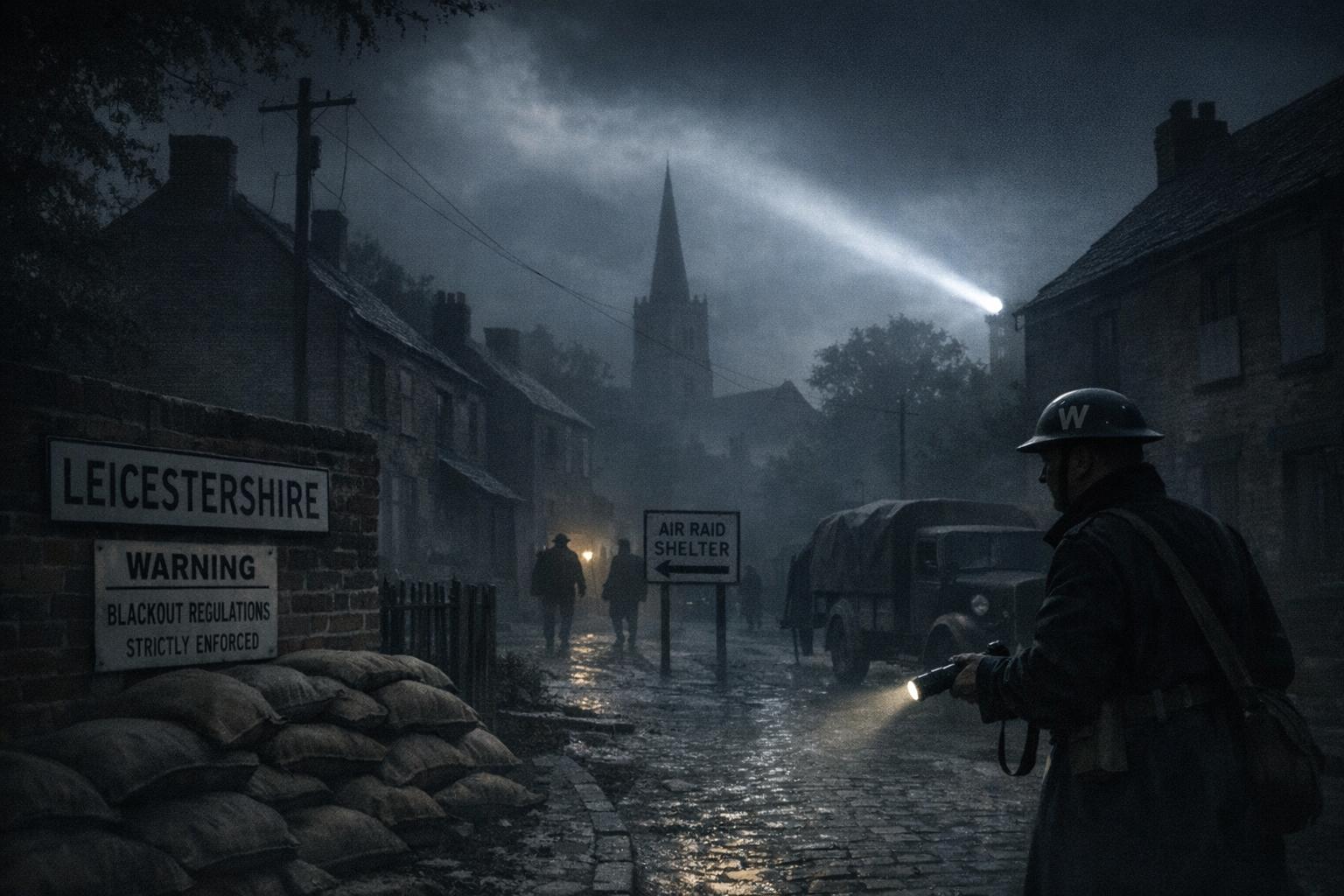
When Britain entered the war in September 1939, Leicestershire came under the same blackout regulations as the rest of the country. After dark, homes, shops, factories, railway stations and public buildings had to prevent visible light from escaping. Street lamps were switched off or heavily screened, vehicle headlights were masked, and residents had to make their windows lightproof. The aim was to make it harder for German aircrews to identify towns, railway routes and industrial districts from above.
The blackout altered the appearance and routine of Leicester and the surrounding county for more than five years. It affected factory workers travelling between shifts, passengers using buses and trains, shopkeepers closing their premises, families managing darkened homes, and air-raid wardens enforcing the rules. Leicestershire did not suffer bombing on the same scale as London, Coventry or Birmingham, but its factories, railways, airfields and urban districts made civil-defence precautions necessary.
Blackout regulations also reached far beyond the larger towns. Villages, farms, isolated workshops and railway crossings had to control their lighting. A farmhouse lamp visible across open fields could attract a warning from an air-raid warden just as readily as an uncovered shop window in central Leicester. The result was a county that became almost completely dark each evening, aside from shielded lamps, dim vehicle lights and the occasional breach that brought a knock at the door.
The introduction of blackout regulations
Preparations for air attack began well before war was declared. During the 1930s, the British government developed Air Raid Precautions, usually shortened to ARP, in response to the growing reach of military aircraft. Earlier wars had shown that civilians could no longer assume distance from a battlefield would protect them. Bombers could cross the coast, follow railways and rivers, and reach inland industrial areas within hours.
Local councils received instructions to organise wardens, first-aid posts, rescue parties, fire services, public shelters and warning systems. Leicester City Council carried much of this work within the city, while borough, urban district and rural district councils handled arrangements elsewhere in the county. Police forces, hospitals, transport operators, utility companies and voluntary organisations also took part.
Recruitment campaigns encouraged residents to volunteer for ARP duties. Training covered subjects such as recognising gas attacks, reporting bomb damage, guiding people to shelters and dealing with incendiary bombs. Blackout enforcement became one of the most visible parts of the programme because it affected every occupied building after sunset.
The national blackout began on the night of 1 September 1939, two days before Britain declared war on Germany. The early start reflected the belief that an air attack might come with little warning. Artificial lighting had to be switched off, concealed or reduced after dark. Illuminated advertisements disappeared, street lamps went out, and householders were told to cover every window through which light might escape.
At first, many residents treated the requirements as a temporary emergency measure. Few could have expected to spend years checking curtains, opening doors cautiously and walking through dark streets. Yet the regulations remained in place through most of the war and became part of ordinary domestic routine.
Why Leicestershire faced a risk of air attack
Leicestershire was inland and lacked the ports, naval bases and very large industrial plants found in some heavily bombed areas. Even so, the county contained several types of site that could attract enemy attention. Leicester was a major manufacturing centre, known for hosiery, footwear, clothing, engineering and machine production. Many firms redirected part or all of their work to military contracts.
Clothing factories made uniforms and other supplies. Engineering companies produced components for aircraft, vehicles, weapons and industrial machinery. Footwear businesses supplied military boots, while firms with metalworking or precision-engineering capacity took on contracts outside their usual peacetime trade. Workers did not always know where the parts they made would be used, and public discussion of factory production was discouraged.
Loughborough had engineering works and major railway connections. Coalville stood within an industrial and mining district, while Hinckley, Market Harborough and Melton Mowbray contained factories, depots and transport facilities. Smaller settlements also housed workshops or storage sites connected with wartime production.
The railway system increased the county’s military value. Leicester had direct connections with London, Nottingham, Derby, Birmingham and Peterborough. Tracks carried troops, fuel, raw materials, food and manufactured goods. Marshalling yards, stations, bridges and junctions could all serve as reference points for aircrews or become targets in their own right.
Airfields added another concern. Wartime flying and training took place at sites including Desford, Bruntingthorpe and Wymeswold. Aircraft factories and maintenance facilities also operated within the county. Lighting near an airfield required careful control because it could reveal the position of runways, hangars or nearby accommodation.
German aircraft did not need to be aiming directly at Leicester for the county to face danger. Crews could lose their route, mistake one town for another or release bombs after failing to reach an intended target. Bombing accuracy at night was often poor. Railway lines, fires and patches of urban lighting could help crews estimate their position, which explains the strict response to even small light leaks.
Making a house lightproof
Householders carried direct responsibility for keeping their properties dark. Normal curtains rarely blocked enough light, particularly if they were pale or thin. Families fitted heavy material, purpose-made blackout cloth, blinds, shutters or improvised coverings. Cardboard, brown paper, blankets and painted boards were commonly used when better materials could not be obtained.
The edges of a window caused many problems. A curtain might cover the glass yet leave a narrow bright line along the top or sides. Residents were advised to enter the garden or street and inspect their homes from outside. This simple check often revealed gaps that were not visible from inside a lit room.
Blackout fabric was usually fixed closely around the window frame. Some families made removable wooden screens, especially for small windows. Others pinned material directly to frames each evening. The latter method worked, though repeated pinning damaged wallpaper and made opening windows inconvenient.
Doors presented another difficulty. Opening a front door could send a broad rectangle of light across the pavement. Many households hung a heavy curtain inside the entrance or placed a screen between the door and the lit part of the house. Residents learned to switch off hall lights before answering the door, a minor routine that soon became automatic.
Airflow was a persistent problem. A tightly covered room could become stuffy, especially during warm weather or when several people were present. Windows could not simply be opened while a lamp was burning. Adjustable screens and double curtains allowed some ventilation, though domestic arrangements varied according to the size and condition of each house.
Families also had to think about skylights, bathroom windows and glass panels above doors. A small pane could be surprisingly visible from outside. Attic rooms required close attention because their windows stood above neighbouring roofs and could be seen from a greater distance.
Managing light inside the home
Blackout did not mean that families had to sit in complete darkness. Indoor lamps could be used after the windows and doors had been properly screened. Even so, many people reduced their lighting to save electricity, fuel or replacement bulbs. A single lamp might serve a room in which several family members read, repaired clothes or completed household work.
Children had to be taught not to pull curtains aside after dark. An innocent attempt to look for an aircraft or check the weather could expose a bright window. In crowded homes, maintaining discipline took some effort. People arriving late from work also had to enter without disturbing carefully arranged coverings.
Domestic life became more enclosed. Once the blackout curtains were drawn, residents could no longer see the street or notice who was approaching the house. Rooms could feel warmer and more confined. The black material also collected dust and required repairs where pins, hooks or daily handling caused tears.
Many households kept a torch near the door in case an air-raid warning sounded. Torches had to be shielded so that their beam pointed downwards. Batteries were not always easy to replace, so families used them sparingly. Candles offered another source of light during power cuts, but they increased the risk of fire and had to remain well away from curtains and paper window coverings.
Factories and wartime production
Factories faced a harder task than most homes. Large windows, loading bays, ventilation openings and shift changes could release a great deal of light. Yet production often continued around the clock. Managers could not solve the problem by closing the building at sunset.
Many industrial premises fitted shutters or covered windows with boards and blackout paint. Where daylight was needed during working hours, removable screens or heavy blinds were used. Entrances were fitted with double doors, internal curtains or angled passages so that workers could enter without exposing the illuminated factory floor.
A basic arrangement used two screened doors with a small lobby between them. One door closed before the other opened. This worked well when staff followed the procedure, but shift changes placed pressure on the system as large groups arrived or departed together. Supervisors sometimes stationed workers at entrances to control movement.
Ventilation remained a serious practical concern. Leicester’s hosiery, footwear and engineering factories could become hot, dusty or crowded. Blocking windows reduced natural airflow, while machinery and electric lighting raised indoor temperatures. Factory management had to combine blackout compliance with safe working conditions, often using roof vents, screened openings or mechanical fans.
Blackout materials also created a fire risk. Cloth, paper and timber screens could burn, especially near industrial processes involving heat or sparks. Fire-watchers inspected premises and stood ready to deal with incendiary bombs. Buckets of sand and water, stirrup pumps and other firefighting equipment became familiar sights.
Workers on evening and night shifts felt the blackout both inside and outside the factory. They spent hours in buildings without visible windows and then emerged into dark streets. Shift ending times could coincide with an air-raid warning, leaving employees to decide whether to remain at work, enter a factory shelter or attempt the journey home.
Shops, offices and places of entertainment
Retail premises lost the illuminated signs and bright window displays that had once marked town centres. Shopkeepers covered display windows, reduced internal lighting and screened entrances. Evening customers could find it difficult to tell whether a business was open. Small signs painted in pale colours sometimes replaced electric advertisements.
Businesses had to purchase cloth, timber, paint and fittings at a time when materials were controlled and labour was scarce. Improvised coverings were common. A screen that worked well in dry weather might warp, tear or come loose after repeated use. Staff had to inspect it regularly rather than assume that an earlier repair remained sound.
Office buildings faced similar requirements, particularly those with several floors and many windows. Cleaners and clerical staff working after dark had to use screened rooms. One uncovered upper-storey window could be visible over a wide area.
Cinemas and theatres continued to provide entertainment, but their entrances and foyers required careful screening. Doors needed arrangements that allowed an audience to leave without sending light into the street. Interior lights were kept low, and staff had procedures for air-raid warnings during performances.
A cinema audience might be told that an alert had sounded and given the choice of staying or leaving, depending on local rules and the immediate circumstances. People who stayed could continue watching unless danger became more direct. Those who left stepped from a dim auditorium into streets where finding a bus stop or bicycle was not always straightforward.
Pubs, restaurants and meeting halls also adapted. Evening social life did not cease, but journeys became slower and closing procedures more involved. Patrons were reminded not to open screened doors carelessly. Publicans and hall managers risked warnings or prosecution if light escaped from their premises.
Darkened streets in Leicester
The removal of street lighting produced one of the most striking wartime changes. Familiar roads became hard to recognise after sunset. Buildings disappeared into darkness, road junctions were difficult to judge, and pedestrians could miss turnings they had used for years.
White paint was applied to kerbs, lamp posts, trees, traffic islands and roadside obstacles. The paint reflected the small amount of available light without creating a strong glow from above. In some places, white bands were placed around posts or gate entrances. Road signs could also receive reflective treatment.
Pedestrians were advised to carry screened torches and wear or carry something pale. A white handkerchief, newspaper or light-coloured armband made a person easier for drivers to see. These measures helped, but they did not restore normal visibility.
Pavement defects became more hazardous. A loose slab, cellar opening or road repair that posed little difficulty in daylight could cause a fall after dark. Rain made matters worse by obscuring markings and producing reflections on the road surface. Fog combined with blackout restrictions could bring traffic close to a standstill.
People developed informal habits to manage the darkness. Some counted doorways, followed walls or used the sound of traffic to judge their location. Regular commuters learned where kerbs, crossings and obstacles lay. Visitors and evacuees, lacking that familiarity, often had a harder time.
Road accidents during blackout conditions
Road safety became a national concern soon after blackout began. Motorists could see only a short distance ahead because headlamp masks restricted the beam. Pedestrians often appeared with little warning, particularly when wearing dark coats. Cyclists were also difficult to spot.
Vehicle headlights were fitted with covers that allowed a narrow, downward-directed beam. Rear lights had to be dimmed or screened. Drivers reduced speed, though delays and wartime duties sometimes encouraged them to take risks. Military vehicles added to traffic on roads that were already hard to use.
Bicycles needed working lamps with approved covers. Cyclists who rode without lights risked both injury and prosecution. Yet batteries and bulbs could be difficult to obtain, and dynamo lamps were not always reliable at low speed. Police regularly reminded riders to check their equipment.
Accident reports became a routine part of local newspaper coverage. Collisions involved cars, buses, bicycles and pedestrians. Falls from unlit platforms, canalside paths or steps also occurred. The blackout protected towns from aerial observation, but it introduced a daily danger at ground level.
Buses, trams and railway travel
Public transport continued throughout the war because factories and public services depended on it. Leicester’s buses operated with masked headlights and reduced interior lighting. Destination displays could be difficult to read, and passengers sometimes had to ask conductors whether the correct bus had arrived.
Windows were screened to prevent interior light from escaping. Inside, passengers could have trouble seeing empty seats, steps or belongings. Conductors worked with small shaded lamps when checking fares. Stops were harder to identify, especially on unfamiliar routes.
Timetables changed in response to wartime demands, fuel restrictions, staffing shortages and air-raid damage. A late-running bus in blackout conditions could leave passengers waiting on an unlit roadside without knowing when it would appear. Rural services posed their own problems because stops might have no shelter or visible marker.
Railway stations followed strict lighting rules while still carrying heavy wartime traffic. Platforms, booking halls, signals and yards needed enough light for safe operation, but lamps had to be hooded or reduced. Station signs were less visible, and carriage blinds were drawn after dark.
Passengers were expected to respect the blinds. Opening one to identify a station could expose a strip of carriage light. Railway staff issued reminders, and guards checked compartments where possible. Steam locomotives also used restricted lighting, though railway signals had to remain visible to crews.
Freight yards presented a difficult balance. Shunting continued at night, but workers handled heavy wagons and machinery under poor illumination. Railway employees relied on shielded lamps, hand signals and close knowledge of the yard. Any bombing damage to tracks or signalling equipment made the work still more hazardous.
Air-raid wardens and local enforcement
Air-raid wardens became the public face of blackout enforcement. Many were volunteers who completed their duties around regular employment. They patrolled assigned streets, checked buildings for visible light and advised residents on repairs. During alerts, they also directed people to shelters, reported damage and passed messages to control centres.
A typical patrol involved walking through a district and studying windows, doors, roofs and business premises. A narrow line of light might show that a curtain had slipped. A brighter glow could indicate an uncovered room or a door being left open. Wardens knocked and asked occupants to correct the fault.
Most incidents ended with a warning. Repeat breaches or clear disregard for the rules could lead to police action, a court appearance and a fine. Newspaper reports of prosecutions reminded readers that blackout regulations carried legal force. Motorists and cyclists could also face penalties for improper lamps.
Relations between residents and wardens varied. Many people accepted advice readily, particularly when a defect was accidental. Others regarded repeated inspections as intrusive or complained that wardens were too strict. From the warden’s position, allowing one bright window to remain uncovered weakened the work of every nearby household.
The familiar instruction to “Put that light out” became closely associated with wartime wardens. In practice, their work involved more than shouting from the pavement. They recorded incidents, checked shelter arrangements, learned the names of vulnerable residents and watched for fire or bomb damage.
Patrols continued in rain, frost and fog. Wardens might spend hours outside during an alert, then report for their ordinary employment the next morning. Fatigue was common, particularly during periods of repeated warnings.
Air-raid warnings and movement to shelters
The blackout operated every night, whether or not enemy aircraft were nearby. Air-raid sirens served a different purpose: they warned that an attack might be approaching. The rising and falling warning signal prompted residents to enter shelters or other protected areas. A steady note announced the all-clear.
Leicester had public and communal shelters in basements, schools, public buildings and purpose-built sites. Some households received Anderson shelters, which were placed in gardens and covered with earth. Families without suitable gardens could use indoor Morrison shelters after these became available.
Moving to a shelter under blackout conditions required care. Residents had to leave without exposing light from the house. They carried gas masks, blankets, water and other items, often while guiding children or elderly relatives through dark streets.
Public shelters varied in comfort. Some were cold, damp and crowded. Benches or bunks were not always available, and ventilation could be poor. Families sometimes preferred to remain at home unless danger appeared close. Official advice changed as authorities assessed building strength and bombing patterns.
Emergency workers needed more light than ordinary pedestrians. Firefighters, ambulance crews, rescue parties and bomb-disposal staff used shaded lamps and temporary lighting. Such light had to be controlled, but complete darkness would have made rescue work impossible. Wardens therefore distinguished between careless illumination and light required for immediate safety.
The Leicester Blitz of November 1940
Leicester’s worst air raid took place during the night of 19–20 November 1940. German bombers dropped high-explosive and incendiary bombs across the city. More than 100 people were killed, many others were injured, and homes, businesses and public buildings suffered damage.
Areas including Highfields and the city centre were among those affected. Fires created an obvious glow that blackout curtains could do nothing to conceal. Fire-watchers and crews worked to prevent incendiaries from spreading, while rescue teams searched damaged buildings.
The raid showed both the value and the boundaries of blackout measures. Darkness could make identification harder for enemy crews, but bombers also used radio navigation, estimates based on speed and direction, and visible fires from earlier attacks. Once incendiary bombs started burning, they could mark an urban area for following aircraft.
For Leicester residents, the raid changed the meaning of blackout rules. What had sometimes seemed like a tiresome nightly procedure now had a direct connection with death and destruction. Wardens could point to the November attack when reminding householders why a small light leak mattered.
Later raids and alerts continued, though Leicester did not endure sustained bombing on the scale suffered by several other British cities. Bombs also fell elsewhere in the county, sometimes near industrial sites, railways or airfields and sometimes in open countryside. Anti-aircraft fire, aircraft crashes and unexploded bombs brought their own dangers.
Blackout life in rural Leicestershire
Rural communities already had fewer street lamps than Leicester, so the visual change could appear less dramatic. Even so, farms, cottages, workshops and village halls had to comply. A light in open country might be visible from several miles away because no nearby buildings blocked it.
Farm work often began before dawn or continued after sunset. Dairy workers, livestock keepers and agricultural labourers needed lamps in yards, barns and sheds. These had to be screened, which made handling animals and machinery harder. Tractor and vehicle lamps also came under wartime controls.
Railway crossings and isolated stations needed careful treatment. Staff had to operate gates and signals safely while avoiding an obvious pool of light. Rural roads, already narrow and poorly marked, became harder to use. Hedges, bends and unmarked junctions presented risks to military convoys as well as local drivers.
Village wardens covered broad districts, sometimes by bicycle. Checking scattered properties took longer than patrolling a compact urban street. Telephone access could be poorer, so reporting an incident or calling emergency services was not always quick.
Evacuees sent to Leicestershire from areas judged more exposed had to learn these local conditions. Children accustomed to lit urban streets could find rural darkness disorientating. Host families explained blackout curtains, shelter arrangements and the need to carry gas masks. Schools reinforced the same instructions through drills and classroom notices.
Blackout products, shortages and household expense
The regulations created demand for blackout cloth, curtain rails, boards, paint, lamp covers and torches. Shops advertised products that promised an easier or more reliable fit. Supply did not always match demand, especially during the first months of the war.
Households with more money could buy fitted blinds or well-made screens. Lower-income families often depended on blankets, reused fabric and cardboard. Improvised materials could work, but they wore out quickly and were awkward to remove during daylight hours.
Repeated repairs added expense. Cloth tore, wooden frames warped and adhesive tape lost its grip. Families moving house or taking in evacuees might need to screen extra rooms. Landlords and tenants could disagree about who should pay for permanent fittings.
Fuel and electricity controls also shaped domestic lighting. Keeping lamps low reduced consumption, though blackout itself did not require a dark interior once openings were covered. Some people still preferred dim rooms because a weaker lamp made an accidental gap less obvious.
Approved torch covers and bicycle lamp masks became common purchases. Home-made versions also appeared. A piece of cardboard with a narrow slit could reduce a beam, though poor construction might block too much light or fall off during use. Wartime practicality often came down to whatever could be made from materials already in the cupboard.
Crime, policing and public behaviour
Dark streets created opportunities for theft, assault and other offences, although popular fears did not always match recorded crime levels. Police had greater difficulty identifying suspects or reading vehicle registration numbers. Residents could also mistake ordinary movement for suspicious behaviour.
Identity cards helped officials confirm a person’s name and address. Police and civil-defence personnel could ask to see them in appropriate circumstances. Wartime controls on movement, photography and discussion of military sites added to the atmosphere of caution.
Householders were advised to lock doors and avoid leaving valuables near entrances. Shopkeepers strengthened shutters and display-window coverings. The same boards that blocked light could also conceal signs of a break-in, so premises still required checks.
Blackout offences ranged from careless curtains to badly screened vehicle lamps. Most were mundane rather than malicious. A gust of wind could move a blind, a child could open a door, or a worker could forget to close a factory screen. Enforcement relied on correction as much as punishment.
Public cooperation remained central. Councils could issue rules and wardens could patrol, but they could not stand outside every house. The system depended on residents checking their own properties night after night, including during periods when no raids had occurred for weeks.
Seasonal and weather-related problems
Winter brought long hours of darkness, icy pavements and poor weather. Workers could travel both to and from their jobs without daylight. Snow sometimes improved visibility by reflecting available light, but it could also reveal roads, rooftops and built-up areas from the air.
Fog created severe disruption. Leicester’s industrial smoke could combine with natural fog, reducing visibility to a few feet. Drivers followed kerbs at very low speed, buses ran late, and pedestrians struggled to cross roads. Shielded headlights were of little help in dense fog.
Summer presented different problems. Blackout curtains made bedrooms hot, and late sunsets delayed the point at which coverings became necessary. Residents had to remember that legal blackout times changed with the season. Newspapers published the relevant hours and reminders.
Heavy rain damaged temporary coverings and made reflective paint harder to see. Wind could blow doors open or pull poorly fixed material away from a frame. Wardens often found more defects during bad weather, precisely when householders were least pleased to answer the door.
The gradual relaxation of lighting controls
Blackout rules changed as the military position improved. By 1944, German conventional bombing posed less danger than during the Blitz, though flying bombs and other weapons remained a threat to parts of Britain. Authorities began moving from full blackout to a less severe dim-out, allowing restricted levels of street and building light.
The change did not produce an immediate return to bright town centres. Street lamps required inspection and repair after years without normal use. Bulbs, fittings and electrical equipment were scarce, while councils faced many competing demands on labour and money.
Residents also needed time to abandon habits learned over several years. People still reached for curtains at dusk or hesitated before opening a door into a lit hallway. Businesses had to remove boards, clean windows and repair fittings that had remained covered since 1939.
After victory in Europe in May 1945, remaining controls were removed in stages. Leicester’s streets, stations and shop windows became visible again after years of regulated darkness. The return of public lighting offered a plain, physical sign that the threat of nightly air attack had passed.
Normal lighting did not mean an immediate return to pre-war life. Rationing, housing shortages, damaged infrastructure and demobilisation continued to affect the county. Even so, being able to walk home under street lamps marked a clear break from wartime routine.
How the blackout was remembered
For those who lived through it, the blackout was remembered through small practical details: the smell and feel of heavy curtain material, white-painted kerbs, masked bicycle lamps, buses with dim interiors and wardens calling at the door. These ordinary memories sit beside recollections of sirens, shelters and bombing.
The blackout also shows how national defence policy reached into private homes. Government regulations controlled the amount of light visible from a bedroom window, while local wardens checked compliance one street at a time. Councils, police officers, transport workers, factory managers and householders all played a part.
Leicestershire’s experience differed between city, town and countryside, but no district remained wholly outside the regulations. Leicester residents faced dark urban roads and industrial shift work. Rural families dealt with isolated travel and farm lighting. Railway employees, factory workers and emergency personnel had to perform demanding jobs under restricted illumination.
The darkness did not prevent every raid, nor could it hide fires once bombing began. Its purpose was narrower: to deny enemy crews easy visual guidance and reduce the value of towns, roads and railways as night-time reference points. Judged on those terms, it formed a practical part of Britain’s air-defence policy.
Wartime blackouts in Leicestershire were therefore not a minor inconvenience confined to covered windows. They affected transport, employment, shopping, entertainment, policing, road safety and domestic life for much of the 1939–45 war. Their success depended less on sophisticated equipment than on repeated human effort: drawing curtains properly, masking lamps, closing doors and checking the street before allowing light to escape. It was repetitive work, often awkward and sometimes dangerous, but it became one of the defining routines of civilian wartime life in the county.