Local War History
Air Raid Precautions in Leicester
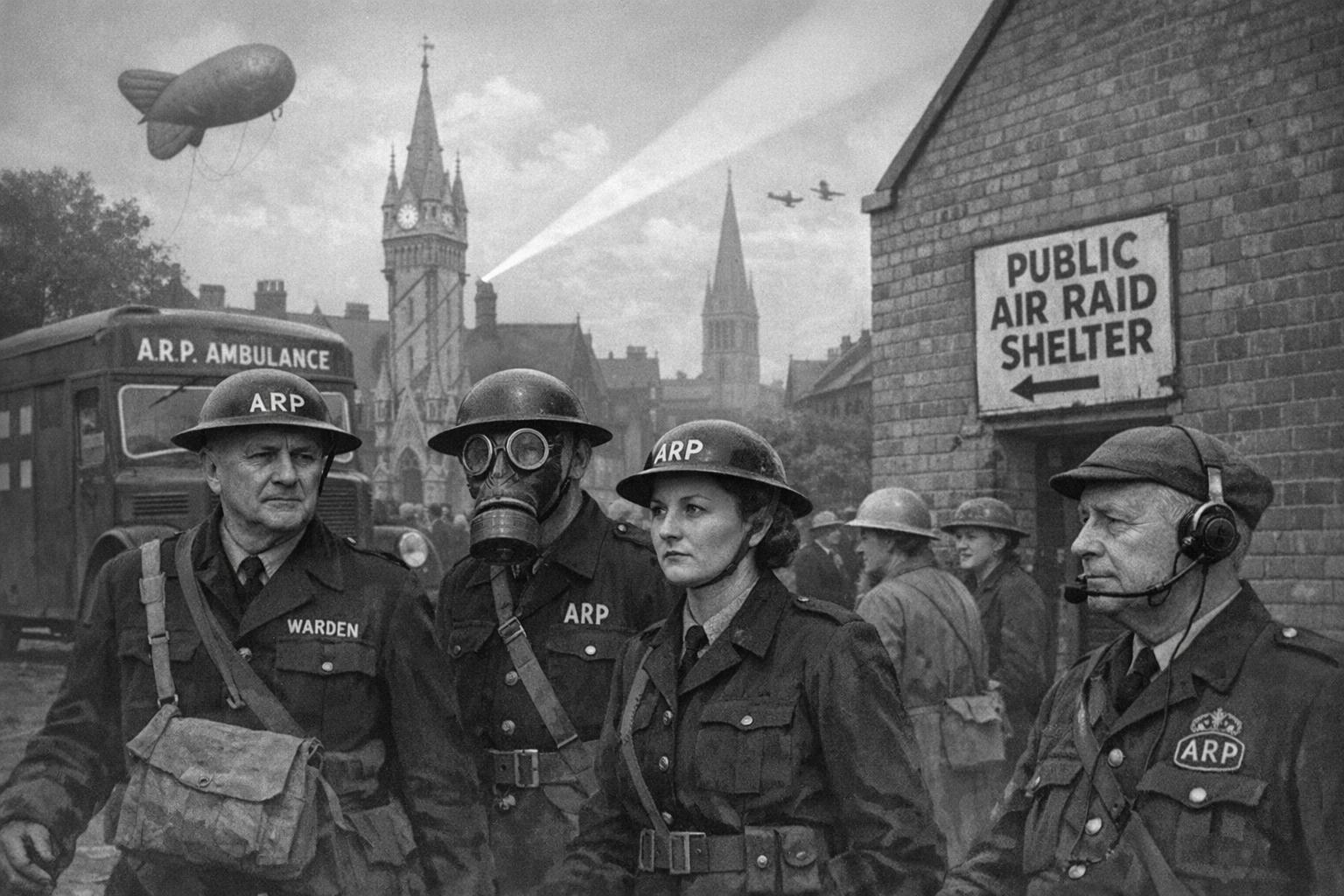
Air Raid Precautions (ARP) in Leicester formed part of the city’s preparations for aerial attack before and during the Second World War. Leicester was not bombed on the same scale as London, Coventry or Birmingham, yet its factories, railway connections, engineering works, power facilities and densely built residential districts made it a plausible target. Local authorities therefore developed a broad civil-defence programme intended to reduce casualties, protect property and keep public services operating after an attack.
The programme involved Leicester City Council, the police, fire brigade, hospitals, public-utility companies, transport operators, industrial employers and voluntary groups. Tens of thousands of residents also took part through fire watching, first-aid work, shelter management and neighbourhood warden duties. Preparations included public air-raid shelters, domestic Anderson and Morrison shelters, gas-mask distribution, blackout enforcement, casualty services and plans for clearing damaged streets.
ARP could not make Leicester safe from direct hits. Nor could it remove the fear, disruption and practical problems caused by repeated warnings. Its purpose was more modest: to reduce the effects of bombing and restore ordinary services as rapidly as possible. That required careful planning, trained personnel and a great deal of routine work long before any bombs fell.
Leicester before the Second World War
During the 1930s, Leicester was a large industrial city with a growing population and a strong manufacturing base. Hosiery and footwear remained closely associated with the city, but engineering, machinery production, printing, textiles and food processing also employed many people. Factories often stood close to terraced housing, shops and schools. This mixture of industry and residential development created practical problems for civil-defence planners because an attack on production sites could also affect nearby families.
Leicester occupied a useful position in the Midlands transport network. Railway lines and goods facilities connected the city with London, Birmingham, Nottingham and other industrial centres. Roads carried workers, materials and finished goods across the region. Electricity, gas and water services supported both domestic life and manufacturing, making utility sites part of local defence planning.
British officials had been considering the risk of air attack for years. German raids during the First World War had shown that aircraft and airships could reach civilian settlements. Developments in bomber range, payload and navigation during the 1920s and 1930s increased concern that a future war would begin with attacks on cities. Government forecasts often predicted casualties on a scale that later proved exaggerated, but these forecasts shaped policy.
The Home Office established an Air Raid Precautions Department in 1935. Councils were instructed to assess local risks, recruit volunteers and prepare emergency services. The Air Raid Precautions Act 1937 gave local authorities clearer duties and allowed central government to meet much of the cost. Leicester’s preparations accelerated during the Munich Crisis of September 1938, when war appeared close. Trenches were dug, gas masks issued and volunteers recruited. Although the crisis passed without war, the work exposed shortages in equipment, accommodation and trained staff.
After Britain declared war on Germany on 3 September 1939, temporary preparations became permanent wartime arrangements. The period that followed was sometimes called the Phoney War because Britain saw relatively little direct military action at first. For Leicester’s ARP workers, however, it was a period of drills, inspections and organisational work. The apparent calm gave the city more time to prepare, though nobody knew how long that calm would last.
How Leicester’s ARP organisation worked
Leicester City Council coordinated much of the local civil-defence programme. Its officers worked with the police, fire brigade, health authorities, hospitals, utility companies and industrial firms. They estimated likely casualty levels, identified buildings suitable for shelters, arranged first-aid posts and created reporting systems for bomb damage.
The city was divided into districts, sectors and smaller warden areas. This structure allowed reports to pass from individual streets to control centres, where officials could allocate rescue teams, ambulances and firefighters. Reliable communication mattered because one attack could produce several incidents at once. Telephone lines might fail, roads could become blocked and emergency staff might have to work without a complete account of what had happened.
Wardens were the public face of ARP. Many residents knew their local warden personally, especially in streets where the same volunteer served for several years. Wardens checked blackout arrangements, advised households about shelters, reported bomb damage and guided people away from unsafe buildings. During a raid, they recorded where bombs had fallen and passed requests for assistance to control rooms.
Some wardens worked full-time, while others combined ARP duties with ordinary employment. They might finish a factory shift and then report for night duty, which was hardly an attractive timetable. Their posts were established in houses, shops, schools or purpose-built structures. A post commonly contained telephones, maps, incident forms, protective clothing, lamps and basic first-aid supplies.
Control centres collated reports and decided which service should attend each incident. A damaged house might require rescue workers, an ambulance, the gas company and the police. A factory fire could require several pumps, traffic control and utility isolation. The system aimed to prevent duplicate dispatches while directing scarce equipment to the most urgent cases.
| ARP service | Main duties |
|---|---|
| Wardens | Reported incidents, enforced blackout rules, advised residents and directed people to shelter. |
| Rescue parties | Searched damaged buildings, removed rubble and supported unstable structures. |
| First-aid parties | Treated casualties near bomb sites and prepared them for transport. |
| Ambulance teams | Moved injured people to first-aid posts and hospitals. |
| Fire services | Controlled fires, dealt with incendiary bombs and protected nearby property. |
| Decontamination teams | Prepared to clean streets, buildings and clothing after a chemical attack. |
| Welfare workers | Provided food, clothing, rest-centre support and temporary accommodation. |
Training and civil-defence exercises
ARP volunteers attended lectures and practical demonstrations. Training covered first aid, bomb recognition, fire control, casualty handling and the dangers of damaged gas or electricity mains. Rescue workers practised moving through artificial rubble and supporting weakened walls with timber. Wardens learned how to write concise incident reports because vague messages wasted time.
Exercises tested how different services worked together. A staged incident might involve a mock high-explosive bomb, several supposed casualties and a simulated fire. Observers then identified delays, communication failures or errors in procedure. These exercises could seem overly formal, but bombing later showed why agreed routines mattered. People working in darkness and noise needed to know their duties without lengthy discussion.
Pre-war training placed heavy emphasis on chemical weapons. Volunteers learned to recognise types of gas, wear respirators and establish decontamination areas. Special clothing and cleansing equipment were obtained. Germany did not use poison gas against British cities, but planners could not safely assume that before or during the war.
Air-raid warnings and public response
Air-raid warnings linked national aircraft detection with local civil defence. Information from radar stations, observers and military command passed through regional channels. Sirens then warned Leicester residents that hostile aircraft might be approaching. The rising and falling note of the alert became one of the best-known sounds of wartime life. A steady note later announced the all-clear.
A warning did not mean bombs would fall on Leicester. Aircraft might change course, pass over the city or attack somewhere else. Repeated alerts could lead to fatigue and complacency, particularly among factory workers and householders who had spent many nights in uncomfortable shelters. Even so, residents were expected to follow local instructions and remain under cover until danger had passed.
Factories had procedures for stopping work, moving employees to shelter and restarting production after the all-clear. Managers had to weigh safety against wartime output. Sending workers to shelter too early reduced production, while delaying too long placed them at risk. Schools also held drills so that pupils could reach protected areas in an orderly manner.
Public and communal air-raid shelters
Shelter provision was one of Leicester’s largest ARP responsibilities. The council surveyed basements, public buildings, schools and industrial premises to determine whether they could offer useful protection. Existing spaces often needed structural strengthening, emergency lighting, ventilation, seating and additional exits.
Public shelters served people caught away from home and households without adequate domestic protection. Some were built above ground from brick and reinforced concrete. Others occupied strengthened basements or underground spaces. Communal shelters were placed near residential districts, shopping streets and workplaces, though the distribution did not always match local demand.
Shelter signs helped residents find entrances during the blackout. Wardens or shelter marshals managed capacity and behaviour. Larger shelters needed sanitation, water and basic medical supplies. Conditions could deteriorate during long alerts, especially in cold or wet weather. Ventilation was another recurring concern because crowded rooms soon became stuffy.
Protection varied according to the shelter’s construction and the location of a bomb. Reinforced walls and overhead cover could stop fragments, falling masonry and some blast effects. A direct hit from a high-explosive bomb was another matter. Officials sometimes had to balance public confidence with honest statements about what shelters could and could not withstand.
Anderson shelters in Leicester gardens
The Anderson shelter became a familiar sight after the government began distributing it in 1939. It consisted of curved corrugated-steel sheets fixed together and partly buried in the ground. Earth placed over the structure added protection. Eligible lower-income households received shelters without charge, while other families could buy them.
Leicester’s terraced housing presented obstacles. Many properties had narrow gardens or yards, and some lacked enough open ground for correct installation. Poor drainage could leave shelters damp or flooded. Householders improvised with timber floors, bunks, blankets and small shelves. Some planted vegetables or flowers on the earth covering, adding a domestic touch to a plainly functional object.
An Anderson shelter offered good protection against flying debris and collapsing walls when installed correctly. It was less pleasant as sleeping accommodation. Winter cold, condensation and insects discouraged some families from using it every night. Residents sometimes preferred a cupboard under the stairs, a cellar or a reinforced room, even when the garden shelter offered better protection.
Morrison shelters inside the home
The Morrison shelter entered use later in the war. It consisted of a heavy steel frame with a solid top and wire-mesh sides. Installed indoors, it could serve as a table during the day and a sleeping space during an alert. Its purpose was to create a survival space if floors or ceilings collapsed.
Morrison shelters suited households without gardens, including many living in dense urban streets. They took up considerable room, however, and could be awkward in small houses. Families had to arrange bedding and furniture around them. Despite the inconvenience, the shelter allowed residents to remain indoors rather than walk through dark streets to a public shelter.
Factory and school shelters
Industrial employers had responsibility for their workforce. Some reinforced basements, while others built covered trenches or surface shelters in yards. Large factories needed enough capacity for hundreds of employees and clear routes from production floors. Fire-watch teams remained outside or returned to roofs while other workers sheltered.
Schools used basements, protected corridors, trenches and purpose-built shelters. Teachers supervised drills and carried registers so that missing pupils could be identified. Lessons sometimes continued in improvised conditions after buildings were damaged or requisitioned. Civil defence became part of school routine rather than an occasional exercise.
Gas masks and preparations for chemical attack
Fear of poison gas strongly influenced British planning. Memories of chemical warfare during the First World War combined with predictions that bombers would release gas over crowded cities. Every resident was therefore expected to have respiratory protection.
Gas-mask distribution centres opened in public halls, schools and other local buildings. Residents attended for fitting and instruction. Standard civilian respirators covered the face and used a filter attached beneath the mouth area. Children received smaller models, while babies had protective devices that relied on an adult-operated air supply.
A poorly fitted mask could allow contaminated air to enter, so staff checked the seal around the face. People were advised to keep the rubber in good condition, avoid crushing the filter and carry the mask in its cardboard case. Replacement straps and minor repairs formed another part of local administration.
Schools held mask drills in which pupils practised fitting their respirators rapidly. Wearing one was uncomfortable. The eyepieces misted, speech became muffled and breathing required more effort. Children sometimes decorated their carrying cases or replaced the plain box with a privately purchased container. Whatever the case looked like, officials wanted the mask close at hand.
ARP preparations went beyond personal respirators. Leicester planned cleansing stations for people exposed to chemicals. Decontamination teams trained to wash streets, remove contaminated clothing and treat affected surfaces. Special detectors and protective suits were issued. None of this equipment was required for an actual gas raid, but it occupied a large share of pre-war training and expenditure.
The blackout in Leicester
Britain imposed the blackout at the start of the war. Its purpose was to make towns, roads, factories and railway facilities harder to identify from the air. Leicester’s streetlights were extinguished or heavily dimmed. Homes, shops and workplaces had to prevent light escaping through windows, doors and roof openings.
Householders used heavy curtains, cardboard, paint and purpose-made blackout cloth. A tiny opening could produce a visible beam, especially when surrounding streets were dark. Wardens walked their areas and called out familiar warnings such as “Put that light out” when they found an uncovered window.
Industrial buildings presented harder problems. Roof lights and large windows had to be screened without stopping ventilation or making factory work dangerous. Entrance lobbies needed double curtains so that opening an outer door did not expose bright interior lighting. Railway operations also continued with shielded lamps and reduced illumination.
The blackout created hazards at ground level. Pedestrians struggled to see kerbs, bicycles and street furniture. Drivers used masked headlights that projected only a narrow beam. Bus passengers could miss stops, while strangers found street names hard to read. White paint appeared on kerbs, lamp posts and obstacles to improve visibility.
Road accidents rose across Britain during blackout conditions, especially early in the war. Leicester authorities issued advice on slow driving, reflective clothing and careful road crossing. Later adjustments allowed restricted lighting under certain conditions, but darkness remained part of urban life for much of the conflict.
Incendiary bombs and fire watching
German aircraft carried both high-explosive and incendiary bombs. High explosives damaged buildings through blast and fragmentation. Incendiaries were smaller devices intended to ignite roofs, timber, stored goods and industrial materials. A single aircraft could scatter many of them across a wide area.
Incendiaries demanded a rapid response. A small device on a roof might be controlled with sand, a scoop or a suitable extinguisher before the fire spread. If left unattended, it could burn through roof timbers and ignite the floors below. Water had to be used with care because some bomb materials reacted violently when soaked.
Factories, offices, warehouses and public buildings appointed fire watchers. They patrolled roofs, upper floors and yards during alerts. Watchers needed protective helmets, heavy gloves, buckets of sand and tools for moving burning material. Their work placed them outside shelter while bombs were falling, often on high roofs with little cover.
The regular fire brigade worked alongside the Auxiliary Fire Service. Auxiliary recruits trained with pumps, hoses and ladders, sometimes using older equipment or converted vehicles. Emergency water supplies were established because bomb damage could break mains or reduce pressure. Static tanks and open-water sources offered alternatives if hydrants failed.
Leicester’s factories required close attention. Hosiery works, footwear premises and warehouses contained fabrics, leather, packaging and chemicals that could feed a fire. Engineering plants held fuel, lubricants and machinery. Stopping a small blaze before it reached stored materials could save an entire building and prevent flames spreading to nearby houses.
Rescue work after bomb damage
High-explosive bombs could collapse walls, floors and roofs within seconds. Rescue parties searched damaged buildings, freed trapped occupants and made unstable structures safer. Their work required physical strength, technical skill and patience. Careless removal of rubble could cause another collapse or injure someone hidden below.
Teams used picks, shovels, crowbars, ropes, jacks and timber supports. Heavy machinery was not always available immediately, so much of the early work was done by hand. Rescuers listened for voices or tapping and tried to trace the position of rooms from the remaining walls. Knowledge of common Leicester house layouts could help them estimate where beds, staircases and cellars had been.
Gas leaks, broken electricity cables and damaged water pipes added to the danger. Utility workers attended incidents to isolate supplies. The police closed unsafe streets and controlled crowds, while wardens recorded residents believed to be missing. Bomb-disposal personnel dealt with unexploded devices, sometimes requiring the evacuation of a wide area.
Rescue did not end when a casualty was removed. Damaged walls might need demolition, streets had to be cleared and adjoining houses inspected. Residents were not always allowed to return immediately, even when their own property appeared intact. Structural damage could remain hidden in roof spaces, party walls and foundations.
First aid, ambulances and hospital planning
First-aid parties treated casualties near the incident before arranging transport. Common injuries included cuts from glass, burns, fractures, crush injuries and shock. Bomb blast could also cause internal injuries that were not immediately obvious. Trained staff had to assess patients rapidly and decide who required hospital care.
First-aid posts were established in suitable buildings across the city. They stocked dressings, splints, blankets and medical supplies. Ambulance teams moved patients from bomb sites to these posts or directly to hospitals. Drivers needed knowledge of alternative routes because debris, fires and unexploded bombs could block familiar roads.
Leicester’s hospitals prepared extra beds and reviewed emergency operating arrangements. Medical staff had to continue ordinary treatment at the same time. Babies were still born, infections still occurred and industrial accidents did not stop because aircraft were overhead. Wartime casualty planning sat on top of the normal workload.
Voluntary organisations supported professional medical staff. Members of the British Red Cross, St John Ambulance and local groups provided first-aid training and personnel. Women served in large numbers as nurses, ambulance attendants and welfare workers. Some roles exposed them directly to bombing and unstable buildings.
Rest centres and help for bombed-out families
A raid could leave a house uninhabitable without causing serious injury. Blast removed roof tiles, shattered windows and damaged doors. Water from broken pipes or firefighting added further harm. Families often needed somewhere to sleep while surveyors assessed the property.
Rest centres opened in schools, church halls and other public buildings. They provided temporary shelter, hot drinks, simple meals and help with registration. Welfare workers recorded names so relatives could locate displaced family members. Clothing, blankets and household goods were distributed when people had escaped with little more than what they were wearing.
Longer-term rehousing created a harder problem. Leicester already had crowded districts, and wartime restrictions slowed new construction. Repair teams had to prioritise work such as temporary roof covering, boarded windows and safe water supplies. Minor damage could remain unrepaired for months because labour and materials were reserved for urgent cases.
Compensation procedures required householders to report losses and complete official forms. This administrative side of bombing received less public attention than rescue work, but it affected families for years. Proving ownership, estimating damage and replacing rationed goods could be slow and frustrating.
Evacuation and Leicester schools
Evacuation formed part of national planning for children, expectant mothers and some other groups. Leicester participated in evacuation arrangements at the outbreak of war, though local patterns changed as assessments of bombing risk shifted. Some children left the city, while Leicester and the surrounding county also became involved in receiving evacuees from places considered more exposed.
Children travelled in school groups with teachers and identification labels. They carried gas masks, food and a small amount of luggage. On arrival, officials assigned them to host families. Brothers and sisters were not always placed together, and accommodation varied from comfortable houses to crowded rooms.
Many parents reconsidered evacuation during the quieter opening months of the war. Children returned home when families felt the predicted raids had not materialised. Later bombing led some to leave again. The repeated movement disrupted schooling, friendships and family life.
Teachers carried responsibilities beyond lessons. They supervised travel, managed records, led shelter drills and watched pupils for illness or distress. Schools in Leicester also served as gas-mask centres, first-aid locations, rest centres and public shelters. This placed pressure on buildings already coping with interrupted timetables and staff shortages.
The Leicester Blitz and other wartime raids
Leicester experienced its worst raid during the night of 19–20 November 1940. German aircraft dropped high-explosive and incendiary bombs across the city, causing heavy damage in residential and industrial districts. The raid became known locally as the Leicester Blitz. More than one hundred people were killed, many others were injured and a large number of homes suffered damage.
The attack affected areas including Highfields, Spinney Hill and parts of the city centre. Houses, factories, public buildings and places of worship were struck. Fires and collapsed structures placed heavy demands on wardens, firefighters, rescue parties and hospital staff. Telephone damage and blocked roads complicated the response.
One raid could generate hundreds of reports, not all of which were accurate. A loud explosion might be reported from several streets, while burning debris could be mistaken for another bomb. Control-room staff had to compare messages and direct teams without leaving other districts unprotected.
Leicester suffered further alerts and raids during the war, though none matched the November 1940 attack in local loss of life. Some bombs may have been intended for industrial or railway targets. Others could have been released by aircraft that had lost their route, faced anti-aircraft fire or failed to reach another city.
Unexploded bombs prolonged disruption after the aircraft had departed. Police established cordons, residents left their homes and bomb-disposal teams examined the device. Factories might stop work and roads remain closed for days. The all-clear ended the immediate warning, but not the work that followed.
Women in Leicester’s civil defence
Women formed a large part of Leicester’s ARP workforce. They served as wardens, ambulance drivers, first-aid workers, telephonists, clerks and welfare staff. The Women’s Voluntary Services supported evacuation, rest centres, emergency feeding and clothing distribution. Its members often worked long shifts after raids.
Many women combined civil-defence duties with paid employment and domestic work. Factory employees could take fire-watch shifts after completing normal production hours. Others cared for children or older relatives while volunteering at a nearby post. Wartime publicity praised voluntary effort, but the daily workload could be severe.
Senior command roles often remained male, reflecting employment practices of the period. At street level, however, civil defence relied heavily on women’s labour. They maintained records, transported casualties, organised supplies and dealt directly with families who had lost their homes.
Industry, transport and public utilities
Leicester’s wartime economy increased the need to protect factories. Footwear and clothing firms supplied military needs, while engineering companies produced machinery and components. Civil defence at industrial premises covered shelter, fire prevention, emergency repair and continuity of production.
Railway staff protected stations, sidings and goods facilities. Damage to a line could delay workers, military traffic and raw materials. Repair gangs stood ready to clear debris and restore track. Road transport operators also needed plans for damaged depots, fuel shortages and blocked routes.
Gas, electricity and water services posed their own hazards. A broken gas main could cause fire or poisoning. Damaged electrical cables threatened rescuers, and a failed water main reduced firefighting capacity. Utility crews therefore worked closely with incident controllers. Restoring supplies was part of recovery, but workers first had to isolate dangerous sections.
ARP and daily life in Leicester
Civil defence affected daily routines even on nights without bombing. Residents carried gas masks, covered windows before dark and kept water or sand ready for incendiaries. Workers joined fire-watch rotas, children practised shelter drills and households stored bedding near their chosen refuge.
Official instructions appeared in newspapers, posters, leaflets and public demonstrations. Advice changed as wartime experience grew. Early fears centred on gas, while later guidance placed more weight on incendiary bombs and fire watching. Residents had to keep up with new rules, rationing measures and changes to shelter policy.
Not everyone faced the same conditions. Families in crowded terraced streets often had fewer shelter options than households with large gardens and cellars. Older people and residents with disabilities could find it hard to reach communal shelters. Night workers and factory employees spent alerts away from their families.
Disputes occurred over noise, shelter behaviour, blackout breaches and compulsory fire watching. Civil defence depended on cooperation, but cooperation was rarely neat. Some residents ignored warnings, complained about wardens or refused to leave their beds. Others volunteered for repeated shifts and helped neighbours with repairs. Both responses formed part of wartime urban life.
From ARP to Civil Defence
The name Air Raid Precautions was gradually replaced by the broader term Civil Defence during the war. The change reflected the range of work being performed. Staff dealt not only with warnings and shelters but also with rescue, firefighting, welfare, communications and post-raid recovery.
Uniforms, helmets and armbands identified the various services. The familiar steel helmet marked ARP or W became closely associated with wardens. Rescue workers, firefighters and medical teams had their own markings. Identification helped incident controllers recognise roles in darkness and confusion.
Experience also altered training. Reports from heavily bombed cities showed the value of mobile rescue units, better communications and coordinated fire control. Leicester benefited from lessons learned elsewhere while contributing its own reports to regional authorities. Civil defence was constantly revised through practice rather than left as a fixed pre-war plan.
Leicester’s ARP legacy after 1945
After the war ended in 1945, Leicester reduced or disbanded many wartime services. Volunteers returned equipment, posts closed and buildings resumed former uses. The regular fire brigade, hospitals, police and utility services continued, carrying wartime experience into peacetime work.
Public shelters were demolished, filled in or converted to storage. Anderson shelters were removed from gardens, although some survived as sheds. Reinforced basements, concrete structures and blocked shelter entrances remained in scattered locations. Their original purpose was not always obvious once signs and fittings disappeared.
Official records preserve another part of the story. Council minutes, ARP reports, bomb maps, casualty lists, newspapers, photographs and personal diaries show how Leicester prepared and responded. Oral histories add details that formal documents often omit: the smell of a crowded shelter, the difficulty of finding a street in blackout conditions or the routine of carrying a gas mask to school.
Leicester’s ARP system brought local government, emergency services, industry and voluntary labour into a single working structure. Shelters and gas masks were its most visible features, but much of the work happened behind the scenes. Control-room staff logged calls, utility crews isolated broken mains, welfare workers registered displaced families and rescue teams searched one damaged room at a time.
The programme had shortcomings. Shelter access varied, equipment shortages occurred and official forecasts did not always match events. Yet the organisation gave Leicester a prepared civilian response when bombing came. It reduced avoidable harm, supported recovery and helped the city continue working through years of aerial threat.